Every career has a stage where you hold a title but not yet the authority that should go with it. Most young men use that gap to relax. A smaller number use it to become the person who will deserve the title when it finally arrives.
In 60 AD, a twenty-year-old aristocrat named Gnaeus Julius Agricola arrived in Britain as a military tribune, attached to the staff of the governor, Suetonius Paulinus.
He had picked, without knowing it, one of the worst possible years to be there. Paulinus was in the middle of annihilating the Druid stronghold on Anglesey when word came that the Iceni queen Boudica had risen in the east, burned Colchester, London, and St Albans to the ground, and put an entire legion to flight. For a stretch of months nobody could say with confidence whether Britain would remain a Roman province at all. Veterans were slaughtered. Colonies were ash. Armies were cut off from support and from each other.
This was the province a twenty-year-old tribune had been assigned to, in a role that gave him a staff position, a title, and essentially no actual authority to affect any of it.
Tacitus — who wrote Agricola’s biography decades later, and who happened to be his son-in-law — tells us exactly what the young man did with that position. It is a shorter story than you might expect.
The temptation every tribune had
A military tribunate was, for a well-connected young Roman, close to a formality. It was the box that needed checking before a real political career could begin — a line on the record, not a job description anyone expected you to take seriously. Tacitus is blunt about what most tribunes did with it: they treated soldiering as a game, traded on their rank and their inexperience to secure leave and comfort, and did the minimum required to say afterward that they had served.
Nobody would have blamed Agricola for doing the same. He had no command. Whatever happened in that war would be decided by Paulinus, by the legions, by circumstance — not by a staff tribune with a title and no real power to shape any of it. The honest, unremarkable, career-safe choice was to stay close to the general’s tent, learn the minimum, and wait for a role with actual authority attached.
He did not do that.
What he did instead
Tacitus’s description is precise enough to be worth quoting almost in full: Agricola made himself known to the province and to the army, learned from the men who actually knew what they were doing, attached himself to the best examples available rather than the most comfortable ones, sought no attention for himself, and backed away from nothing out of fear.
None of this was command. He wasn’t deciding troop movements or setting strategy. He was a junior officer with no formal power, choosing to spend that powerlessness on learning rather than on comfort — accumulating exactly the knowledge and reputation that a man with real command would need later, at a moment when no one was requiring it of him yet.
This is the part of the story that tends to get skipped in favour of the battles: the single decision that made everything after it possible was made when Agricola had no authority to make any decision at all.
The actor and the assigned role
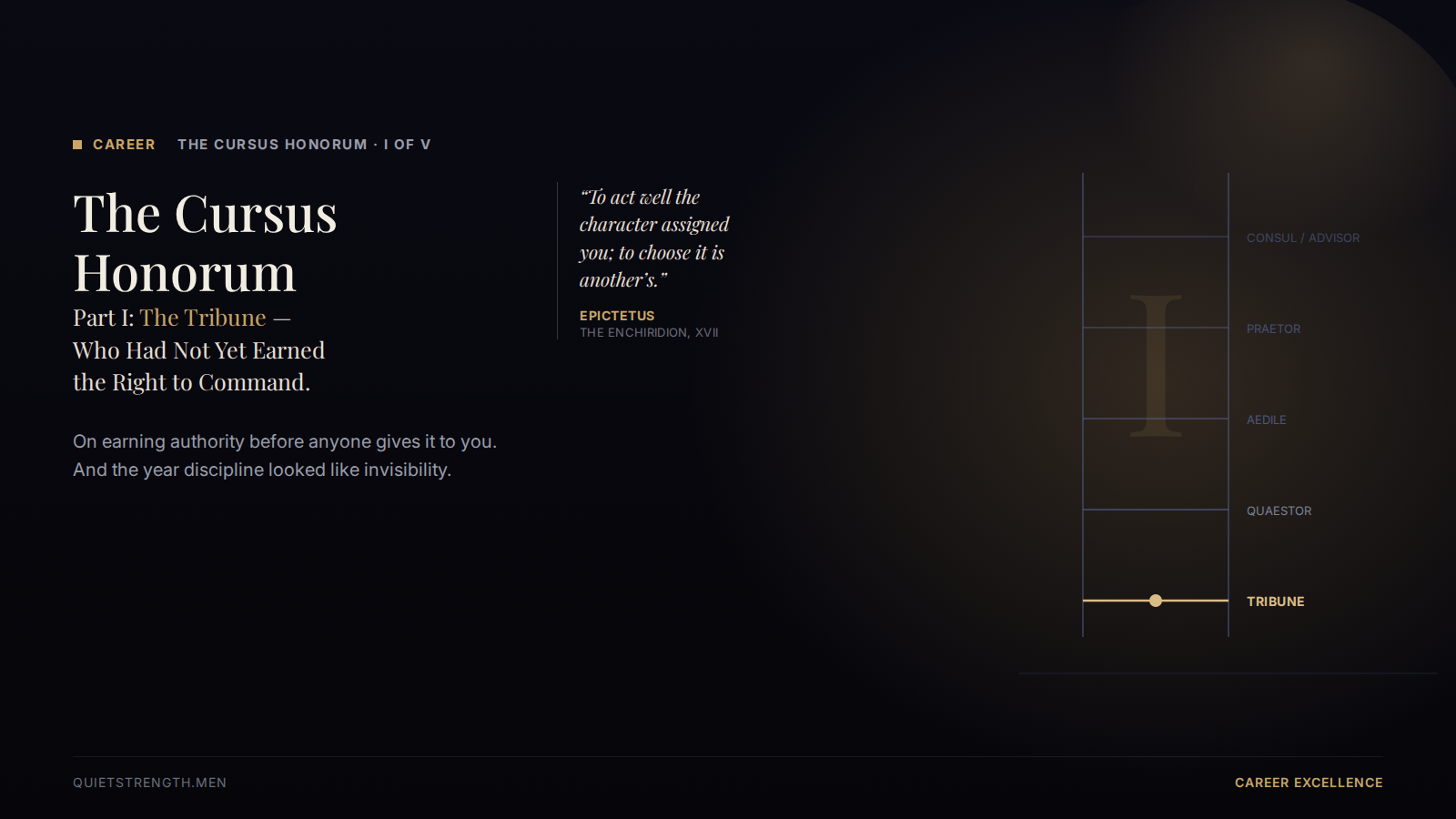
Epictetus, writing a few decades after Agricola’s death, gave this exact situation a name. Life, he said, is a play, and the role — long or short, prominent or minor — is assigned by someone other than the actor. To act well the character assigned you; to choose it is another’s.
A tribunate with no real authority is, in this frame, simply the role you have been given for this act of the play. The temptation is to treat a small part as not worth playing well — to save your best performance for whenever a bigger role arrives. Epictetus’s point is that this is precisely backwards. The part you are given now is the only evidence anyone will ever have of how you play the parts you haven’t been given yet. There is no dress rehearsal where the stakes don’t count. The tribunate is the audition, whether or not anyone told you that going in.
Agricola, as far as the record shows, was never told this. He simply behaved as though it were true.
The year he chose to disappear
The more interesting decision, in some ways, came later, and reveals that Agricola’s early discipline wasn’t a young man’s one-time enthusiasm. Tacitus tells us that after his quaestorship, in the year before and during his tribunate of the plebs, Agricola deliberately kept still. He sought no attention, pursued no cases, made no noise — because, Tacitus writes, he understood the political climate of Nero’s Rome well enough to know that in those years, idleness could be a form of wisdom.
This is a different skill from the one Anglesey required, and arguably a harder one. Learning hard in a role nobody’s watching is a discipline of application. Choosing visible stillness, in a system where ambition itself could get a man noticed by the wrong people, is a discipline of restraint — knowing when the assigned role calls not for effort but for the appearance of none. Agricola held both skills without apparently finding them in tension. He worked hard when working hard was the right response to the room, and he went quiet when quiet was.
What this bought him later
The rest of the climb reads, by Roman standards, almost conventional: command of a legion in Britain under the governors Bolanus and Cerialis, the governorship of Gallia Aquitania, a consulship, and finally — in 77 AD — the consular governorship of Britain itself, the province where he had once held no authority at all.
He spent seven years there, campaigning further into the island than any Roman had before him, eventually meeting a coalition of Caledonian tribes under a chieftain named Calgacus at Mons Graupius, somewhere in the Scottish highlands, in 84 AD, and defeating them decisively enough that Tacitus could claim — with the usual Roman confidence about what victory actually settles — that Britain had been fully subdued.
None of that was available to the twenty-year-old on Paulinus’s staff. What was available to him was a choice about how to spend a position with no power in it. He spent it becoming someone worth giving power to later. The distance between those two facts is the entire content of this essay.
Why Tacitus was writing this down at all
There is one more layer worth naming. Tacitus wrote the Agricola around 98 AD, shortly after his father-in-law’s death, in the immediate aftermath of the reign of Domitian — a period Tacitus describes elsewhere as one in which honest men learned to survive by saying as little as possible, in public, about anything that mattered. Agricola himself served capably under Domitian and, by Tacitus’s account, was quietly sidelined rather than promoted further, precisely because his competence had started to look like a threat to an insecure emperor.
The biography is, among other things, a demonstration that a man can serve with total discipline through both a tolerable regime and an intolerable one, and that the discipline itself — showing up prepared, doing the unglamorous work of the role in front of him, refusing to either grandstand or collapse — was the one constant across both. The role changed. What Agricola brought to it, starting on Suetonius Paulinus’s staff at twenty, did not.
Career Excellence — The Cursus Honorum, a five-part reading of the Roman career ladder and what each rung actually demands. Next: Part II — The Quaestor No One Was Watching, on Cato the Younger and the discipline of an office with no audience.