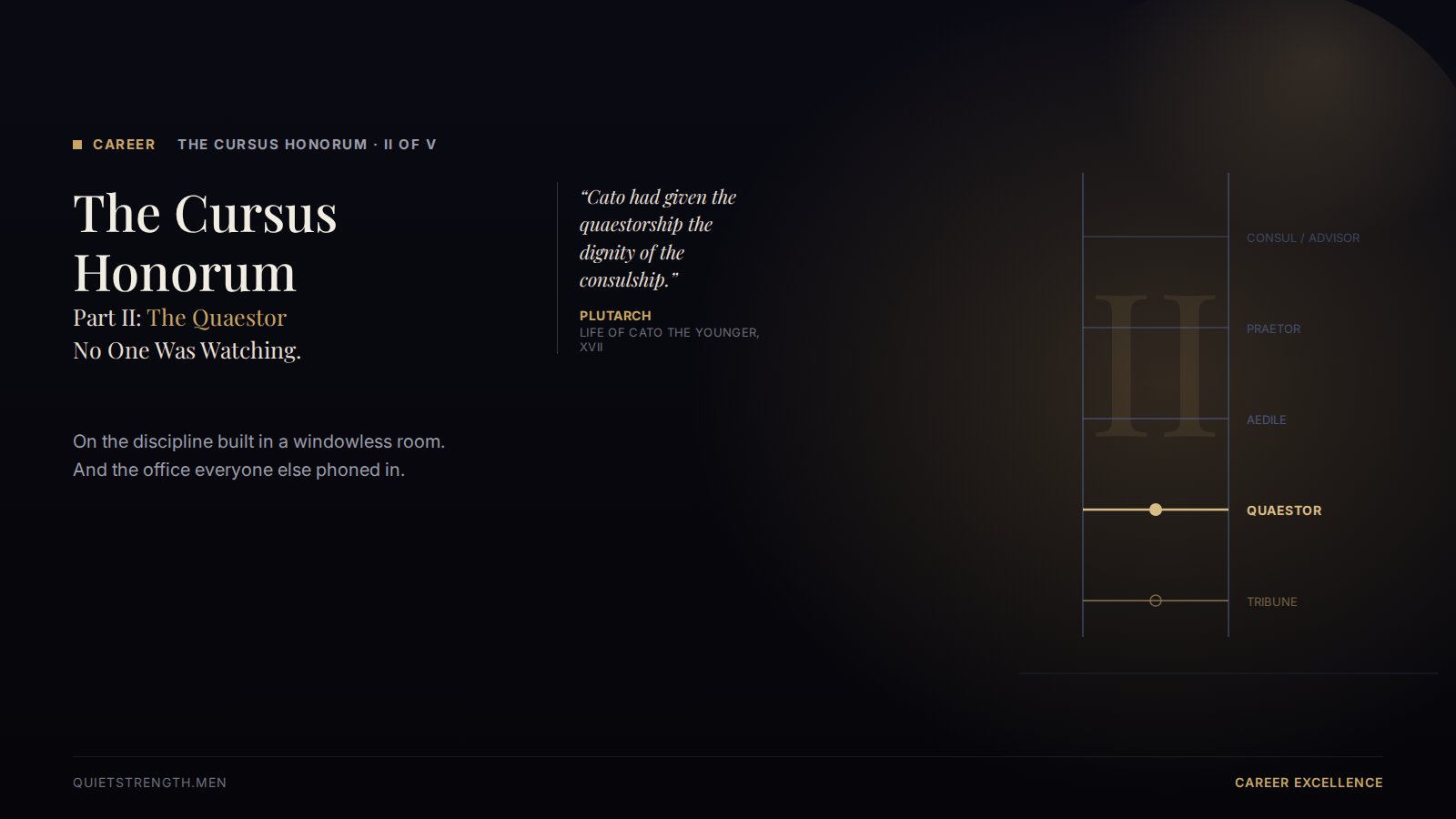
The tribune’s discipline had an audience of one general who might notice. The quaestor’s discipline has an audience of nobody — a windowless treasury, a ledger, a clerk who has been doing this longer than you and is fairly confident you won’t check his work. Most men, offered that much invisibility, take it.
Before dawn, in 64 BC, a Roman treasury building on the slopes of the Capitoline was already occupied.
Marcus Porcius Cato — thirty years old, newly installed as quaestor, one of the more junior offices on the cursus honorum — was already at his desk. He would be there before any of his fellow quaestors arrived, and according to Plutarch, who wrote his biography a century and a half later from sources that knew the man personally, he would still be there after every one of them had gone home. This was not a single dramatic gesture. It was the normal shape of his working day, repeated for a full year, in a job that came with no glory attached to it at all.
The quaestorship was the entry rung of the cursus honorum — the first real office, the one every ambitious young Roman passed through on the way to something better. It managed the state treasury, the aerarium: revenues in, disbursements out, the accounts of a Republic that ran an empire on a system of ledgers, clerks, and inherited paperwork nobody senior wanted to deal with personally. Most quaestors treated it exactly as its reputation suggested — a formality to survive, a credential to collect, a year to be endured on the way up.
Cato did not treat it that way, and the record of what he did instead is unusually well preserved, because Plutarch found it worth preserving in detail.
The office everyone else phoned in
The structural joke of the Roman quaestorship was that the men nominally in charge of it almost never actually ran it. Quaestors arrived young, served exactly one year, and left. The treasury’s permanent clerks — the scribae, career civil servants who might hold their positions for decades — stayed. Every new quaestor arrived needing to be taught the job by the very staff he was supposed to be supervising, and most quaestors, sensibly enough from a purely careerist standpoint, simply let the clerks run things and signed what was put in front of them. Why fight a system you’ll leave in twelve months, administered by men who’ll still be there in twenty years?
The clerks had, in effect, become the actual treasury. The quaestor was decoration.
Cato had spent the run-up to his election doing something almost nobody else bothered with: reading the actual laws governing the office, in detail, before he held it — not cramming once he arrived, but arriving already knowing more law than the men whose entire career was built on knowing it better than any quaestor could. This is worth sitting with, because it inverts the normal order of competence. Most people learn a job by doing it badly for a while under people who already know it. Cato arrived already capable of catching the people who already knew it in the act of taking advantage of people who didn’t.
What he found once he could actually see
The clerks, per Plutarch, were “bold, impudent fellows” who had gotten used to managing quaestors rather than being managed by them. Cato’s first act was to treat them as what they legally were — subordinates — rather than what they had functionally become. He went through the accounts. He found a senior clerk who had committed fraud in the handling of an inheritance and had him removed from the treasury. A second clerk was brought to trial for a separate fraud; when one of the sitting censors, a man named Catulus, personally intervened to argue for the clerk’s reinstatement, Cato refused anyway — a direct, public rejection of a censor’s request, delivered by a thirty-year-old first-year quaestor, over a clerk’s job. This is not a small thing to have done in Roman public life. Censors held enormous informal authority. Cato did it regardless, and by every surviving account did it without theatrics, simply as the correct application of a rule he had already read.
None of this made him popular in the building. It made him correct, which turned out to matter more.
The debt Rome had been pretending didn’t exist
The more politically dangerous work Cato did that year involved a category of men everyone in Rome already knew about and no one had touched: those paid by Sulla, a decade earlier, for killing men on the proscription lists — a bounty system that had turned murder into a state-subsidised transaction, at a rate Plutarch records as twelve thousand drachmas a head. These men still held the money. Nobody had ever asked for it back, because asking meant reopening a period everybody preferred to leave buried, and because several of the men in question were still well-connected.
Cato called each of them to account, on the specific legal ground that they held public funds obtained unjustly, and demanded repayment. Once the money was flagged as improperly held, the underlying killings became prosecutable as murder rather than protected as Sulla-era business, and trials followed — with, notably, a young Julius Caesar, then serving as a prosecutor fresh off his own aedileship, working several of the cases from the other side of the same argument. Two men who would spend the following two decades as the Republic’s most famous rivals began, for one brief documented moment, on the same side of a treasury ledger.
Plutarch records that the convictions that followed were received across Rome as a kind of overdue reckoning — Sulla’s dictatorship, in the public imagination, finally being punished after the fact, through the accounting of men who had profited from it. This did not happen because Cato held unusual power. He held the least powerful office on the ladder. It happened because he was willing to do the specific, unglamorous work of checking who owed what, and then finishing the sentence that work implied.
The last day
The single most quoted anecdote from Cato’s quaestorship happens on his final day in office, and it is worth telling in full because the shape of it is the entire argument of this essay compressed into one afternoon.
Cato had, by the end of the year, become genuinely respected — respected enough that on his last day, a substantial crowd of citizens gathered to escort him home, a mark of real public esteem for a man who had spent the year being, by his own colleagues’ account, “obnoxious and troublesome.” Partway through this walk home, word reached him that his childhood friend and fellow quaestor, Marcellus, was at that moment approving an improper remission of a debt to the treasury for a friend of his own — precisely the kind of favour Cato had spent a year refusing to grant to anyone.
Cato turned around, walked back to the treasury, and in front of Marcellus and everyone present, personally struck the entry from the register before it could be finalised. Then he took Marcellus home with him for dinner.
There was no lasting rupture between them. Marcellus, by Plutarch’s account, never held it against him, then or later. The point was never punitive. It was that the rule did not have an exception for friendship, or for the fact that Cato was technically off duty, walking home, already celebrated by a crowd that would have let the moment pass unnoticed. Nobody there that day would have faulted him for letting it go. He had, by any reasonable measure, already finished.
He had not, by his own measure, finished. The office ended at midnight, not at the first moment it became inconvenient to keep holding it.
The watch that didn’t end
What happened after Cato left the treasury is, if anything, more telling than what happened while he held it. He did not stop watching. He kept servants employed to continue copying the ongoing expenditure records even after he had no formal standing to request them. And he personally purchased — at his own expense, a genuinely large sum, five talents by Plutarch’s account — a complete copy of the treasury’s accounts stretching back to Sulla’s time, specifically so that future prosecutions of treasury fraud would have a paper trail an ex-quaestor with no current authority could still supply.
This is the detail that separates discipline from performance. A man who wanted credit for a well-run year in office had already received it — the crowd on the final walk home, the reputation, Plutarch’s later verdict that Cato had “given the quaestorship the dignity of the consulship.” None of what came after bought him anything further. He paid for it anyway, because the actual goal had never been his own credit. It had been a treasury that stayed honest whether or not he was the one currently required to make it so.
Cyprus, later
The same pattern reappears, at far larger scale, when Cato was later sent to annex Cyprus and settle its royal treasury into Roman hands — a mission that put an enormous, ungoverned quantity of gold briefly under one man’s personal discretion, in a province with essentially no one positioned to check his accounts if he had chosen not to keep them honestly. He raised some seven thousand talents for the Roman treasury, kept meticulous records of every transaction, and — in a detail almost too fitting to need embellishing — had ropes tied to the money chests with cork floats attached, so that if the ships carrying the silver were wrecked at sea, the treasure could still be located and recovered.
He was, by that point in his career, planning for the accountability of money he might not personally survive to deliver. The habit built alone in a treasury nobody was watching, at thirty, had become the reflex of a much older man handling a fortune with nobody watching at all.
What the empty room actually teaches
The tribune, in the first part of this series, had at least the possibility of being noticed — a general who might see how he carried himself, a war that made competence visible to somebody. The quaestor has no equivalent audience. The treasury is indoors, the ledgers are boring, the clerks would prefer not to be checked, and nobody outside the building is positioned to know whether the accounts you signed were the accounts you actually verified.
Cato’s answer to that condition was not motivation, in the sense of some private fire that needed feeding. It was closer to a decision, made once and then simply not revisited: that the office would be run the same way regardless of who could see it being run. The discipline that would later hold against senators, censors, and eventually Caesar himself was not summoned for those larger stages. It was built here, in a windowless room, on a job most men were relieved to finally finish.
Career Excellence — The Cursus Honorum, a five-part reading of the Roman career ladder and what each rung actually demands. Next: Part III — The Games You Didn’t Need to Win, on the aedileship and the specific temptation of a job built entirely around being watched.