Anger feels like strength because it produces an immediate, visible effect. It rarely is strength. The man who can hold a position without raising his voice has usually done more work to get there than the man who can’t stop raising it.
In 93 AD, the Emperor Domitian issued an edict expelling all philosophers from Rome.
Epictetus — a former slave who had built a reputation as one of the city’s sharper Stoic teachers — did not argue the point, petition for an exception, or make a public stand on the steps of whatever building philosophers made public stands on in the first century. He packed up his school and left for Nicopolis, on the coast of Epirus, and kept teaching exactly what he had been teaching in Rome, to whoever showed up.
Nothing about the content changed. Nothing about the delivery softened. He had spent his life saying blunt, uncomfortable things to people with far more power than he had — that was, by every surviving account, his whole method — and losing the city did not alter that. He simply relocated the same directness to a smaller, further place, and it worked exactly as well there.
This is not a story about capitulation. It is a story about the difference between bending and breaking, and about how rarely people can tell the two apart in the moment.
What assertiveness actually is
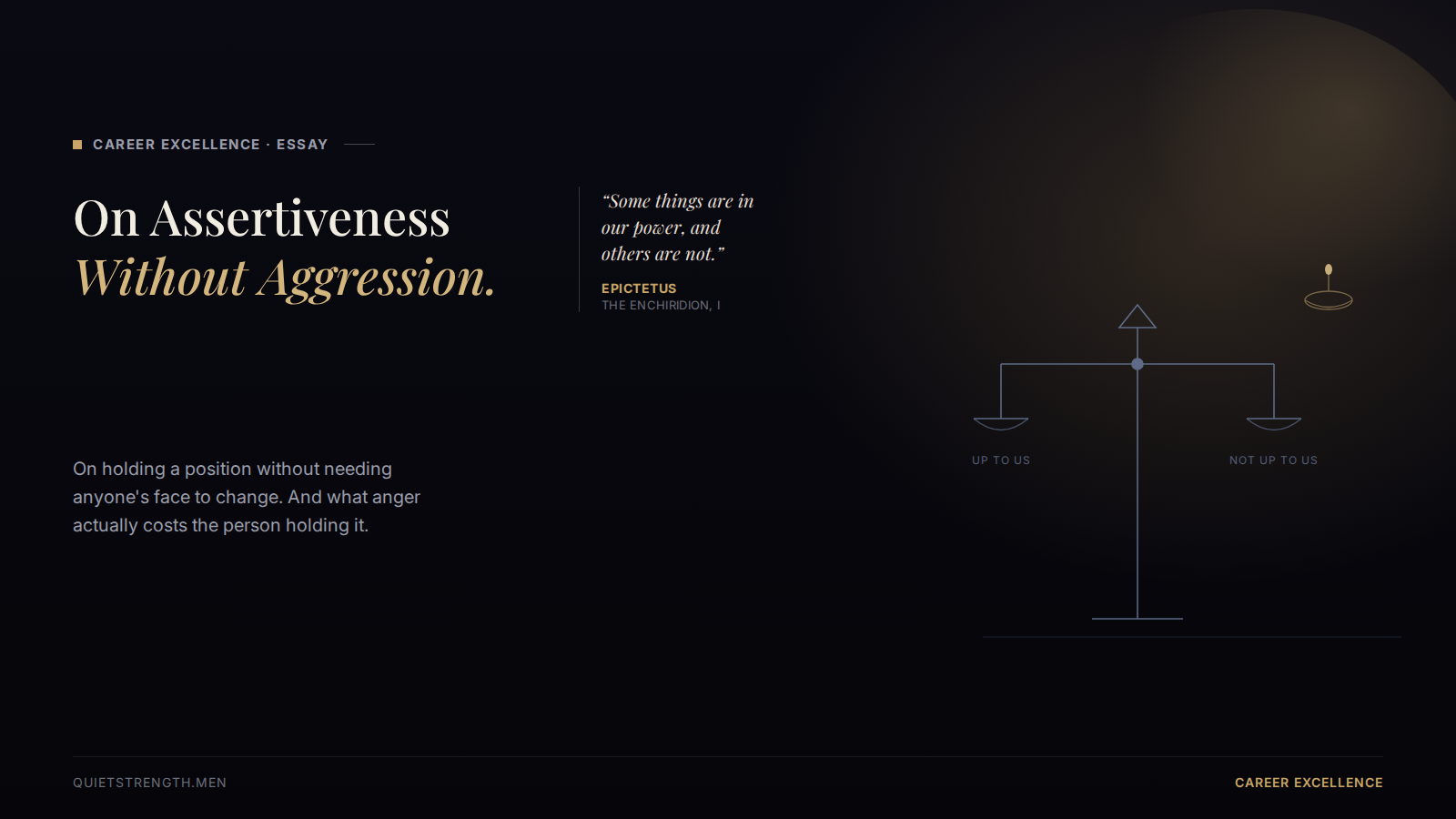
Epictetus’s entire philosophical project rests on a single division, repeated so often across the Discourses that it functions less as an idea than as a reflex: some things are up to us, and some things are not. Our judgments, our choices, our responses — up to us. Other people’s opinions, the emperor’s edicts, the outcome of an argument — not up to us.
Assertiveness, properly understood, is the practice of acting fully within the first category and refusing to be dragged into pretending you control the second. You state the position. You hold it. You do not need the other person’s agreement, their good mood, or their approval for the position to remain what it is. What you cannot do — what genuinely is not up to you — is guarantee how they respond to it.
Aggression is what happens when someone tries to control the second category anyway. When holding a position stops being enough, and the goal quietly shifts to making the other person feel the cost of disagreeing. That shift is rarely a conscious decision. It creeps in as tone, as volume, as the extra sentence that wasn’t necessary to make the point but felt satisfying to add.
Epictetus, teaching men who mostly held far more social power than he did, could not afford that shift. A former slave who raised his voice at a senator did not get remembered as principled. He got removed from the conversation entirely, and probably worse. He learned, out of necessity rather than temperament, to make the point land without needing anyone’s face to change. The account of his teaching that survives is not gentle. It is precise. Those are not the same thing.
The difference between firm and loud
There is a common failure mode in people newly promoted into positions where they finally, for the first time, feel safe enough to say what they actually think. Having spent years deferring, they now overcorrect, and mistake volume for the courage they didn’t previously feel able to show. The correction is understandable. It is also usually wrong, because it conflates two things that were never the same skill.
Firmness is the refusal to move a position under social pressure. Loudness is a bid for social pressure of your own, deployed because the position, argued calmly, wasn’t landing. The two often appear together, which is precisely why they get confused — the person who has to raise their voice to keep from being talked out of something has usually already noticed, at some level, that the argument alone wasn’t sufficient. The volume is compensating for a gap.
A firm position doesn’t need volume, because it doesn’t need the other person to feel anything in particular. It only needs to be stated clearly enough to be understood, and held consistently enough that the other party stops expecting it to move. Consistency, held quietly over time, is a more effective form of pressure than any single loud moment, because it cannot be dismissed afterward as someone having “lost their temper.” Nobody apologises for having been calm.
What anger actually costs the person holding it
Marcus Aurelius, governing an empire that generated an unreasonable supply of frustrating people, wrote to himself constantly about this exact problem — not because he had solved it, but because he kept needing to re-solve it. The recurring insistence, across the Meditations, is not that anger is immoral. It is that anger is a bad trade. It spends a resource — your own composure, your own clarity of judgment — in order to produce a reaction in someone else that you were never going to fully control anyway.
This is the part that gets missed by anyone who treats assertiveness as primarily about the other person. The immediate cost of aggression is not what it does to the room. It is what it does to your own thinking, in real time, while you’re still supposed to be making decisions. Anger narrows attention onto the target of the anger and away from everything else that also needs judgment in that moment — the rest of the meeting, the rest of the negotiation, the actual goal you were trying to hold a position about in the first place.
The person who stays composed under provocation is not merely being polite. They are keeping their own reasoning faculty intact for the parts of the conversation that still require it, while the other person, having succeeded in provoking a reaction, has usually stopped needing to argue the substance at all. Provoking anger is, among other things, a highly effective way to end an argument without winning it.
The gap between provocation and response
There is a specific, practical discipline underneath all of this, and it is less about temperament than about timing. Between the provocation and the reply, there is a gap — sometimes a full second, sometimes less — in which the reflexive reaction has occurred but the spoken response has not yet been chosen. Most aggression lives in the compression of that gap to nothing: the reflex and the reply become the same event, and whatever the emotion wanted to say gets said before anything has actually decided to say it.
Widening that gap, even slightly, is most of the practical skill. Not suppressing the reaction — the Stoics were not asking anyone to feel nothing — but declining to let the reaction author the sentence that comes out of your mouth. Epictetus taught this as a matter of habitual practice, not a single act of willpower deployed in the crucial moment: you train the gap in the small, low-stakes provocations of an ordinary week, so that it is already wide by the time a provocation actually matters.
By the time Epictetus was calmly relocating an entire school in response to an imperial edict, this was not a new skill he was improvising under pressure. It was a widened gap he had been practising for years, applied to a genuinely large provocation instead of a small one. The scale of the response was unremarkable to him precisely because the discipline had already been built at a smaller scale, repeatedly, long before an emperor gave him a reason to need it.
What this looks like on a Tuesday
Nobody encounters an edict from an emperor. Most people encounter a colleague who takes credit for their work in a meeting, a report that gets rejected for reasons that don’t hold up, a request they need to refuse without becoming the person who “isn’t a team player.” The scale is smaller. The mechanism is identical.
State the position once, clearly, without the extra sentence that exists only to make sure they feel it. Hold it the second time it’s challenged, in the same tone as the first. Notice the moment the reflex wants to author the reply, and let a half-second pass before anything gets said. None of this guarantees the outcome — the outcome was never up to you. What it guarantees is that whatever happens next, you will still have your own judgment intact to meet it with.
That was the whole of what Epictetus had, teaching in a borrowed room in a smaller city than the one he’d been made to leave. It was, on the available evidence, enough.
Career Excellence — on doing the work well, and on what the work quietly asks of the person doing it. Next: How to Protect Your Energy — on the difference between generosity and depletion, and why the two get confused.