There is a kind of man who speaks to fill space. And there is another kind who speaks to change it. They are not the same man, and the room always knows the difference.
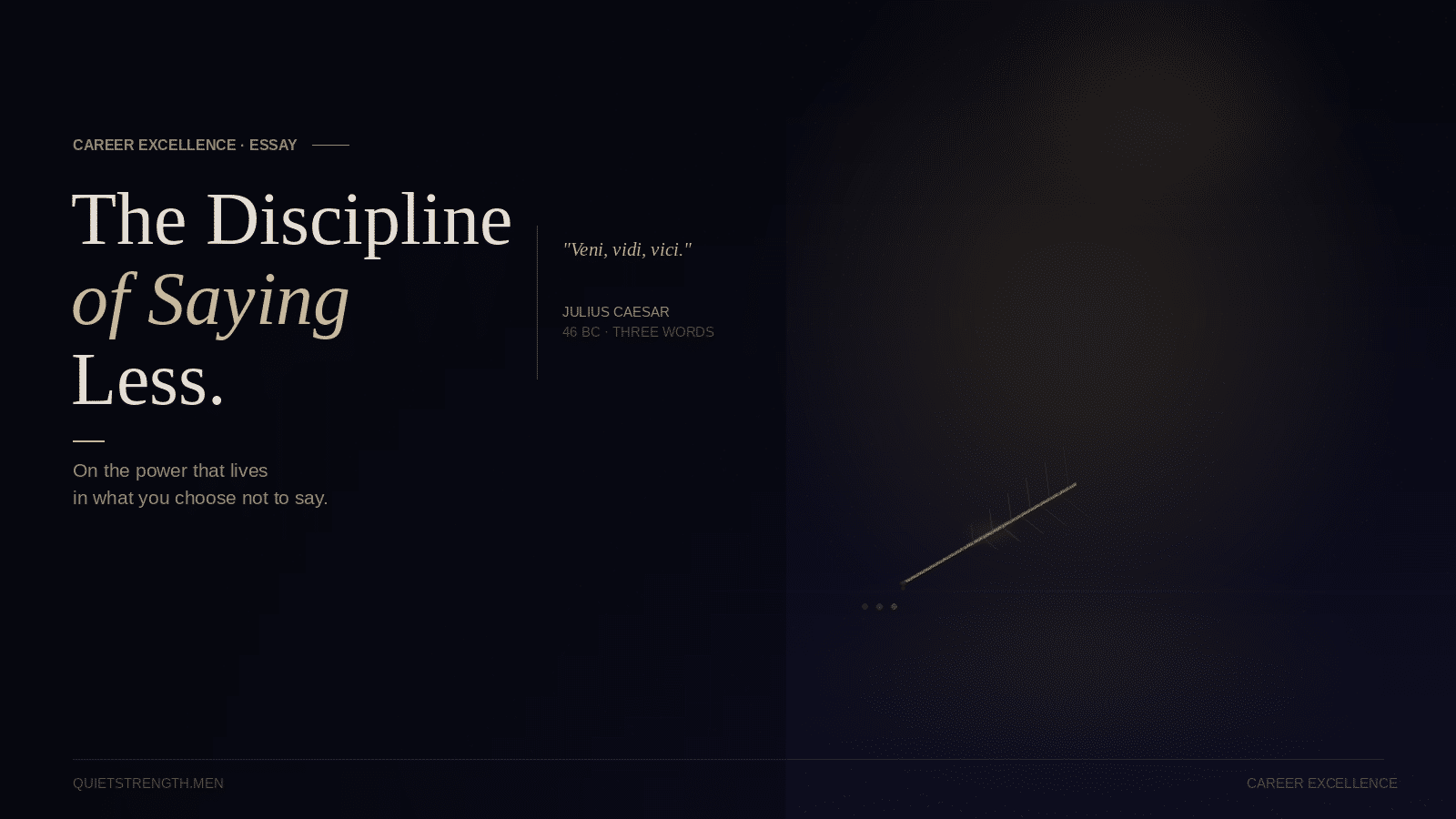
In 46 BC, Julius Caesar crossed into North Africa to fight Pharnaces II, King of Pontus — a minor king who had taken advantage of Rome’s civil war to expand his territory and massacre Roman soldiers.
The battle lasted four hours.
Caesar’s account of it was three words.
Veni, vidi, vici.
I came, I saw, I conquered.
This was not modesty. Caesar was not a modest man. This was something more precise: the understanding that the gap between what happened and what needed to be said about it was vast, and that filling that gap with words would diminish rather than amplify the thing itself.
He understood something that most men never learn.
What you don’t say is often more powerful than what you do.
The talking problem
Most men talk too much. I don’t mean in the obvious, tedious way — the man at the dinner table who won’t stop, the colleague who needs three minutes of preamble before arriving at a sentence. I mean something more subtle and more common.
Most men say what they’re going to do before they do it. They explain their reasoning before it’s necessary. They qualify every assertion until it’s indistinguishable from its opposite. They apologise for opinions before sharing them. They fill silence with words because silence feels like a verdict.
None of this is dishonesty. Most of it is anxiety — the fear that if you don’t explain, you won’t be understood; that if you don’t qualify, you’ll be misrepresented; that if you don’t fill the silence, the other person will fill it in ways you can’t control.
What it produces, though, is noise.
And noise has a cost.
What the Stoics understood
Epictetus was clear about this in a way that is almost uncomfortable to read directly:
“Be silent for the most part, or say only what is necessary, and in few words.”
This was not a personality prescription. Epictetus was not recommending introversion or coldness. He was describing a discipline — the same kind of discipline that governs how you eat, how you spend money, how you manage your attention. The discipline of not wasting a resource.
The resource, in this case, is credibility.
Every unnecessary word costs you a small amount of it. Every qualification that wasn’t needed. Every explanation that nobody asked for. Every opinion expressed before it was earned. These withdrawals are individually invisible, but they accumulate. The man who speaks without discipline eventually speaks to an audience that has stopped fully listening — not because he’s boring, but because the signal-to-noise ratio has become unfavourable.
Marcus Aurelius put it differently in Book VII of the Meditations:
“Confine yourself to the present.”
He meant time — but the principle translates. Confine yourself to what is necessary. To what the moment actually requires. Not to what your anxiety suggests you should add.
The silence problem
Here is the thing most advice about communication misses: the discomfort of silence is almost entirely your problem, not the other person’s.
When you make an assertion and the other person says nothing, your nervous system interprets that silence as threat — as disagreement, as judgment, as the prelude to something bad. The instinct is to rush in. To explain. To soften. To add.
This is almost always the wrong move.
Silence after a statement means the other person is thinking. It means the words landed and are being processed. Filling that silence is the conversational equivalent of pulling up a plant to check if the roots have taken hold — the checking prevents the very thing you’re checking for.
The men I have watched operate most effectively in rooms — in negotiations, in difficult conversations, in meetings where the outcome mattered — share one habit. They make their point. They stop. They wait longer than is comfortable.
They let the silence do the work.
This requires something that has nothing to do with language. It requires the belief that what you said was sufficient. That you don’t need to augment it. That your credibility doesn’t depend on filling every available moment with evidence of your own intelligence.
That belief is hard won. It is the product of knowing what you think clearly enough that you don’t need to think out loud in front of other people.
The preparation problem
Most men who talk too much in meetings, in negotiations, in difficult conversations — do not have a talking problem. They have a preparation problem.
The words come because the thoughts aren’t clear enough yet. The qualifications arrive because the position isn’t solid enough. The explanations proliferate because the argument hasn’t been distilled. Speaking more is how they work through what they should have worked through before they walked in.
This is understandable. It is also expensive.
The Stoics had a practice they called melete — meditation, rehearsal, the deliberate prior consideration of what is coming. Before a difficult conversation, before an important meeting, before a situation you know will require something of you — you think it through. You decide what you think. You determine what needs to be said and what doesn’t.
You do the work in private so you don’t have to do it in public.
The result is not that you become quiet. The result is that when you speak, you mean it. Every sentence is load-bearing. Nothing is scaffolding. And people feel that difference immediately, even when they can’t articulate what it is.
The apology problem
A specific and particularly costly form of over-talking: the pre-emptive apology.
I’m not sure if this is right, but…
This might be a stupid question…
You probably already know this…
Every one of these is a small self-demolition. A credibility withdrawal before you’ve said anything of substance. You are asking the other person to lower their expectations of what’s coming — and they will.
The Stoics were uncharacteristically blunt about this. If you have thought something through and you believe it, say it. If you haven’t thought it through, either think it through first or say clearly that you’re uncertain. The middle ground — the half-thought presented with apologies for its half-thoughtness — serves no one.
Seneca, in Letter XLII to Lucilius, wrote about this in the context of men who spend their lives preparing to live rather than living:
“Dum differtur vita transcurrit.”
While we delay, life passes.
He meant it temporally. But it applies here too. While you qualify, the point passes. While you apologise, the credibility passes. While you fill the silence, the power passes — from you, to the room.
What saying less actually requires
This is not a piece about being cold or withholding or performing mystery. Men who deliberately say very little as a power move are exhausting in a different way. That is performance, not discipline.
The discipline of saying less is not about saying less. It is about meaning more of what you say.
It requires knowing what you think. Not having an opinion available on request — actually thinking things through, in private, before you are asked to perform your thinking in public.
It requires being comfortable with the possibility that you will be misunderstood. That the silence will be misread. That some people will fill in gaps in ways you didn’t intend. This discomfort is the price of not explaining yourself to death.
It requires believing — actually believing, not just believing it’s a good idea to believe — that you are not obligated to justify your presence in a conversation with volume.
These are not communication skills. They are character requirements.
And like most character requirements, they are developed the same way the Stoics developed everything: through practice, against resistance, one conversation at a time.
Caesar again
He was not a quiet man. He wrote extensively — the Gallic Wars, the Civil War, letters and speeches. He argued vigorously in the Senate. He was, by all accounts, magnetic company.
But he understood the difference between speaking and performing, between communicating and filling space, between the three words that would echo through two thousand years of history and the hundred words that would have said the same thing worse.
Veni, vidi, vici.
The battle was four hours. The account was three words.
The discipline is deciding which of those two things you are doing when you open your mouth.
Career Excellence — the third of five pillars. Next in this series: on assertiveness without aggression, and why most men confuse the two.