Command is not the skill that got you promoted. It is what you do once that skill stops being enough. Marcus Aurelius discovered this at fifty, in a tent, on a frontier he never asked to defend — and wrote down what he found instead.
In 172 AD, somewhere among the Quadi, on the river Gran, a report reached Marcus Aurelius after dark.
It contradicted the report from two days before. The tribe his legions were watching had either withdrawn or regrouped — the scouts disagreed, and both scouts were experienced men with no obvious reason to lie. A decision was needed by morning: hold the position, or move to meet a threat that might already be gone by the time anyone arrived. Five thousand men would act on whatever he decided, without knowing the report was uncertain, without needing to know. That was the point of the decision. It removed the uncertainty from everyone except the man who made it.
He made the call. Then, before sleep, by candlelight, he wrote to himself about something else entirely — the ruling faculty, and what it owed to a man in exactly this condition.
This is not a story about a battle. It is a story about the hour before one, when a man holds authority he cannot fully verify he has earned, over soldiers he mostly does not know, based on facts that were accurate an hour ago and may not be now.
Nobody tells you, when you take the job, that most of command has nothing to do with the thing you were trained for.
The general who wrote philosophy
For nineteen of his nineteen years as emperor, Marcus was either putting down a war, preparing for one, or recovering from one. The Marcomannic Wars — a decade and a half of fighting Germanic tribes along the Danube — occupied most of the back half of his reign. He co-ruled, briefly, with Lucius Verus, and when Verus died in 169 AD, during the same plague years that were emptying out the legions faster than any enemy could, Marcus governed and commanded alone, from a war zone, while an empire stretching from Britain to Syria continued generating every problem an empire generates — all of which eventually reached his desk, regardless of where his desk happened to be.
He wrote the Meditations in this condition. Not in a library. Not on a sabbatical. In a tent, between decisions that could not wait and decisions already made that could not be taken back.
This inverts the usual assumption about where clear thinking comes from. We tend to imagine a person sorts out their philosophy first, under calm conditions, then applies it later when things get hard. Marcus did the opposite. He built the framework while actively under the pressure it was meant to withstand. The philosophy was not preparation for command. It was a tool forged in real time, because command was wearing him down and he needed something that wouldn’t.
What a general actually does
Strip away the horses and the frontier, and a Roman command post looks a great deal like an executive’s Monday morning: a stream of reports of uncertain reliability, several of which contradict each other; subordinates who need a decision before there is enough information to make one well; a resource that is finite and that everyone wants more of; and the near-certainty that whatever gets decided, someone qualified will later explain why it was wrong.
The legatus’s actual skill — the one separating the commanders history remembers from the ones it doesn’t — was rarely tactical genius. It was the capacity to decide, commit to it visibly enough that five thousand men could act without hesitation, and then adjust without collapsing when the situation diverged from the plan, which it always did. Indecision was more dangerous than a mediocre decision executed with confidence. A legion that watched its commander freeze did not fight well, regardless of what he eventually chose.
Your subordinates are not primarily damaged by your being wrong.
They are damaged by your being unclear.
Delegation is not a soft skill
The Roman command structure ran on delegation because it had no alternative. A general who tried to personally verify every centurion’s decision would have lost before the battle began. Authority was pushed down to the lowest level that could reasonably hold it, and the officer who delegated well was rewarded with a legion that could act without him. The officer who couldn’t let go got a legion that waited for permission and lost the initiative every time.
Modern executives tend to treat delegation as a matter of trust — a personality trait, something you’re either comfortable with or not. The Romans treated it as a structural discipline: define the boundary of a subordinate’s authority precisely, make it known to everyone it affects, and then do not reach across it except in genuine crisis — because every time you do, you teach the whole organisation that the boundary was decorative.
This is harder than it sounds, because reaching across the boundary usually feels, in the moment, like good management. You can see the mistake forming. You know the better call. The temptation to intervene is rarely laziness — more often it is conscientiousness misapplied. But an organisation where the senior person reaches in whenever they’re fairly confident they’re right is an organisation that has quietly learned to stop deciding and start guessing what the senior person wants.
You end up commanding an army that has forgotten how to move without you. Which is another way of saying you no longer command an army. You have a large, expensive dependency.
The ruling faculty, applied downward
Marcus had a term for the part of a person that governs — τὸ ἡγεμονικόν, the ruling faculty, sometimes rendered the governing self. For the Stoics, this was the seat of judgment, the part of you responsible for deciding, which was supposed to remain composed regardless of what the senses reported or the emotions demanded.
The insight that matters for anyone in command is that this faculty has to work in two directions at once. It has to govern you — keep your own reactions from running the show when the report is bad, the deadline moves, or the mistake was yours. And it has to govern the organisation through you, which means your composure is not merely a personal virtue. It is operational information that everyone below you is constantly reading.
A leader whose face changes when the numbers are bad has just told the room how afraid to be.
This is not a call for the performance of calm. Marcus was explicit, across the Meditations, in the letters to himself he never expected anyone else to read, that he found this difficult — that he did not always manage it, that some days the discipline was closer to endurance than mastery. The value was never in feeling nothing. It was in the fact that the ruling faculty, however strained, kept deciding what to do next, rather than surrendering the decision to whatever emotion arrived first.
What you owe the people under you
There is a specific failure common to people promoted for individual competence: they keep measuring their worth by the standard that got them promoted — personal output — even after their job has become almost entirely about other people’s output. They stay up late doing the analyst’s job instead of building analysts who don’t need them to. It feels like diligence. It is often an avoidance of the harder, less immediately gratifying work of command — the work that produces no artefact you can point to, only a team that functions when you’re not there.
The Roman answer to this was structural, not sentimental. A commander who could not be replaced, even temporarily, had failed at command — because command dependent on one irreplaceable man was a single point of failure the empire could not afford, and every competent Roman administrator knew it. The measure of a general, in the histories that survive, was rarely how brilliant he was in the moment. It was whether the legion still functioned when he was wounded, reassigned, or dead.
Succession wasn’t a courtesy. It was the actual test.
If your team’s competence is downstream of your constant presence, you have not built a team. You have built an extension of yourself — and extensions do not survive their source.
What this is actually for
None of this is a metaphor for its own sake. The reason the Roman command structure keeps mapping so precisely onto modern executive life is that the underlying problem hasn’t changed in two thousand years: a small number of people are asked to make consequential decisions with incomplete information, on behalf of people who will experience the consequences more directly than the decision-maker does, under conditions that reward composure and punish both hesitation and overreach.
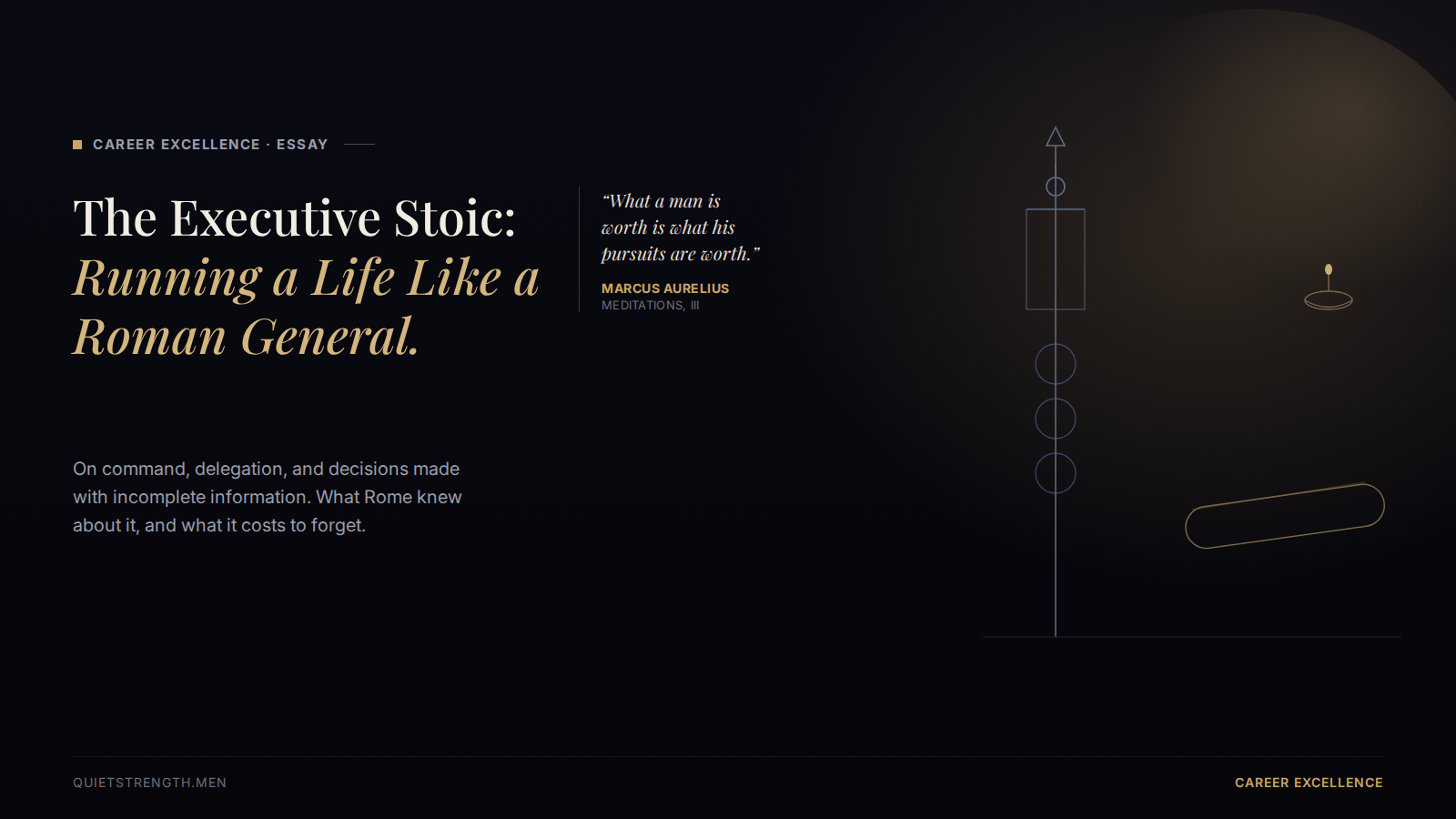
What a man is worth is what his pursuits are worth. Marcus wrote that about a different context. It applies here without modification. Not what he says his priorities are. Not what’s on the wall in the conference room. What he actually spends his attention on, under pressure, when no one is grading the performance — that is the real measure, and it is available to anyone willing to look honestly at how they actually spend a difficult Tuesday.
The tent Marcus wrote in was cold, and the war did not pause for his philosophy.
That was rather the point. The discipline was never going to be built anywhere easier than where he actually was.
Neither is yours.
Career Excellence — on doing the work well, and on what the work quietly asks of the person doing it. Next: On Assertiveness Without Aggression — on holding a position without needing to raise your voice to hold it.