Two of the offices in this series so far rewarded a man for doing good work no one saw. This one does the opposite. It hands you a stage, an audience, and a budget, and the only question it actually asks is whether you can tell the difference between winning the crowd and doing the job.
One morning in 65 BC, Rome woke up to find the trophies of Gaius Marius standing again on the Capitoline Hill — the golden images of his victories over Jugurtha and the Cimbri, torn down decades earlier on Sulla’s orders and, as far as anyone in the city knew, gone for good.
They had not, in fact, reappeared overnight. Restoring monuments of that size took architects, metalworkers, and a crew large enough that word should have leaked. But the effect Caesar wanted was exactly the one Plutarch records: a city that went to sleep under one political settlement and woke up under the visible symbol of another, with no memory of the labour in between. That was the year Caesar held the aedileship, and the trophies were, by any honest accounting, the least expensive part of what he spent it on.
The aedileship is where this series turns a corner. The tribune and the quaestor were tested by what they did when nobody was looking. The aedile is tested by the opposite problem entirely: everybody is looking, all the time, on purpose, because that is what the office is for. And the specific danger of an office built for an audience is that it becomes very easy to mistake the audience’s applause for the actual measure of the work.
The office built for the crowd
By the time Caesar held it, the aedileship had a split personality baked into its job description. Aediles were responsible for the cura annonae — the grain and water supply of the city — and the cura urbis — the physical fabric of Rome: roads, drains, public buildings, urban order. This was the unglamorous half, essential and continuous, the kind of work that only becomes visible when it fails. Nobody in Rome thanked an aedile for a road that didn’t have a pothole in it.
The other half of the job was the cura ludorum — the games. Public festivals, theatrical productions, gladiatorial contests, religious spectacle, all funded partly by the state and, whenever an ambitious man held the office, topped up enormously from his own pocket or his creditors’. This half of the job was visible by design. It existed specifically to be watched, remembered, and rewarded at the ballot box, because a spectacular aedileship was widely understood as the down payment on a praetorship and, eventually, a consulship.
Caesar understood this arithmetic with more clarity than almost anyone who ever held the office. He borrowed heavily — modern estimates of the year’s total spending run as high as twenty million sesterces — and built an aedileship that Rome talked about for years: three hundred and twenty pairs of gladiators in silvered armour, officially in honour of his long-dead father but scaled for maximum public effect; beast hunts; theatrical productions; the Forum and the Capitoline dressed for spectacle. The Senate, watching a private citizen assemble what amounted to a small standing army of loyal, armed men, got nervous enough to pass emergency legislation capping how many gladiators anyone could keep in the city at once.
None of this was subtle, and none of it was meant to be. Caesar had correctly identified which half of the aedileship Rome would actually remember.
Bibulus’s temple
The detail that makes this year worth studying closely, rather than simply admiring or condemning from a distance, involves the man who held the office alongside him.
Curule aediles served in pairs, and Caesar’s colleague that year was Marcus Calpurnius Bibulus — a capable, conventional aristocrat who, by every surviving account, paid his fair share of the year’s expenses without complaint. The games, the buildings, the public spectacle: much of it was funded jointly, as the office required. And yet, when Rome talked about that year afterward, it talked about Caesar.
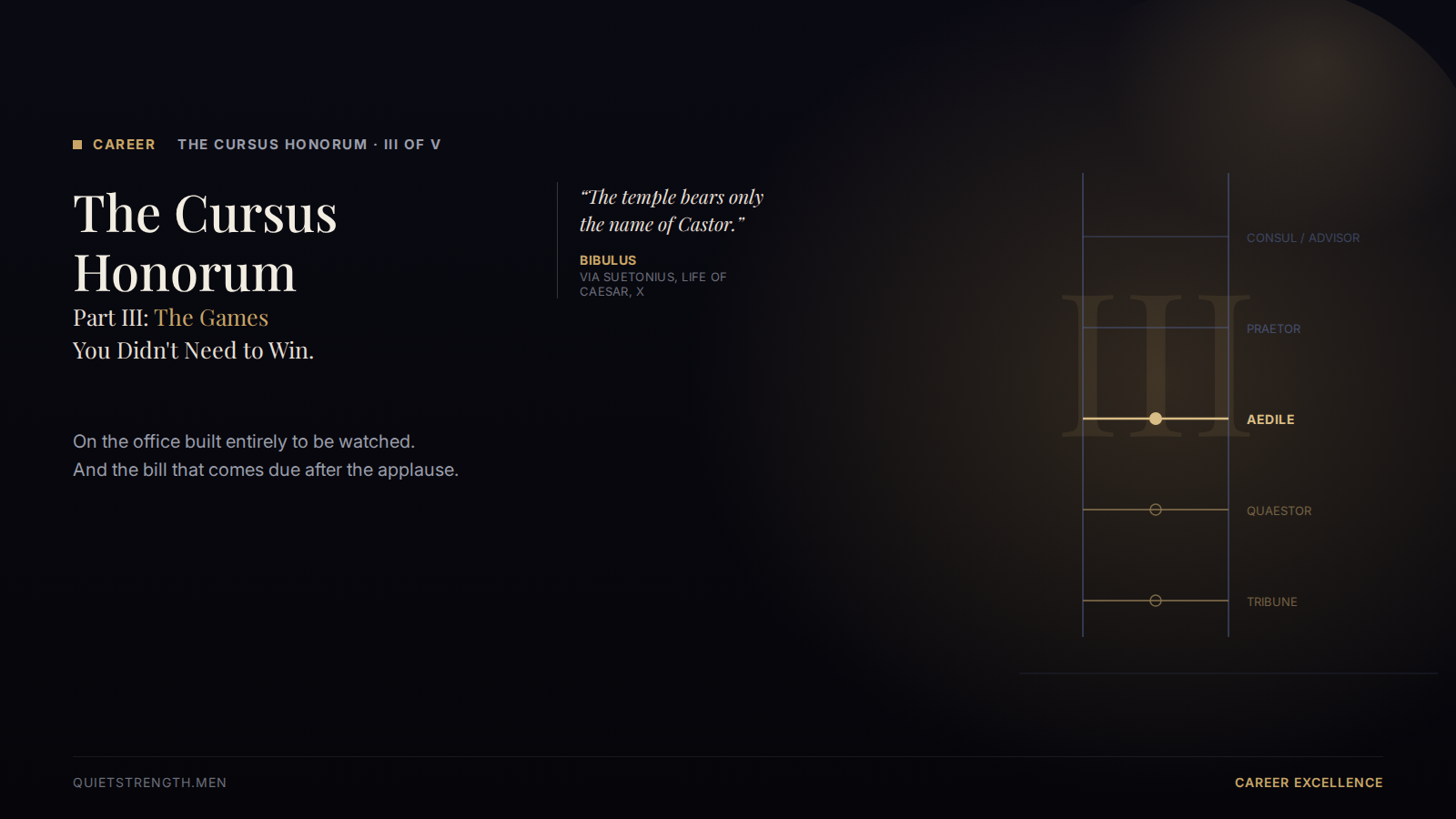
Bibulus’s own recorded complaint, preserved by Suetonius, is unusually self-aware for a Roman aristocrat: he said he found himself in the position of Pollux, whose temple in the Forum, though built and dedicated to both him and his twin brother Castor, had been known for generations by Castor’s name alone. Two men underwrote the same festivals. One man’s name survived attached to the memory of them.
This is the mechanism worth sitting with, because it’s not really about Caesar’s talent, and it isn’t really a story about one ancient man being more charismatic than another. It’s a demonstration of how an office designed around visibility distributes its rewards. The games do not pay out proportionally to the investment made in them. They pay out to whoever is positioned, and willing, to be seen making it — and everyone standing next to that person, having quietly paid the identical price, gets Bibulus’s temple: real ownership, no attribution.
Bibulus would spend much of the rest of his political career reacting to this asymmetry, and not always well. It is one thing to notice that the games reward visibility rather than contribution. It is a harder thing to decide what to do with that knowledge once you’ve noticed it — chase the same visibility more aggressively, as Bibulus increasingly tried and mostly failed to do, or find out what the office looks like when you stop competing for the applause at all.
The bill that came due
The part of the story that gets told least often is the part that mattered most to Caesar personally in the years immediately following: the twenty million sesterces did not evaporate along with the crowd’s applause. It was owed, to real creditors, at real interest, and the political capital the games had purchased was not, by itself, a currency any lender would accept.
This is the detail that turns the aedileship from a story about ambition into a story about structural consequence. Caesar’s debts from his aedileship followed him into his praetorship, and followed him again when he was assigned the governorship of Hispania Ulterior — a posting he needed not simply as an honour but as a financial necessity, since a province at the edge of Roman control was also, not coincidentally, an opportunity to extract exactly the kind of plunder that could clear a debt of that size. The spectacular win at the games did not conclude the story. It committed him to a specific, high-risk sequence of moves afterward, each one partly explained by the need to service a bill incurred years earlier for an audience that had long since gone home.
The games, in other words, were not free even for the man who won them decisively. They bought popularity on credit, and credit of that kind always eventually asks to be repaid, usually by a version of yourself with fewer options than the one who took out the loan.
The other half of the job nobody remembers
Here is the detail that belongs at the centre of this essay, and that most retellings of Caesar’s aedileship compress into a single clause on the way to the gladiators: he also fixed roads. He maintained temples. He oversaw the actual grain and water supply of a city of roughly a million people, the same cura annonae that would occupy Seneca’s father-in-law a century later and nearly break him with its relentless daily demands. Ordinary Romans depended on that half of the aedileship considerably more than they depended on three hundred and twenty pairs of gladiators, and it is almost never what anyone remembers about the year, including most modern accounts, including large parts of this one until this specific paragraph.
That asymmetry is the whole argument of Part III. The office did not actually require Caesar to neglect the cura urbis and cura annonae in favour of the games — by all accounts he executed both halves of the job competently. What the office demonstrates, through Caesar with unusual clarity precisely because he pursued both halves at once and to such extremes, is that the visible half will always be tempting to over-invest in, because it is the half that pays out in the currency an ambitious man can actually see accumulating: attention, gratitude, votes. The invisible half pays out only in a city that continues to function, which is a real and valuable thing and also, structurally, incapable of generating applause.
What the games actually bought, and what they cost
It would be a mistake to read this as a straightforward morality tale where Caesar chose spectacle over substance and should have chosen otherwise. He didn’t neglect the substantive duties — he simply understood, correctly, that Rome’s political system rewarded the games far more than it rewarded competent road maintenance, and he built his aedileship accordingly. The games worked exactly as intended. They were a primary reason he reached the praetorship, then the consulship, then everything after.
What they also did was lock in a specific, compounding form of obligation — financial, then political, then military — that shaped nearly every major decision of the following fifteen years of his life. The win at the games was real. It was also the first domino in a sequence he did not fully control afterward, each subsequent move partly explained by debts incurred winning a contest he had, strictly speaking, never needed to enter at that scale to hold a functioning aedileship.
This is the distinction the title of this essay is pointing at. Some games are the actual job. Winning the trust of five thousand soldiers as a green tribune, as Part I described, or keeping an honest ledger as quaestor, as Part II described — these were the substance of those offices, not decoration on top of them. The aedileship is different in kind. Its most visible contest is separable from its actual function, optional in a way the earlier rungs were not, and the ambitious man’s job is to know which contest he is actually required to enter and which one he is simply choosing to, at a cost he will keep paying long after the applause has stopped.
What this asks of you
Almost nobody holds an office literally structured like the Roman aedileship, but almost everybody eventually holds a role with the same split personality built into it: an unglamorous, continuous set of duties that keep something functioning, running alongside a visible, optional stage — the flashy project, the public presentation, the initiative that will be seen by the people who decide what happens to your career next — that pays out in attention and advancement in a way the unglamorous half never quite does.
The temptation Caesar’s aedileship makes vivid is not that the visible stage is worthless. It manifestly worked for him. The temptation is subtler: that the visible stage is so much more rewarding, in the currency that ambitious people can actually feel accumulating, that it quietly starts to look like the whole job — until the unglamorous half either gets neglected, or gets financed the way Caesar financed his gladiators, on borrowed capacity that someone, eventually, has to repay.
Know which contest you actually need to win to do the job in front of you. Know which one you are entering by choice, for the applause, at a price you have not yet finished calculating. Caesar knew the difference and chose the games anyway, with his eyes open, and spent the next decade and a half paying for that choice in ways he had not fully priced in in 65 BC. Bibulus never got his name on the temple regardless of what he chose. The office rewards the man willing to be seen. It says nothing at all about whether being seen was the actual job.
Career Excellence — The Cursus Honorum, a five-part reading of the Roman career ladder and what each rung actually demands. Next: Part IV — What Pliny Asked Trajan When He Didn’t Know, on the praetorship and the discipline of admitting you need help before the mistake happens.