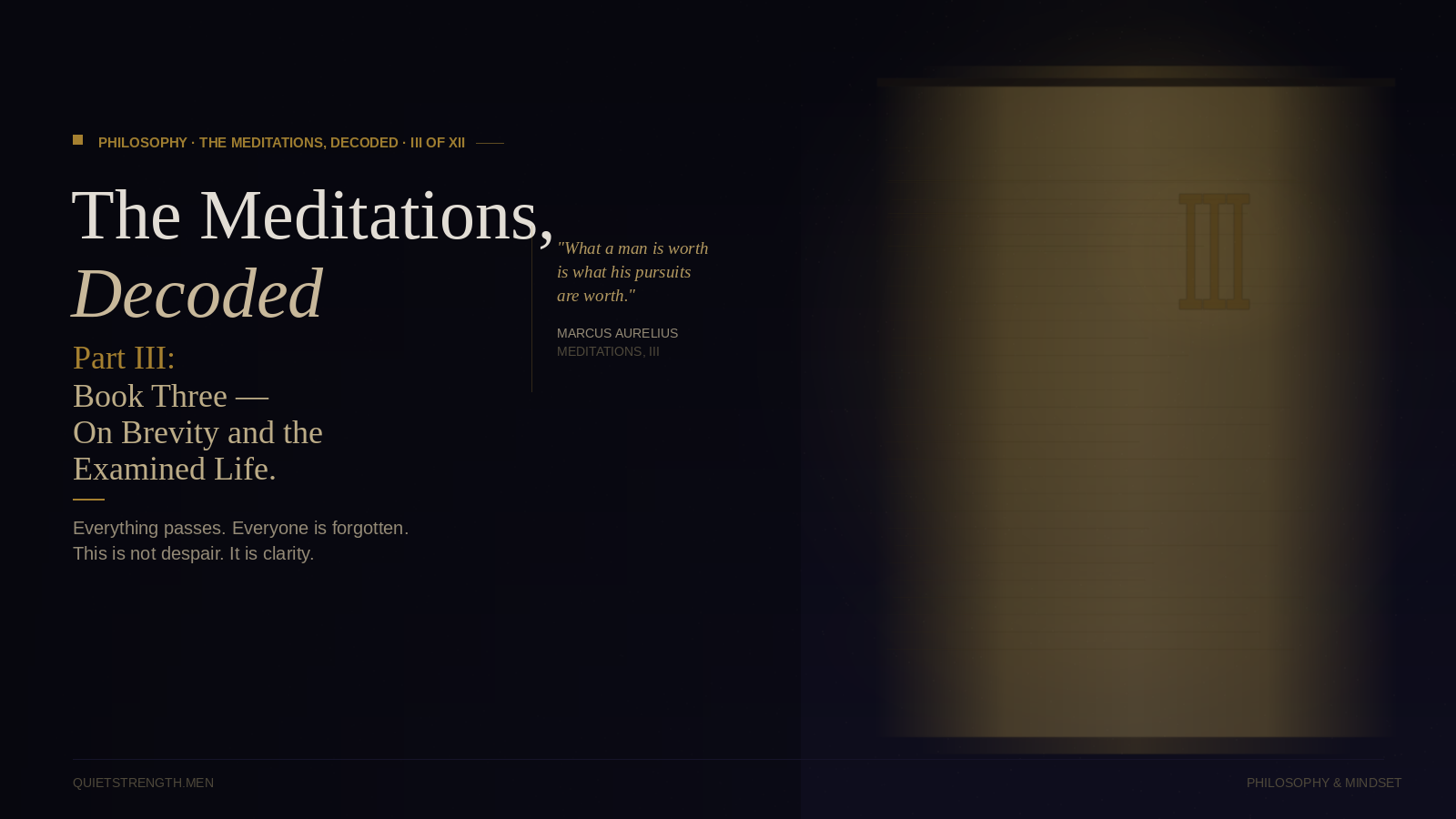
The Meditations, Decoded · A twelve-part reading of Marcus Aurelius · Part III of XII
Book Two ended with the insistence on the present. Book Three begins with the consequence: if the present is all there is, then what you do with it is everything. And if what you do with it is everything, then what are you actually doing?
Book Three is the shortest book in the Meditations. Sixteen sections. Some of them a single sentence. It reads as if Marcus was writing in haste — which, given that he was probably on campaign, he likely was — and the haste produced a kind of compression that the longer books don’t have. Every sentence is load-bearing. Nothing is scaffolding.
The central preoccupation of Book Three can be stated simply: everything passes, everyone is forgotten, and this is not a reason for despair but a reason for clarity.
Marcus makes this argument in more ways than you might expect from a man who had every reason to believe his own legacy was secure. He was emperor of Rome. He had armies and monuments and the full apparatus of historical commemoration available to him. And yet he kept writing, to himself, about how quickly the powerful are forgotten, how thoroughly even the most famous names dissolve into obscurity, how the man who bases his life on the approval or memory of others is building on sand.
This is not false modesty. It is philosophy doing its job.
The forgotten names
Book Three opens with a meditation that is more like an archaeological exercise than a philosophical argument.
“We should not look only at the lifespan itself as the measure of duration; we ought to consider that Alexander the Great and his muleteer were both brought to death after the same fashion; both were absorbed into the same universal reason of things.”
He does not name only the famous. He names them alongside their obscure contemporaries — the muleteer, the groom, the minor functionary. His point is not that greatness is an illusion, but that duration is relative in a way that makes seeking it in the opinions of others particularly futile.
“Consider how much of the past is already obliterated. Think of the commonplace men and women who thought themselves greater than they were, who competed urgently for honours they imagined were important — where are they now?”
The rhetorical question is not rhetorical in the way such questions usually are. Marcus actually wants you to sit with it. To take the names you know — the powerful, the celebrated, the much-discussed — and to observe that even the best-remembered of them are remembered by a tiny fraction of the people who have ever lived, for an infinitesimally brief portion of time.
This is the brevity argument, and it has a specific target: the man who lives primarily for reputation. For external validation. For the approval of others as a measure of his own worth.
Marcus is not telling this man he is wrong about what he wants. He is telling him he is wrong about where to find it.
On the examined life
What Book Three is really arguing for — underneath the meditations on brevity and forgotten names — is the examined life. Not in the abstract philosophical sense, but in the specific, daily, deliberate sense: the life that is regularly interrogated, that checks itself against something more durable than the opinions of contemporaries.
“What a man is worth is what his pursuits are worth.”
We have already met this line — it belongs to Book Three itself, and it is one of the most compressed and most radical sentences in it. It does not say: do not care what people think. It says something considerably more demanding: the majority may be wrong, and the fact that they are the majority does not make them right, and the man who orientates himself by what most people think is not a pragmatist — he is a man who has outsourced his judgement.
The insanity Marcus refers to is not clinical. It is the specific irrationality of men who pursue things — wealth, status, fame, pleasure — that they believe will make them flourish, without ever examining whether these things actually do what they believe.
The Stoics inherited from Socrates the idea that the unexamined life is not worth living. Marcus is extending this: the unexamined life is not merely not worth living, it is a form of madness — the madness of the man who is very busy doing something he has never checked to see if it matters.
On the body and the philosophical life
Book Three contains a passage that most readers skip, and that I think is one of the most useful in the entire Meditations.
“What a man is worth is what his pursuits are worth.”
Six words in translation. In the original Greek, fewer. But the implications are significant enough that Marcus unpacks them across several sections.
The argument is about priorities — not in the self-help sense of time management, but in the deeper sense of what a man’s actions reveal about what he actually values, as distinct from what he says he values.
Marcus observes that most men’s actions reveal something other than their stated values. The man who says he values family but spends his hours at the office. The man who says he values learning but has not finished a book in two years. The man who says he values integrity but makes small compromises so routinely that he has stopped noticing them.
These men are not hypocrites in the dramatic sense. They are men whose actual pursuits do not match their stated beliefs, and who have never paused long enough to notice the gap.
“What a man is worth is what his pursuits are worth.”
The pursuits are the evidence. The beliefs are just words.
The Stoic cosmopolitanism
One of the ideas that recurs through Book Three — and that becomes increasingly important in the later books — is Marcus’s conviction that all humans share a fundamental nature, and that this shared nature creates obligations.
“From my relation to rational beings, I am drawn towards society; but from my relation to the Universe, I am drawn towards its nature.”
This is Stoic cosmopolitanism — the idea that belonging to humanity is as real and as binding as belonging to a particular city or family. Marcus was emperor of Rome, which gave him every reason to think of Rome as the relevant community. He kept insisting, instead, on the larger one.
The practical implication of this, in Book Three, is his treatment of difficult people — the ungrateful, the arrogant, the thoughtless. He does not recommend patience with them because patience is virtuous in the abstract. He recommends it because they share his nature, operate from the same fundamental capacity for reason that he does, and are therefore related to him in a way that makes writing them off impossible.
“For what ails my neighbour also ails me.”
This is not sentiment. It is philosophy. The man who causes you frustration is doing so from the same basic material you are made of. His failure to use it well is a reminder, not a reason for contempt.
On leaving things
Book Three ends — as several of the books do — with a meditation on death that is neither morbid nor consoling, but simply clarifying.
“To depart from among men, if there are gods, is not a thing to be afraid of, for the gods will not involve thee in evil; but if indeed there are no gods, or if they have no concern with human affairs, what is it to me to live in a universe devoid of gods or devoid of providence?”
Marcus was not certain about the gods. This is one of the things that makes the Meditations philosophically interesting and personally honest: he does not claim a faith he does not have. He reasons from uncertainty, which is the only intellectually defensible position he could take.
What he is saying here is something more important than a theological position. He is saying that his conduct does not depend on the answer. Whether the universe is providentially ordered or randomly indifferent, the obligation to act well remains. The examined life remains. The present moment remains.
This is the deepest claim in Book Three: the good life does not require external validation — not from the crowd, not from history, not from the gods. It is constituted by what it is, by the quality of the actions and the honesty of the examination.
The present action, done well, is complete in itself. It does not require the endorsement of posterity. It does not require that anyone notice or remember. It requires only that it be done.
What Book Three gives you
Book Three is the book of the examined life — not as an ideal but as a practice, daily and unglamorous and entirely private.
What it asks is not dramatic. It asks that you look, regularly and honestly, at what you are actually pursuing — not what you intend to pursue, not what you believe you value, but what your days reveal about where your attention and effort actually go. And that you measure this against something more durable than the opinions of the people around you.
The majority may be wrong. History will forget you regardless. The gods may not be watching.
None of this changes what is worth doing.
The question Book Three leaves is not what Marcus Aurelius believed. It is what you believe — and whether your days reflect it.
The Meditations, Decoded — Part III of XII. Part I: Book One, Debts and Lessons. Part II: Book Two, Obligation and the Present Moment. Next — Part IV: Book Four, where Marcus writes the most sustained meditation on impermanence in the entire text, and arrives at something that sounds like peace.