The most important thing Seneca ever wrote. And the most uncomfortable.
Seneca wrote De Brevitate Vitae — On the Shortness of Life — sometime around 49 AD, addressed to his father-in-law Paulinus, who was at the time the superintendent of Rome’s grain supply, a bureaucrat of significant responsibility and presumably significant busyness.
The essay begins with one of the most direct sentences in Latin literature.
“Ita est, Pauline carissime: omnes alienos esse, tempus tantum nostrum.”
So it is, dearest Paulinus: everything is foreign to us; time alone is ours.
He was writing to a busy man. He was telling him, gently but without apology, that the life he was living — the meetings, the administration, the obligations, the important work — was consuming the one thing that could not be replenished. Not money. Not health. Not reputation.
Time.
And then he made the argument that has been making readers uncomfortable for two thousand years.
The argument
The argument is compressed into a single paragraph near the opening, and it is worth sitting with rather than paraphrasing past.
“It is not that we have a short time to live, but that we waste a great deal of it. Life is long enough, and a sufficiently generous amount has been given to us for the highest achievements if it were all well invested. But when it is wasted in heedless luxury and spent on no good activity, we are forced at last by death’s final constraint to realise that it has passed away before we knew it was passing.”
This is the argument. Life is not short. Life is long. What we call a short life is almost always a wasted life — not wasted in the sense of idleness, necessarily, but wasted in the sense of spent on things that were not worth the spending.
The distinction matters enormously. If life is short, the problem is external — we were given insufficient time, we are victims of biology and mortality. If life is long but wasted, the problem is internal — we had the time, and we chose badly what to do with it. The second diagnosis is harder to hear and more useful to act on.
What Seneca means by waste
Seneca is not making an argument against rest. He is not telling you to optimise every hour, to eliminate leisure, to treat time as a resource to be extracted rather than a life to be lived.
He is making a more specific argument about the particular ways that men — educated, thoughtful, well-intentioned men, the kind of man who reads philosophy and considers himself serious — spend their lives on things that feel important but are not.
He identifies several categories.
The consumed by ambition. “How many are kept busy by the pursuit of a high position! They toil from the time they are young… and when old age arrives it is still hoped for.” These men have spent their lives working toward a version of their life — the position, the recognition, the arrival — that recedes ahead of them and, when it is achieved, proves less satisfying than imagined. The goal was always just over the next horizon.
The consumed by acquisition. Men who spend their prime years accumulating — money, property, status — on the theory that once they have enough, they will then live. But enough is a moving threshold. The man who needs one million to feel secure will, upon reaching it, discover that two million is the real number. The accumulation is not the preparation for life. It is the consumption of it.
The consumed by distraction. This category is Seneca’s most prescient, because it describes something that has only accelerated since the first century. The man who fills every available moment with noise — entertainment, gossip, the news of other people’s lives — not because he values these things but because the silence would require him to be with himself, and himself is not company he currently enjoys.
The consumed by the wrong things. Men who are genuinely hardworking and genuinely committed — but committed to things that are not their own. Who live by someone else’s schedule, someone else’s priorities, someone else’s definition of what matters. Who are busy in the service of other people’s purposes and call it productivity.
The common thread is not laziness. It is abdication — the failure to consciously choose how the time is spent, and the resulting discovery, at fifty or sixty or seventy, that the life was spent by default rather than by decision.
The man who owns himself
Against these categories, Seneca sets a different kind of man.
“Of all people only those are at leisure who make time for philosophy, only those are really alive.”
This sounds like the self-serving endorsement of a professional philosopher. It is not. What Seneca means by philosophy here is not academic study. He means the practice of examining one’s life — of asking, regularly and honestly, whether the time being spent is being spent on things that actually matter, by the standard of what the man himself values rather than the standard of what is expected of him.
The man who does this — who maintains a live, active relationship with the question of what his life is for — is the only man who genuinely possesses his time. Everyone else is allowing their time to be possessed by something else: the job’s demands, the social expectations, the accumulated momentum of a life that was set in motion years ago and has never been seriously re-examined.
“Recede in te ipse quantum potes.”
Retreat into yourself as much as you can.
This is the prescription. Not withdrawal from the world, but the maintenance of an interior life that is genuinely your own — from which you can look at the world’s demands and ask, clearly, which ones are worth meeting, and at what cost, and to whom the cost is actually being paid.
The letter to Lucilius
De Brevitate Vitae is an essay. But Seneca’s most compressed and practically useful work on time is not an essay — it is the first letter of the Epistulae Morales, the Letters to Lucilius. The very first thing he wrote to his friend.
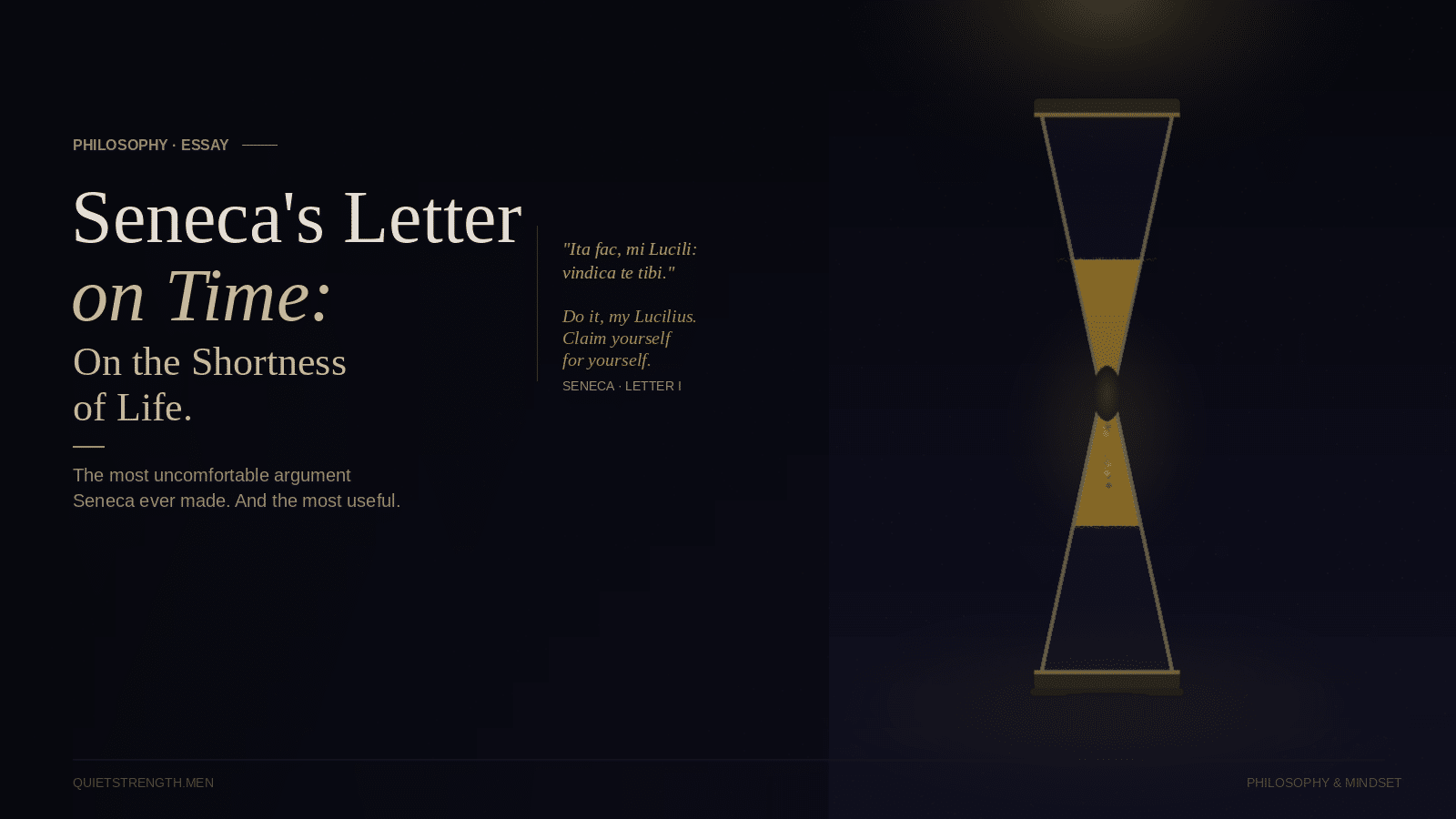
“Ita fac, mi Lucili: vindica te tibi.”
Do it, my Lucilius. Claim yourself for yourself.
Four words in Latin. Claim yourself for yourself. Then he continues:
“Collige itaque et serva omne tempus quod adhuc auferebatur aut subripiebatur aut excidebat.”
Collect and save all the time which until now has been taken from you, or subtracted, or has simply fallen away.
He is writing to a man he respects, at the beginning of what he considers the most important correspondence of his life, and the first piece of advice he gives is: stop letting your time be taken from you.
Not stop working. Not withdraw from life. Stop the passive, inattentive, default surrender of the hours to whatever arrives. Collect the time. Save it. Treat it as the only genuinely non-renewable resource, because that is precisely what it is.
The arithmetic
Seneca does the arithmetic that most men avoid.
“Persuade yourself of this: that certain men of the highest mental qualities have abandoned all obstacles and given up wealth, business, and pleasure, and have made it their aim to live only for the whole of their remaining time, since many have found that even the little left was enough if used rightly.”
The little left was enough. This is the sentence that should be read carefully by every man who is deferring — deferring the real work, deferring the real relationships, deferring the examination of what he actually values — on the grounds that there will be more time later.
There will not necessarily be more time. And even if there is, the habit of deferral will have become so entrenched that the arrival of more time will not change the behaviour.
The man who has spent twenty years deferring the things he claims to value does not, at forty-five, suddenly stop deferring. He defers differently. He defers with more sophistication, more justification, more elaborate explanations for why now is still not quite the right moment.
The arithmetic of wasted time is not resolved by more time. It is resolved by different decisions made with the time already available.
On busyness
There is a passage in De Brevitate Vitae that reads as if Seneca had seen the modern productivity complex and was specifically responding to it.
“Men are thrifty in guarding their private property, but as soon as it comes to squandering time they are most wasteful of the one thing in which it is right to be miserly.”
Miserly with time. He is recommending, explicitly, what would in most contemporary contexts be considered antisocial: the deliberate, unapologetic refusal to spend time on things that do not warrant it.
The dinner you do not want to attend. The obligation that is social inertia rather than genuine connection. The meeting that could have been an email. The activity that exists because it has always existed, and not because anyone has recently asked whether it should.
Seneca is not recommending rudeness. He is recommending consciousness — the active evaluation of where the time is going, rather than the passive acceptance of whatever arrives.
“Non differtur vita transcurrit.”
While we delay, life passes. He wrote this as a warning. It reads, two thousand years later, as a description.
The question Seneca leaves
At the end of De Brevitate Vitae, after the argument has been made in full, Seneca addresses Paulinus directly.
He does not tell him what to do. He asks him to consider what he is doing. To look at the life he is living — the important work, the genuine responsibilities, the things he has committed to — and to ask, honestly, whether the time being spent is being spent as he would choose to spend it if the choice were fully conscious.
It is a question, not a verdict.
The question is: whose life are you living?
Not who is benefiting from your time — that is usually clear enough. But whose values are driving the allocation. Whose definition of important is being served. Whether the life currently being lived is the one you would choose if you stopped, looked clearly at it, and made the choice again.
Paulinus probably read this, nodded thoughtfully, and went back to managing the grain supply.
Most people do. The essay is not designed to produce a dramatic conversion. It is designed to be returned to — at thirty, at forty, at fifty — and to ask the question again, in a different context, with different stakes, and see if the answer has changed.
The time is passing either way.
The question is whether you are the one deciding where it goes.
Philosophy — the first of five pillars. On the Stoic relationship with time: see also Memento Mori, Amor Fati, Premeditatio Malorum. Next in the Philosophy series: what Marcus Aurelius wrote about anger, and why his advice is the hardest thing in the Meditations to actually follow.