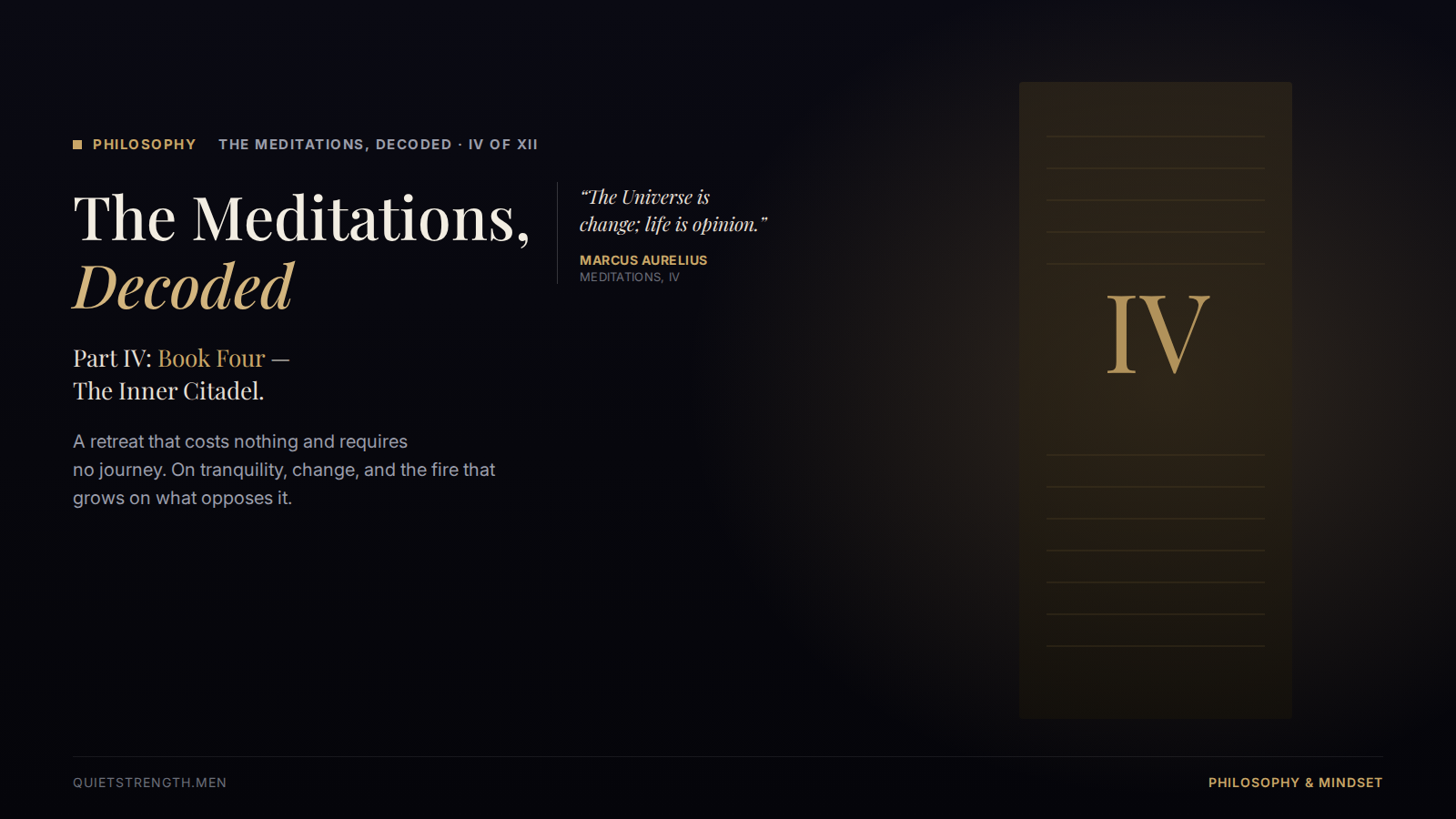
The Meditations, Decoded · A twelve-part reading of Marcus Aurelius · Part IV of XII
Book Three ended with the examined life — the daily, unglamorous audit of what a man’s actual pursuits reveal about him. Book Four begins with the place that audit has to happen: not in a courtroom, not in a confessional, but in a retreat Marcus insists is always available, to anyone, at any hour, free of charge.
He did not always believe his own advice. That is the part of Book Four worth starting with.
The retreat he kept almost taking
“Men seek retreats for themselves, houses in the country, sea-shores, and mountains; and thou too art wont to desire such things very much.”
This is a strange thing for an emperor to admit to himself, in a private notebook nobody else was meant to read. He is not scoring a philosophical point against other men’s weakness. He is confessing to the exact same weakness. Marcus owned country villas — Lorium, where he had been raised, among others — and by his tutor Fronto’s own letters, he used them, the way any Roman aristocrat used a family estate, as a place to escape the grinding public performance of being emperor. The desire for a physical getaway was not a temptation Marcus had transcended. It was one he was actively managing, in real time, while writing the very sentence that catalogues it.
What follows is the correction, delivered to himself rather than to the reader:
“But this is altogether a mark of the most common sort of men, for it is in thy power whenever thou shalt choose to retire into thyself. For nowhere either with more quiet or more freedom from trouble does a man retire than into his own soul.”
The country house requires geography, time, and the cooperation of an empire that does not stop generating problems just because its emperor has left town. The retreat into one’s own mind requires none of these things. It is, Marcus is telling himself, strictly better than Lorium on every practical measure that matters — and he still wanted Lorium. Holding both of these facts at once, without pretending the second one cancels the first, is closer to what this book is actually modelling than any clean resolution would be.
The citadel
Pierre Hadot, the scholar most responsible for taking Marcus’s private notebook seriously as a record of practised technique rather than abstract philosophy, gave Book Four’s central image its modern name: the inner citadel. A fortress that cannot be besieged from outside, because its walls are not made of anything an army — or a bad day, or an ungrateful colleague, or an empire falling apart at the edges — can actually reach.
The passage itself is precise about what stocks the fortress. It is not empty stillness. It is furnished, deliberately, with a small number of fixed convictions Marcus returns to by name: that external things cannot lay hold of the mind, that disturbance comes only from the judgment made about a thing and never from the thing itself, and that everything visible is already in the process of changing into something else.
“Let thy axioms be short and elemental, such as, when set before thee, will at once rid thee of all trouble.”
This is worth being exact about, because the citadel is easy to misread as withdrawal — a man closing the shutters on a difficult world. Hadot’s reading, and the text itself, point the other way. The retreat exists so that Marcus can go back out.
“Make use then of this retirement continually, and regenerate thyself… and send thee away with no discontent at those things to which thou art returning.”
The citadel is not where Marcus hides. It is where he reloads.
What tranquility actually meant
The Greek term Marcus reaches for here — sometimes rendered as ease, sometimes as tranquility — gets a definition most modern readers slide past too quickly.
“By ease I mean nothing else but good behaviour.”
Other translations render the same line as “tranquility is nothing else than the good ordering of the mind.”
Either way, the claim is specific and slightly startling: tranquility is not a feeling. It is an arrangement. Not the absence of disturbance, which is a passive state that could in principle be achieved by numbness, distraction, or simply not caring about anything — but the active, maintained order of a mind that has decided in advance what a small number of things are actually true, and keeps returning to them under pressure rather than improvising a new position every time something goes wrong.
This is why the citadel needs to be stocked with specific axioms rather than left as an empty room. An empty mind under pressure does not default to calm. It defaults to whatever the pressure suggests. The order has to be built and maintained on purpose, the way Marcus is visibly doing, in real time, in the sentence that describes it.
The universe is change
Book Four’s second fixed conviction is the one Book Three’s closing line promised: the most sustained meditation on impermanence in the entire text.
“All that your eyes behold will change in a moment and be no more, and of how many things you have already witnessed the changes, think continually of that. The Universe is change, life is opinion.”
Four words, in the most compressed rendering: Universe — mutation. Life — opinion. The claim underneath the compression is that these two convictions do the same defensive work from different directions. If the universe is nothing but continuous change, then no particular arrangement of it — including the one causing you distress right now — was ever going to be permanent regardless of what you did. And if life is opinion, then the distress itself is not a fixed property of the event but a judgment layered onto it, which means it was never as solid as it felt.
This is not offered as consolation in the soft modern sense. Marcus is not telling himself that change is secretly fine, or that impermanence is beautiful if you look at it the right way. He is telling himself that change is simply what is actually happening, continuously, to everything, and that resisting this fact costs energy that could instead go toward the only thing actually within his control — the judgment he attaches to it.
The fire that grows on what opposes it
Book Four opens, before any of this, with an image that is easy to skip past on a first reading and hard to forget on a second: the mind, functioning as it should, behaves like a strong fire fed with difficult material.
“As fire lays hold of what falls into it, by which a small light would have been extinguished: but when the fire is strong, it soon appropriates to itself the matter which is heaped on it, and consumes it, and rises higher by means of this very material.”
A weak flame is smothered by exactly the same fuel that a strong one converts into height. The obstacle is not different in the two cases. The fire is. This is the same governing faculty the rest of Book Four keeps describing — the hēgemonikon, tending its own order — and here Marcus gives it a physical image instead of an axiom: something that does not merely tolerate what opposes it, but runs on it.
What Book Four gives you
Book Four is less personal than Book Two or Book Three — Marcus is arguing here more than confessing, working through the logical architecture of Stoic cosmopolitanism at a level of abstraction the surrounding books mostly avoid. But underneath the argument is the same practical instrument the whole series keeps returning to: a small, portable, always-available retreat, stocked in advance with a short list of things held to be true, that a man can enter at will and leave stronger than he entered.
Marcus wanted the country house. He said so, in his own notebook, without editing it out. What he built instead — or alongside it — was a retreat that required no journey, cost nothing, and worked precisely because he kept furnishing it with the same few convictions rather than waiting to discover new ones under pressure. The empire did not get easier after Book Four. Marcus simply built somewhere to stand while it stayed hard.
The Meditations, Decoded — Part IV of XII. Part I: Book One, Debts and Lessons. Part II: Book Two, Obligation and the Present Moment. Part III: Book Three, On Brevity and the Examined Life. Next — Part V: Book Five, where Marcus writes about getting out of bed, and what a man actually owes the day ahead of him.