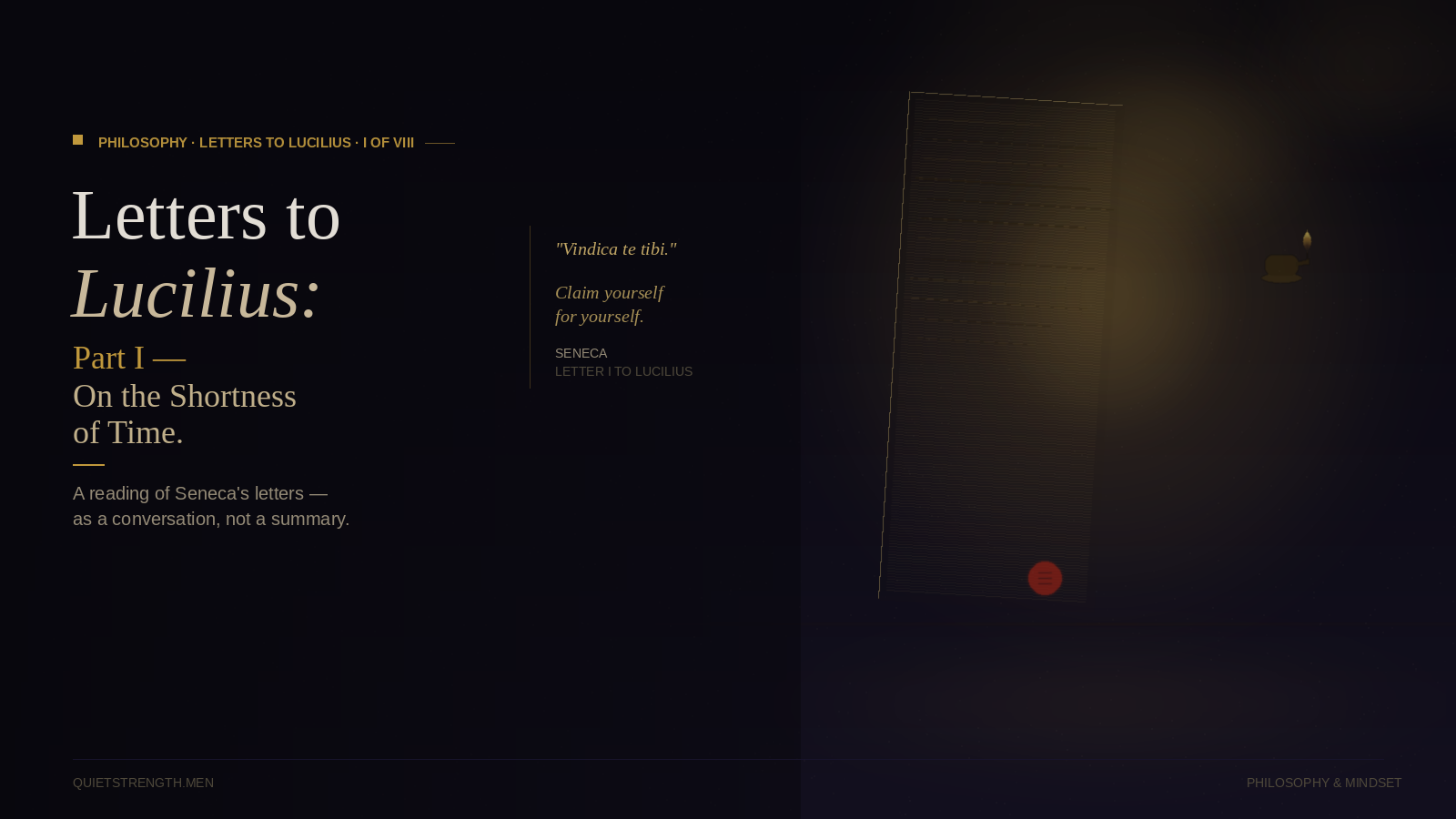
Letters to Lucilius · A reading of Seneca’s Epistulae Morales · Part I of VIII
Seneca wrote 124 letters to his friend Lucilius over the last years of his life. They are the most intimate philosophical document in the Latin tradition — a man in his sixties, under Nero’s court, writing to a friend about how to live before it was too late. This series reads them slowly. Not as a summary. As a conversation.
Letter I begins with a command.
Not advice. Not a suggestion. A command, issued to a friend, with the urgency of a man who has already wasted enough time thinking about wasting time.
“Ita fac, mi Lucili: vindica te tibi.”
Do it, my Lucilius. Claim yourself for yourself.
Four words in Latin. The shortest sentence in one of the longest philosophical correspondences ever written. And Seneca follows it immediately, before Lucilius can object or ask for clarification, with the one thing that makes the command make sense:
“Collige itaque et serva omne tempus quod adhuc auferebatur aut subripiebatur aut excidebat.”
Collect and save all the time which until now has been taken from you, or subtracted, or has simply fallen away.
He does not begin with a theory. He does not begin with a definition of virtue or a discussion of the Stoic cosmos. He begins with time — specifically, with the three ways it disappears without your permission.
The three thefts
Seneca’s taxonomy is precise and should be read carefully, because each category describes something different.
What is taken from you — auferebatur — is time stolen actively by others. The meeting that had no purpose. The obligation that was someone else’s priority, assigned to you by inertia or social pressure or the simple fact that you were available and couldn’t say no. This is time that disappears through external demand.
What is subtracted — subripiebatur — is time that slips away through distraction and small indulgence. Not the dramatic losses. The quiet ones. The twenty minutes that became an hour. The evening that dissolved into nothing you can account for. This is time you didn’t choose to spend but didn’t choose to protect either.
What falls away — excidebat — is time lost through inattention. The days that went by while you were thinking about the future or rehearsing the past. The conversations you were present for physically but absent from in every meaningful sense. This is the most insidious category, because it leaves no visible evidence. The time simply is not there when you look for it.
Three categories. Three different relationships to loss. And Seneca’s prescription addresses all three with the same word: collige. Collect.
Not change your life. Not meditate or purify or philosophize. Collect the time. Treat it the way a careful man treats money — not with anxiety, but with attention.
The arithmetic of distraction
De Brevitate Vitae — On the Shortness of Life — is the essay where Seneca makes his most extended argument about time, and it belongs alongside Letter I as the foundation of everything he will say to Lucilius across 124 letters. The argument is compressed into a single observation that has no wasted words:
“Ita est, Pauline carissime: omnes alienos esse, tempus tantum nostrum.”
So it is, dearest Paulinus: everything is foreign to us; time alone is ours.
Not money. Money can be borrowed, recovered, earned again. Not reputation, which fluctuates with the opinions of people who will also die. Not health, which is partly circumstances and partly luck. Time alone is ours — and it is ours only in the present, only now, and is being spent whether you choose how to spend it or not.
The most dangerous implication of this observation is its arithmetic.
Seneca was sixty-two when he began writing to Lucilius. He had been a senator, an exile, a playwright, a philosopher, a tutor to an emperor, a very rich man who wrote extensively about the dangers of wealth. By most accounts of a Roman life, he had done everything. He had accumulated everything that men of his class and education considered the marks of a successful existence.
And he wrote Letter I as if he were beginning. As if there were not a moment to lose.
This is not false modesty. It is the specific calculation of a man who had finally understood that the question was never how much time he had accumulated — he had accumulated sixty-two years — but how much of it he had actually been present for. How much of it had been genuinely his.
The answer, he seems to have concluded, was considerably less than the arithmetic suggested.
What Lucilius was actually being told
Lucilius was not a young man when Seneca wrote to him. He was a successful provincial administrator — a procurator in Sicily — with a career, obligations, and the apparatus of a Roman official life. He was not wasting time by most conventional definitions of the phrase.
Seneca is not telling him he is idle. He is telling him something more precise and more uncomfortable: that the conventional definition of not wasting time is wrong.
The man who is busy all day doing things he did not choose, for purposes he did not set, under pressures he did not examine — this man is wasting time as surely as the man who sleeps until noon. He is wasting it in a more socially acceptable way, which makes it harder to see, which makes it more dangerous.
“Dum differtur vita transcurrit.”
While we delay, life passes.
He is not describing procrastination. He is describing the specific habit of treating the present as a vestibule — the place you wait while your real life is being prepared elsewhere. The future where things will be better arranged. The career milestone after which you will finally have time. The retirement when everything you deferred will finally be addressed.
Seneca’s argument is not that the future is an illusion. It is that the present, consistently sacrificed to the future’s preparation, eventually becomes the totality of a life. And that life will have been spent in preparation for something that never quite arrived.
The misreading
There is a version of this argument that has been absorbed into contemporary productivity culture, and it is worth naming precisely because it is the opposite of what Seneca meant.
The productivity reading goes: your time is being wasted. Be more efficient. Eliminate distractions. Optimise your systems. Get more done.
This is not the argument. Getting more done is not the point. The man who optimises his schedule to do twice as many things he didn’t choose, for purposes he never examined, has not claimed himself for himself. He has merely increased his throughput of borrowed life.
What Seneca is asking Lucilius to do — what the four-word command at the beginning of Letter I actually means — is to look at how the hours are being spent and ask whose priorities they are serving. Not whose in the sense of who scheduled the meeting. Whose in the deeper sense: which version of yourself decided this was worth the portion of your life it costs.
The answer, for most people, most of the time, is that no version of themselves decided. The hours were allocated by default — by what was expected, what was convenient, what was already in motion. The life was being lived, and the living was happening to them rather than being chosen by them.
This is what Seneca means by the time that falls away. Not the hours you chose badly. The hours you never chose at all.
The first practice
Letter I ends with a practical instruction that is often missed because it sounds trivial.
“Recede in te ipse quantum potes.”
Retreat into yourself as much as you can.
He does not mean introversion or isolation. He means the daily practice of returning — briefly, deliberately, against the constant pressure of everything that wants your attention — to the question of what you are actually doing and why.
Not as a dramatic philosophical exercise. As a small, regular, almost unremarkable act of self-governance. The five minutes before the day begins when you choose rather than react. The moment at the end of an hour when you ask what just happened to it. The question — whose priority was that? — asked consistently enough that it becomes a habit rather than an interruption.
This is where Seneca begins, and where he will return, in different forms and different contexts, across the remaining 123 letters.
The time is passing. It will pass regardless.
The only question is who is deciding where it goes.
Letters to Lucilius — Part I of VIII. This series reads Seneca’s letters to his friend slowly and without summary — as a conversation between a man who has run out of time to be indirect, and a reader who hasn’t yet. Next: Part II — On True Friendship, and what Seneca actually meant when he said you should never tell a man you trust him before you trust him.