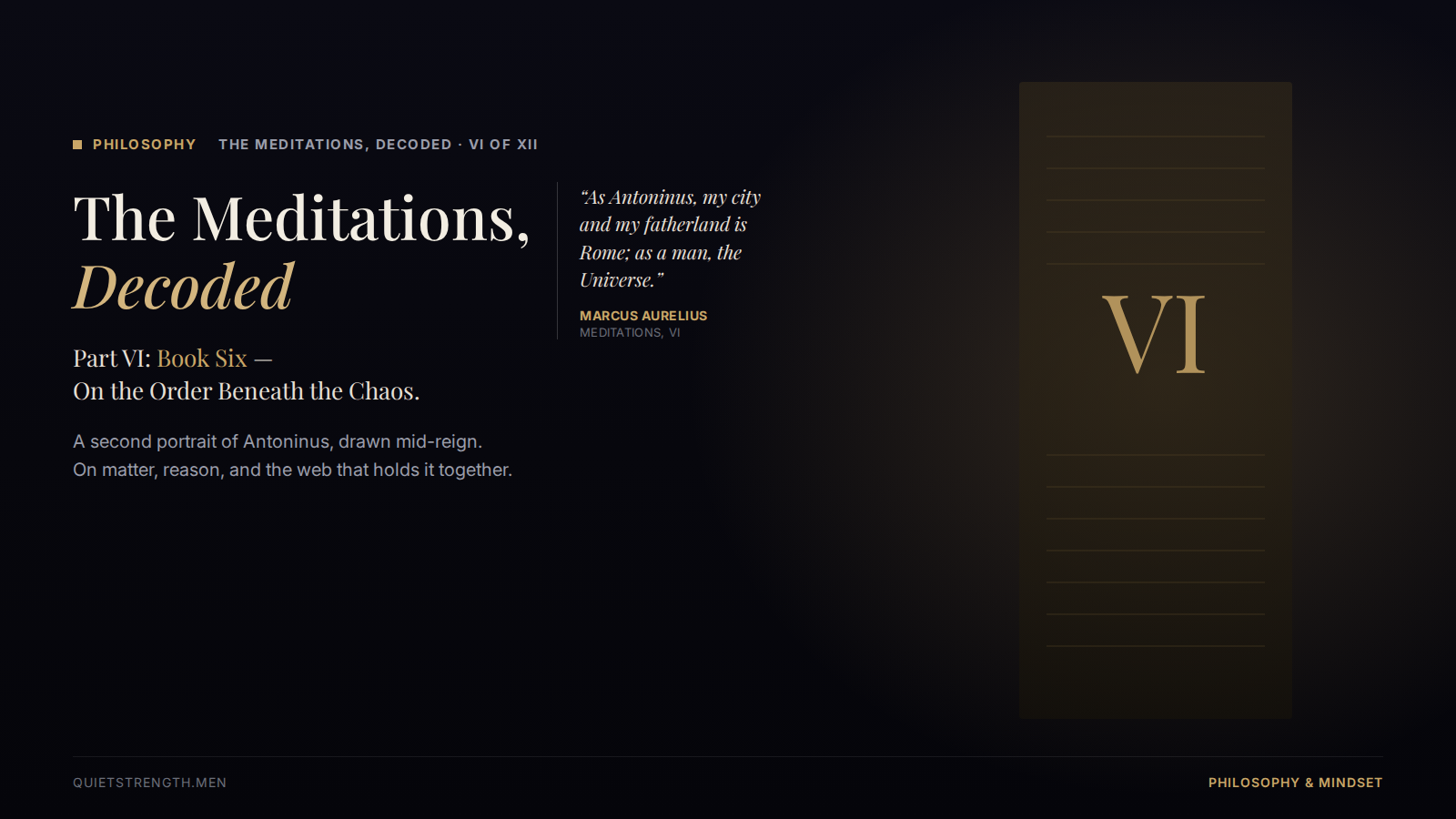
The Meditations, Decoded · A twelve-part reading of Marcus Aurelius · Part VI of XII
Book Five gave Marcus a reason to get up every morning: the work itself, done for its own sake, without needing an audience. Book Six asks the harder question underneath that one — what kind of universe would make that work worth doing at all? Whether the getting up matters, in other words, or whether it’s simply motion inside a machine that doesn’t care either way.
He opens with an answer he has clearly already settled on, stated as though it were self-evident, which for him it was.
The matter that obeys
“The matter of the Whole is docile and adaptable, and the Reason that controls it has in its own nature no ground to create evil, for it contains no evil; nor does it create anything amiss, nor is any injury done by it; and all things come into being and are accomplished according to it.”
This is the architecture the rest of Book Six is built on top of, and it is worth being precise about what it actually claims, because it is easy to hear it as wishful thinking dressed up in Greek metaphysics. Marcus is proposing a division: there is passive material — Matter — and there is the active principle that shapes it — Reason, or Logos, the governing intelligence the Stoics believed ran through the entire universe the way a sculptor’s intention runs through a block of marble. The material offers no resistance. The shaping principle has, in its own nature, nothing evil to impose. If both halves of that claim hold, the conclusion is not optional: what results from their combination cannot itself be malicious. Harsh, difficult, painful in the moment — all of that survives the argument intact. Malicious does not.
This is not a claim Marcus can fully verify, and he seems to know it. What it gives him instead is a working assumption sturdy enough to build a life on: that the universe he is currently governing, currently suffering in, currently trying to hold together, is not indifferent to him in the way a machine is indifferent to the gears grinding inside it. It has a shape. The shape is called Reason. And reason, by definition, does not aim at harm.
There is a specific kind of relief available in this framing, and it is worth naming precisely because it is not the relief of being told everything will be fine. Marcus does not promise Lucilius, or himself, an easy year. He promises something narrower and more durable: that whatever the year brings will not be an act of spite from a universe that has singled him out. Weather is not malicious toward the man it soaks. Winter is not malicious toward the crop it kills. The absence of malice does not soften the difficulty. It simply removes one particular kind of suffering — the suffering of believing yourself persecuted — from the pile of things a man has to carry on top of everything else already in it.
The second portrait of Antoninus
Deep in Book Six, without preamble, Marcus writes himself a warning:
“Take heed not to be transformed into a Caesar, not to be dipped in the purple dye; for it does happen. Keep yourself therefore, simple, good, pure, grave, unaffected, the friend of justice, religious, kind, affectionate, strong for your proper work. Wrestle to continue to be the man Philosophy wished to make you. Reverence the gods, save men. Life is brief; there is one harvest of earthly existence, a holy disposition and neighbourly acts.”
And then, in the same breath, he reaches for the same source he reached for in Book One — his adoptive father — and draws him again, from a different angle:
“In all things like a pupil of Antoninus; his energy on behalf of what was done in accord with reason, his equability everywhere, his serene expression, his sweetness, his disdain of glory, his ambition to grasp affairs.”
Readers of this series will recognise the name. Book One gave Antoninus its longest single entry — a young man’s catalogue of debts, written before Marcus had worn the purple himself. This is a second portrait, painted by an emperor who has now spent years actually doing the job Antoninus once modelled for him, and scholars who have studied the manuscript’s structure have long suspected this passage sits deliberately near the centre of the entire work, as though Marcus needed to return to the same well twice — once as an heir cataloguing what he’d been given, and once as a sitting emperor checking, years into the job, whether he was still spending it well. The first portrait was gratitude. This one reads like an audit.
The difference in tone between the two entries is itself instructive. Book One’s Antoninus is a man observed from the outside — his habits, his simplicity, his patience with petitioners, catalogued the way a student catalogues a teacher’s method. Book Six’s Antoninus is invoked as a standard to be measured against, mid-reign, by a man who has discovered exactly how much the purple dye wants to change him and is naming the specific virtues he is at risk of losing. Gratitude does not require ongoing vigilance. An audit does. That Marcus needed both, at different points in the same long document, says something about how character actually gets maintained — not secured once by good influences in youth, but re-examined, deliberately, against the same models, for as long as the temptation to drift remains live.
My city, my fatherland
Later in the same book, Marcus writes a single sentence that compresses an entire political philosophy into eight words:
“As Antoninus, my city and my fatherland is Rome; as a man, the Universe.”
The structure is doing real work. He does not choose between the two loyalties, Rome and everything beyond it. He nests them, according to which fact about himself is currently governing. As the specific man who inherited Antoninus’s name and office, his obligations are Roman, local, particular — the actual senate, the actual frontier, the actual grain supply. As a rational being, full stop, his citizenship extends to every other rational being alive, which was the Stoic doctrine of cosmopolitanism stated as plainly as it appears anywhere in the text. This is the same idea Book Three reached for when discussing the ungrateful and the arrogant — that a shared rational nature makes writing other people off structurally impossible — now given its most compressed, most quotable form.
A little clod of the universe
Marcus follows this with a piece of perspective that reads less like argument than like a man deliberately making himself smaller on purpose:
“Asia, Europe are corners of the universe: all the sea a drop in the universe: Athos a little clod of the universe: all the present time is a point in eternity.”
Athos was, to a Roman, an enormous physical fact — a mountain famous enough that Xerxes had once cut a canal through the land beside it rather than sail around it. Marcus reduces it to a clod. The sea that separated continents becomes a drop. The device is not despair at human insignificance. It is calibration — the same instrument Book Four used on the citadel and Book Five used on the bedclothes, now aimed at scale itself. A man who has just watched a mountain shrink to a clod of dirt is considerably less likely to treat his own wounded pride, later that same afternoon, as a matter of cosmic importance.
Spelling out the name
Book Six contains one more passage, quieter than the others, that shows the same principle applied to something almost comically small: irritation at being asked to do a tedious task correctly.
Marcus imagines someone asking him how to spell the name Antoninus — his own family name, by then — letter by letter. Would he raise his voice at each syllable, he asks himself, or lose his temper if the person grew impatient with him for going slowly? Of course not. He would simply enumerate the letters, in order, calmly, until the word was complete. His conclusion: every duty in life has exactly this shape — a fixed, finite sequence of components that must be gone through in order, without drama, regardless of whether the people around you make the process difficult. You do not shout your way through spelling a name. You do not need to shout your way through anything else either.
The web is holy
Book Six’s final major thread returns to the claim it opened with, now extended into something closer to a physics of relationship:
“Keep reminding yourself of the way things are connected, of their relatedness. All things are implicated in one another and in sympathy with each other. This event is the consequence of some other one. Things push and pull on each other, and breathe together, and are one.”
If the opening chapter established that Reason governs the material of the universe without malice, this passage insists that the governing was never abstract or distant. Every event is stitched to the ones beside it. Nothing arrives at you unconnected from everything else that has already happened. This is the same logos that shapes the marble in Book Six’s first line, now shown at work in the texture of a single ordinary day — your bad morning, the argument you’re having, the name you’re being asked to spell out letter by letter, all of it threaded into the same fabric, none of it evidence that the fabric has come apart.
What Book Six gives you
Book Five told Marcus to get up and do the work. Book Six tells him why the work was never happening inside an indifferent machine: because the material of the world is compliant, the principle shaping it contains no malice, and the two together weave something that can be trusted even when it is difficult to bear.
Antoninus appears twice in this reading for a reason. A young man can only inherit a model of character. An old one, still doing the job that model prepared him for, has to keep checking whether he is still living up to it — and Marcus, deep into a reign that had given him plague, war, and a frontier that would not stay quiet, went back to the same well rather than assume the earlier debt had already been paid in full. The universe, on his own account, would not begrudge him the audit. It was built, after all, without any capacity to begrudge him anything at all.
The Meditations, Decoded — Part VI of XII. Part I: Book One, Debts and Lessons. Part II: Book Two, Obligation and the Present Moment. Part III: Book Three, On Brevity and the Examined Life. Part IV: Book Four, The Inner Citadel. Part V: Book Five, On Getting Up Anyway. Next — Part VII: Book Seven, where Marcus turns from the order of the universe to the specific, harder discipline of living well among the people who make up the rest of it.