The way you start a day is a decision. Most men never make it.
There is a version of the morning that happens to you.
The alarm goes off and you silence it, or you don’t and it goes off again. You look at your phone before you look at anything else. You check what arrived in the night — messages, news, whatever the algorithm decided was important at 3am. You scroll for a few minutes that become ten. You get up eventually, move through a kitchen, produce coffee, perhaps eat something, and find yourself at a desk or in a car with no clear memory of how you got there.
This is not a morning. It is the absence of one.
Most men live this way not because they’ve decided to, but because they’ve never decided not to.
Why the morning matters more than you think
The Stoics had a practice they called the morning meditation — not meditation in the contemporary, cushion-and-app sense, but a deliberate preparation for the day. Epictetus described it. Marcus Aurelius practised it. Seneca wrote about it repeatedly in his letters to Lucilius.
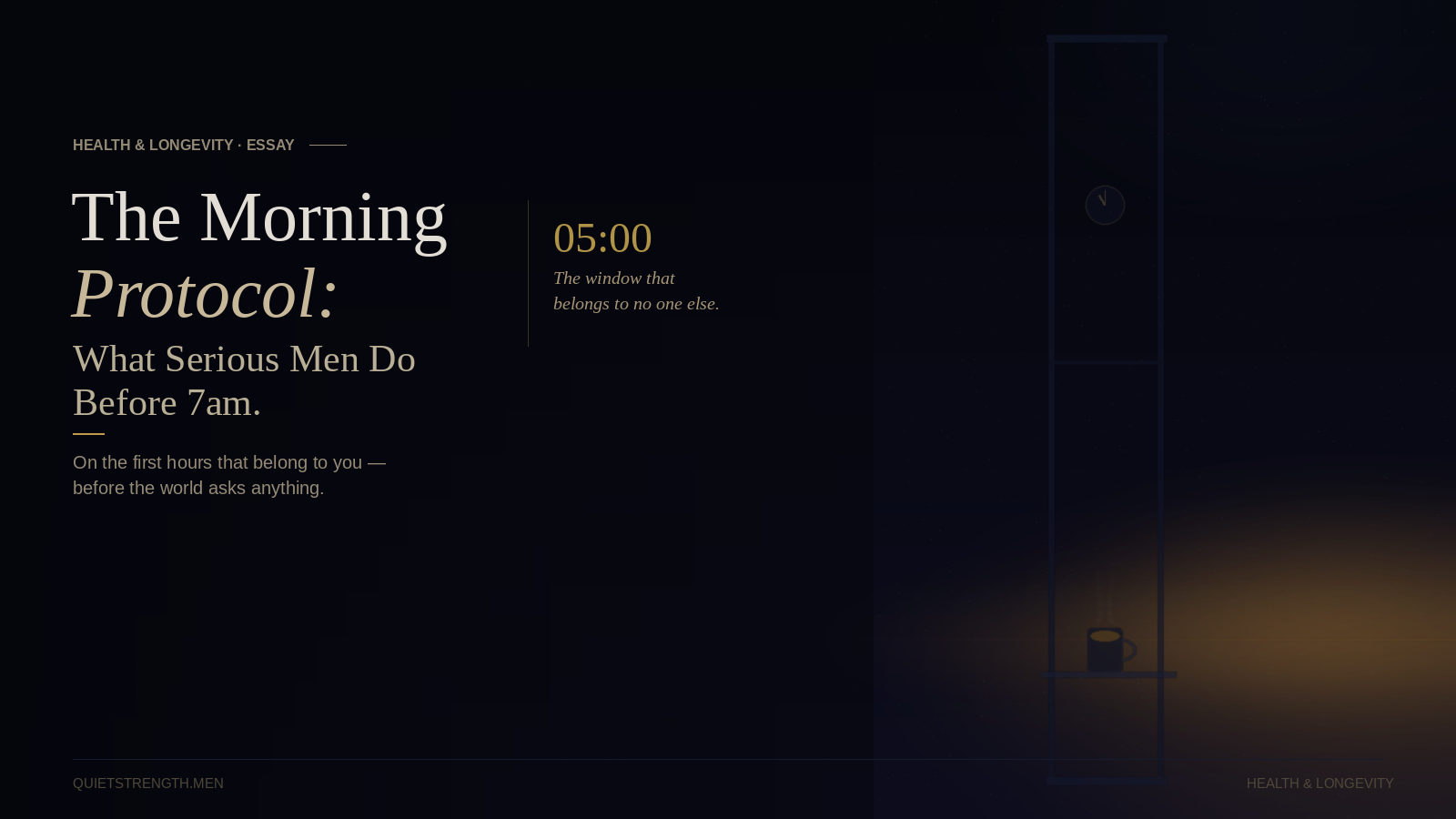
The argument was simple: the first hours of the day are the hours when the mind is least colonised by the world. Before the demands arrive, before the inbox fills, before other people’s urgencies become your urgencies — there is a window. What you do with that window determines, in large part, what kind of man shows up for the rest of the day.
This is not self-help philosophy. This is neuroscience with a two-thousand-year head start.
The prefrontal cortex — the part of the brain responsible for deliberate thought, long-term planning, and the ability to resist immediate impulse — is most active in the morning, after sleep, before the accumulated decisions and distractions of the day have depleted it. What neuroscientists call decision fatigue and what the Stoics called the dispersal of the ruling faculty is a real, measurable phenomenon: your cognitive resources are finite, and the first claim on them matters.
Spend them on what you choose, or spend them on what arrives.
What doesn’t work
Before the protocol: what serious men specifically don’t do before 7am.
They don’t check their phone first. This is not a productivity tip. It is a sovereignty issue. The moment you open a message or a news feed, you have handed the first claim on your attention to someone else — to whoever sent the message, to whatever algorithm curated the feed. You have started the day in reaction mode, and reaction mode is difficult to leave.
They don’t make consequential decisions before their body is fully awake. Cortisol, the hormone that primes the body for alertness, peaks roughly 30-45 minutes after waking. Before that peak, you are operating at reduced capacity. Important decisions made in this window are made with diminished resources. The Stoics would have said: prepare your mind before you deploy it.
They don’t eat immediately. This is contested, and individual biology varies. But there is solid evidence that a brief fasting window in the morning — even just delaying eating by 60-90 minutes — improves mental clarity and metabolic flexibility. More importantly: hunger is a mild stressor, and tolerating mild stressors deliberately is, in the Stoic framework, practice for tolerating larger ones.
The protocol
What follows is not a prescription. It is a structure — one that can be compressed or expanded depending on the time available, but which contains the essential elements that the evidence (ancient and modern) suggests matter.
The sequence takes approximately 90 minutes. It can be done in 60 if necessary. It cannot be meaningfully done in 20.
I. Stillness — 10 minutes
Before anything else: no phone, no news, no conversation. Coffee if you need it, but in silence. The single purpose of this window is to let the mind come fully online before you ask it to do anything.
Marcus Aurelius began every day, according to his own accounts in the Meditations, by reminding himself of what the day would contain. Not anxiously, not as a worry list — but factually. Today I will encounter difficult people. Today things will not go as I want. Today I will be tested. He was not preparing for catastrophe. He was removing the element of surprise from ordinary difficulty.
You can do this literally — sit with your coffee and think through what the day actually contains. Where the friction points are. Who you will need to deal with and how. What you want to be true about how you show up.
This is not journalling. It does not require a notebook. It requires only the willingness to be intentional for ten minutes before the world arrives.
II. Movement — 30 minutes
Non-negotiable. The research on this is overwhelming and not meaningfully contested: morning exercise improves cognitive function, emotional regulation, and resilience to stress for the following 8-12 hours.
The specific form matters less than the consistency and the intensity. Walking does not produce the same cognitive benefits as elevated-heart-rate exercise. Thirty minutes of something that makes you breathe harder than you’d like — running, lifting, swimming, cycling — produces a measurable and lasting neurological effect that no supplement, no coffee quantity, and no productivity system can replicate.
The Stoics practised physical discipline not because they were athletes but because they understood the relationship between the body and the mind’s capacity for virtue. Epictetus explicitly connected physical hardship with psychological resilience. The body that has been made uncomfortable this morning is better equipped to be patient, clear-headed and stable when the afternoon brings its difficulties.
III. Reading — 20 minutes
Not news. Not social media. Not anything connected to work.
A book. Philosophy, history, biography — something that operates at a different frequency than the fast-moving information environment you will spend the rest of your day inside. Twenty minutes of this is not about becoming learned, though that is a side effect. It is about spending time with thinking that has survived long enough to be worth surviving — thinking that has been tested by time rather than optimised for engagement.
Seneca’s prescription in Letter II to Lucilius is as good as anything written since:
Read a fixed author each day, he said. Do not wander from book to book seeking novelty. Find the man whose thinking challenges and clarifies your own, and spend time with him. Let the reading leave a mark.
Twenty minutes a day is 120 hours a year. That is a university semester of focused reading, accumulated in the margins of mornings.
IV. The single priority — 10 minutes
Before the day begins in earnest — before email, before meetings, before anything reactive — write down the one thing that matters most today.
Not a list. One thing.
This is harder than it sounds because most days contain many things that feel equally important, and the mind resists the discipline of choosing. But the discipline of choosing is precisely the point. A man who knows what matters most today will make better decisions throughout the day than a man who treats everything as equally urgent.
The Stoics called this prohairesis — the faculty of choice, of deliberate decision. It was, for them, the central human capacity — the one that distinguished the man who was in command of his life from the man who was merely subject to it.
One thing. Written down. Before the world asks anything of you.
V. The threshold — 10 minutes
Before you cross into the working day: five minutes of quiet and five minutes of something that reminds you who you are when you’re operating well.
This sounds vague, so I’ll be specific: some men read a paragraph they’ve found important. Some review what they wrote in the stillness section at the start. Some sit for five minutes without any input at all. The form is not important.
What is important is the recognition that there is a threshold between the morning, which belongs to you, and the day, which belongs to everything else. And that crossing it consciously — deliberately, with your full faculties engaged rather than in the reactive drift that passes for starting most days — is itself a form of preparation.
Epictetus, in the opening of the Enchiridion:
“Make the best use of what is in your power, and take the rest as it happens.”
The morning protocol is, in its entirety, the practice of making the best use of what is in your power before the rest begins happening.
On the excuse of time
The most common response to a morning protocol of this kind is: I don’t have time.
This is almost always untrue in the way that matters. What is usually true is: I haven’t yet decided that this is worth the time it requires, so I continue spending that time on things that feel easier or more immediately rewarding.
That is a legitimate position. But it is a choice, not a constraint.
If you genuinely cannot create 90 minutes in the morning — if children, work, caregiving make it impossible — then 60 minutes. Or 45. The sequence compresses: fifteen minutes of stillness and reading, twenty minutes of movement, ten minutes of the single priority. The shape holds even when the duration contracts.
What does not compress into ten minutes and remain meaningful is the intention behind it. You are not following a routine. You are practising the Stoic discipline of beginning the day with what you choose rather than what arrives. The time commitment is in service of that. If the time must be reduced, the intention must not be.
What changes
Not immediately, and not dramatically. This is not a conversion experience.
What changes, over weeks, is the quality of the person who shows up for the day. More patient, more deliberate, less reactive to things that don’t warrant reaction. More capable of distinguishing between what matters and what merely feels urgent. Better equipped to maintain the inner life the Stoics called the hegemonikon — the ruling faculty, the place from which you actually govern yourself — against the constant pressure of the world to govern it for you.
Marcus Aurelius woke every morning in an empire under pressure, surrounded by people who needed things from him, carrying responsibilities that would have broken most men. He still found time, every morning, to sit with his own thoughts before he gave himself to everything else.
He wrote it down so we would know it was possible.
The alarm goes off. You have a choice.
Health & Longevity — the second of five pillars. Next: Sleep as a Stoic Discipline — why the ancients understood something about rest that we have largely forgotten.