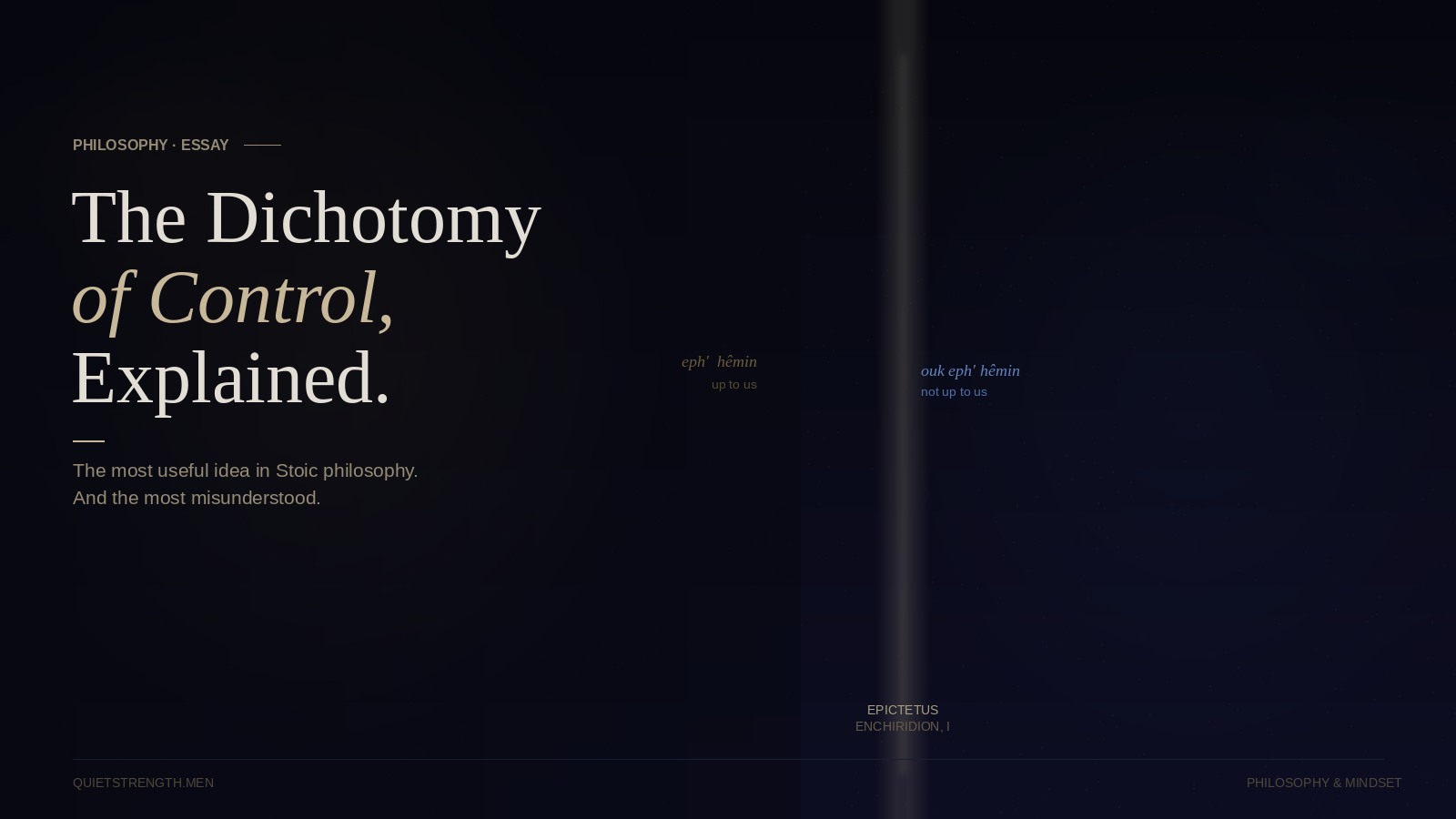
The most useful idea in Stoic philosophy. And the most misunderstood.
Epictetus was a slave.
This is not a biographical footnote. It is the entire context for everything he ever wrote.
He was born into slavery in Hierapolis — modern Turkey — sometime around 50 AD, and was brought to Rome as property. His owner, a freedman named Epaphroditus who worked in Nero’s court, apparently broke his leg deliberately at some point. Epictetus, according to the historian Celsus, warned him calmly that it would break. When it did, he said simply: “Did I not tell you that it would break?”
A man who owned nothing, controlled nothing, could be beaten or killed at the discretion of another person — this man developed what is probably the most powerful practical philosophy of self-governance ever articulated.
You would.
The idea
The dichotomy of control is stated at the very opening of Epictetus’s Enchiridion — the handbook, the manual, the book his student Arrian compiled from lecture notes and titled as a thing you would carry with you. A tool, not a treatise.
The opening lines:
“Some things are in our control and others not. Things in our control are opinion, pursuit, desire, aversion, and, in a word, whatever are our own actions. Things not in our control are body, reputation, command, and, in one word, whatever are not our own actions.”
That is the whole idea. Everything else in Stoic philosophy is either an elaboration or an application of this.
What belongs to you: your judgements. Your choices. Your responses. Your values. Your effort. These are, in a precise philosophical sense, your own — no external force can compel them without your participation.
What does not belong to you: everything else. Your body, which will age and fail regardless of your preferences. Your reputation, which is made in other people’s minds and subject to their psychology, not yours. The weather. The economy. Other people’s behaviour. The outcome of your work, as distinct from the quality of it.
The Stoics called the first category eph’ hêmin — up to us. The second, ouk eph’ hêmin — not up to us.
The practice of Stoicism, at its most basic, is the practice of learning to tell the difference.
Why this is harder than it sounds
The idea is simple. The practice is not.
The difficulty is that most of us have spent our entire lives emotionally invested in things that are not up to us, and intellectually confused about what is. We have been taught — by culture, by school, by family, by the entirety of commercial life — that the right response to the things outside our control is to try harder to control them.
Anxious about what people think of you? Work on your image. Afraid of failure? Work on your performance metrics. Worried about the future? Plan more, save more, insure more. The answer is always more control, more management, more influence over the external world.
This is not entirely wrong. There is a category of things that are genuinely influenced by our effort — the quality of our work, the maintenance of our health, the cultivation of our relationships. Effort matters here.
But there is a subtler error embedded in this approach that the Stoics identified and that most of us never examine: we are not just trying to influence the influenceable. We are trying to guarantee outcomes that cannot be guaranteed. And we are measuring our own adequacy by whether those outcomes arrive.
This is the source of most human suffering that is not caused by physical pain.
The two errors
Epictetus identified two symmetrical mistakes.
The first is caring about things outside your control as though they were inside it. Worrying about your reputation. Being distressed by other people’s behaviour. Grieving over circumstances you cannot change. Experiencing your health, or your financial security, or your children’s lives, as something that reflects on your fundamental worth as a person.
This is the error most people recognise — at least intellectually — as the Stoic problem. Don’t worry about things you can’t control. Yes. Understood. Extremely difficult in practice, but the principle is clear.
The second error is less obvious and, in my experience, more common among men who have thought about Stoicism a little but not enough: treating things that are inside your control as though they were outside it.
I had no choice. That is the formulation. I had no choice but to respond the way I did. I had no choice but to stay in a situation that was destroying me. I had no choice but to become the kind of person I have become.
Epictetus would have been unmoved by this. He was a slave. He literally had no choice about most of the material conditions of his life. And yet he wrote, from that position, about the absolute inviolability of his interior life — his judgements, his responses, his values — from external compulsion.
If a man in chains can maintain sovereignty over his inner life, the claim that circumstances forced your hand on something that was always a choice is difficult to sustain.
What it actually means to “not care”
Here is where the philosophy is most commonly misread, and where it causes real damage when misread.
The Stoic position is not that outcomes don’t matter. It is not that you should be indifferent to whether your work succeeds or fails, whether your relationships flourish or wither, whether your children are healthy or sick. That is not Stoicism. That is a parody of it.
Marcus Aurelius grieved his children. He lost most of them. He wrote about it. He was not unmoved.
What the Stoics argued is something more precise: that your peace of mind — your capacity to function, to think clearly, to act well — should not be held hostage to outcomes you cannot guarantee. That you can care deeply about something while refusing to make your sense of self contingent on whether it goes the way you want.
The technical term for this is preferred indifferents — things that are genuinely better to have than not to have (health, success, good relationships) but that are not, in the deepest sense, good or bad. They are external. What is good or bad is only what you do with them.
This distinction matters because it is the only one that actually works. The man who needs external outcomes to feel adequate will be constantly at the mercy of a world that does not reliably produce the outcomes he needs. The man who has genuinely internalised what is and isn’t his to determine — this man can pursue the same goals with the same intensity and considerably more equanimity.
Not because he cares less. Because he understands more precisely what he is responsible for.
The practice
What does this look like, actually?
It looks like the distinction Marcus Aurelius was constantly reminding himself of: between what he could and couldn’t answer for. He was responsible for the quality of his decisions. He was not responsible for whether events cooperated.
It looks like Epictetus’s advice on how to prepare for a difficult meeting, a difficult conversation, a difficult day: before you go in, remind yourself what is yours and what is not. Your conduct is yours. The outcome is not entirely yours. Do not confuse them.
It looks like this: you can want the promotion, work for it with full commitment, and simultaneously hold it loosely — knowing that the decision will be made by other people, based on factors you will never fully understand, and that your adequacy as a professional and as a person is not determined by whether they decide in your favour.
This is not resignation. It is what the Stoics called amor fati — love of fate — not as passivity, but as a posture toward the uncontrollable that doesn’t waste energy on resentment and doesn’t confuse equanimity with indifference.
You prepare thoroughly. You act fully. You hold the outcome loosely.
Why this philosophy came from a slave
It is worth sitting with the biographical fact for a moment longer.
Epictetus’s philosophy was not developed in comfort. It was developed by a man for whom the entire apparatus of control — ownership of his time, his body, his movement, his future — had been removed. What remained was what he was actually responsible for.
This is not incidental to the philosophy. It is the philosophy.
When everything external is stripped away, what you are left with is precisely what Epictetus described: opinion, choice, desire, aversion. The interior life. The only thing that was ever genuinely yours.
Most of us live with the luxury of being able to confuse what we have with what we are. A man with money, status, health, a good reputation, good relationships — this man can sustain the illusion that these things are him for a very long time. Sometimes until something takes them away.
Epictetus had no such luxury. He could not confuse his circumstances with his identity because his circumstances were appalling. What he found, underneath all of that, was something that could not be taken. And he spent the rest of his life — after his eventual freedom — trying to teach other people to find it without first having to lose everything.
The one sentence
If you could extract the entire practical teaching of Epictetus into a single instruction, it would be this:
Before you react to anything — before you feel distressed, before you feel resentment, before you feel defeated — pause, and ask one question.
Is this up to me?
If it is: address it. You are responsible. Act.
If it is not: you are not responsible for it. You can have preferences about it. You can work to influence it. But your peace of mind is not contingent on it, and neither is your worth as a person.
That is the whole practice. A lifetime of application, in one question.
Epictetus appears throughout this journal — he will return. Next in the Philosophy series: what Seneca wrote to Lucilius about the one thing that shortens every life, and why he was right.