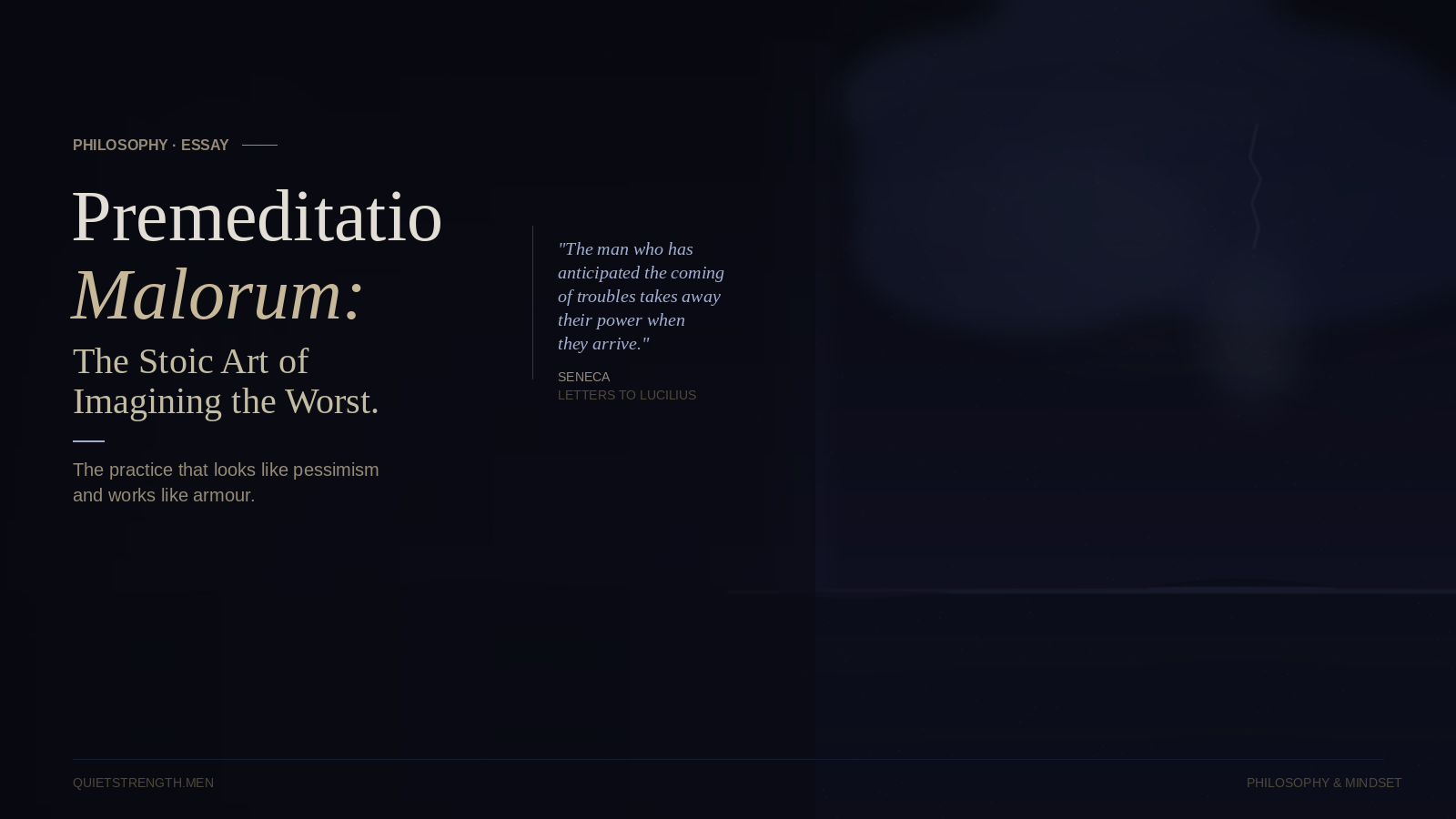
The practice that looks like pessimism and works like armour.
Seneca wrote a letter to Lucilius that begins with a piece of advice so counterintuitive that most people read it twice to make sure they understood correctly.
“Let us prepare our minds as if we had come to the very end of life. Let us postpone nothing. Let us balance life’s books each day.”
He was not writing from despair. He was writing from a position of considerable comfort — Nero’s court, substantial wealth, a private villa near Naples where he cultivated oysters and wrote philosophy. He was writing as a man who had everything, telling his friend that the most important mental practice available to them both was to regularly, deliberately, and specifically imagine losing it.
Not as a warning. Not as anxiety. As a discipline.
The Stoics called it premeditatio malorum — the premeditation of evils. The deliberate anticipation of loss, difficulty, and failure. The practice of sitting down, in the morning or the evening, in the comfort of your ordinary life, and thinking carefully about what could go wrong.
It sounds like the last thing a sane person would recommend. It turns out to be one of the most useful things a person can do.
What it is not
Before the practice, the misreadings.
Premeditatio malorum is not pessimism. The pessimist believes bad things will happen and concludes the effort is not worth making. The Stoic practises imagining bad things in order to make effort more considered and equanimity more accessible. The direction of the conclusion is completely different.
It is not anxiety. Anxiety is the uncontrolled, repetitive, intrusive dwelling on possible negative outcomes without the capacity to move through them. Premeditatio malorum is the controlled, deliberate, contained consideration of specific possible negative outcomes with the explicit purpose of processing them in advance. The key word is deliberate. Anxiety happens to you. This is something you do.
It is not morbidity. Marcus Aurelius wrote about death in the Meditations with a frequency that makes modern readers uncomfortable — but he wrote about it in the same tone in which an engineer writes about structural failure. Not with fascination, not with horror, but with the clear-eyed attention of someone who wants to understand what could go wrong so that what goes right is more deliberate.
What premeditatio malorum actually is, is this: a rehearsal. The mind encountering difficulty in controlled conditions, before the difficulty arrives in uncontrolled ones.
The argument from neuroscience
The Stoics were working from philosophy and observation. Contemporary neuroscience has given the same practice a biological foundation.
The brain’s threat response — the amygdala’s activation, the cortisol spike, the fight-or-flight cascade — is calibrated by surprise as much as by severity. Unexpected negative events produce larger threat responses than expected ones of equal magnitude. This is not a flaw in the system. It is the system doing its job — unexpected threats require maximal response because there has been no opportunity to assess and plan.
What premeditatio malorum does, neurologically, is reduce the surprise component of future difficulties. When the mind has already encountered a scenario — even in imagination, even without the full emotional weight of reality — the threat response to that scenario is modulated. The amygdala has, in a sense, already seen it. The response is calibrated rather than maximal.
This is why soldiers in high-stress training perform better under fire than untrained civilians of equivalent intelligence and physical capability. Not because they are braver, but because the scenarios they encounter in combat are partially familiar — they have been rehearsed, in controlled conditions, until the response is a managed one rather than a raw one.
Premeditatio malorum is this training for the situations that do not have a formal training programme.
What Seneca practised
Seneca was specific about his practice in a way that many Stoic writers were not. He describes, in various letters to Lucilius, a range of premeditations he considered regularly.
He imagined poverty. Not abstractly, but specifically — What would I actually do if I lost my wealth tomorrow? Where would I live? What would I eat? What would remain of my life? He reports that this exercise produced, over time, a genuine reduction in his anxiety about wealth. Not because he no longer valued comfort, but because he had already thought through the scenario clearly enough that it no longer held the power of the unexamined.
He imagined exile. He had, in fact, experienced exile — eight years in Corsica, at the order of Claudius. And he wrote that even before his exile, the premeditation of it had partly prepared him. The experience was still terrible. It was less terrible than it would have been.
He imagined the death of those he loved. This is the most difficult premeditation, and the one most people resist. He recommended it not to diminish love but to protect it — the man who has genuinely contemplated losing someone he loves is capable of a quality of attention in their presence that the man who takes presence for granted cannot achieve.
“Omnia aliena sunt, tempus tantum nostrum.”
Everything is foreign to us. Time alone is ours. He wrote this partly as philosophy and partly as the result of a practice that had made the impermanence of everything viscerally clear.
The practical form
The practice has a specific structure, and the structure matters.
It is not open-ended worry. Open-ended worry is the mind circling a threat without resolution. Premeditatio malorum moves through a scenario to its conclusion. The question is not what if this goes wrong but if this goes wrong, what then?
The practical form:
Name the feared outcome specifically. Not “things could go badly at work” — that is anxiety-territory, too vague to process. “I could lose this job. I could lose this relationship. I could fail at this project I have invested two years in.”
Imagine it happening. Not catastrophically, not dramatically — just clearly. You have lost the job. What does the first day look like? The first week? Who do you tell? What are the actual, practical consequences?
Work through the response. What would you actually do? Not what you fear you might do — what would you, knowing yourself as you do, actually do? Most men, when they walk through this honestly, discover that the response is more competent than the fear suggested. The fear imagines helplessness. The walk-through usually reveals resourcefulness.
Return to the present. The premeditation is complete. The feared outcome has been examined, the response has been considered, and you are still here, in the present, where none of it has happened yet.
Marcus Aurelius wrote a version of this every morning. What difficulties will today bring? What virtue will they require? He was not steeling himself through gritted teeth. He was reducing the surprise load of the day before it arrived.
The asymmetry of benefit
Here is the argument that Seneca makes most explicitly, and that is most useful to hold onto.
If the bad thing happens, and you have premeditated it, you are better prepared to meet it. The premeditation has value.
If the bad thing does not happen — which is the more common outcome — and you have premeditated it, you have lost nothing. The time spent is real time, but the benefit of equanimity in the present is also real. And there is an additional benefit: the recognition, each morning, of what you have not lost yet.
“The man who has anticipated the coming of troubles takes away their power when they arrive.”
Seneca wrote this. But the corollary — the one he implies more than states — is that the man who has anticipated troubles and then not encountered them walks through the day in possession of what he might have lost. Not taking it for granted. Genuinely in possession of it.
This is amor fati by another route. The premeditation of loss produces the genuine appreciation of what has not yet been lost. Not as performance, not as gratitude journalling — as the direct consequence of having actually thought, this morning, about what you could be without.
On the death premeditation
I want to address this one separately because it is both the most powerful and the most resisted.
Memento mori — remember you will die — is the first step. Premeditatio mortis — the specific, detailed contemplation of your own death — is the second.
Most people find this morbid. Seneca found it clarifying. Marcus found it necessary — the Meditations are saturated with it. Epictetus taught it to his students as a foundational practice. The consistency across multiple Stoic thinkers over several centuries suggests something more than personality preference.
What the death premeditation produces — when it is done properly, which means not as a flash of existential dread but as a deliberate, patient, honest examination — is a specific kind of simplification.
When you have genuinely sat with the fact of your death — not theoretically, but specifically, as a real event that will occur at some unknown point and that will end everything you experience — the things that feel urgently important in ordinary consciousness begin to sort themselves. The things that were never actually important become visible as such. The things that are genuinely important become clearer.
This is not a mystical experience. It is the cognitive consequence of correct perspective-taking.
The man who has genuinely premeditated his own death is difficult to panic. The man who has not is at the mercy of every perceived threat to his ego, his status, his comfort — because he has never examined what he is actually afraid of losing.
The practice, in brief
Every morning, before the day begins: name one thing that could go wrong today. Walk through it. Consider your response. Return to the present.
Once a week, something larger: the relationship, the career, the health, the life. Not dramatically. Specifically. What would it look like? What would you do?
Not as punishment. Not as rehearsal for catastrophe. As the practice of a man who wants to move through his life with his eyes open — who has seen the worst that reason can imagine and decided to live fully anyway.
That is all premeditatio malorum ever was.
A man, in the morning, looking clearly at what could be lost, so that what remains is truly held.
Philosophy — the first of five pillars. Previously: The Dichotomy of Control · Memento Mori · Amor Fati. Next: The Obstacle Is the Offering — on what Marcus Aurelius actually meant by the obstacle being the way.