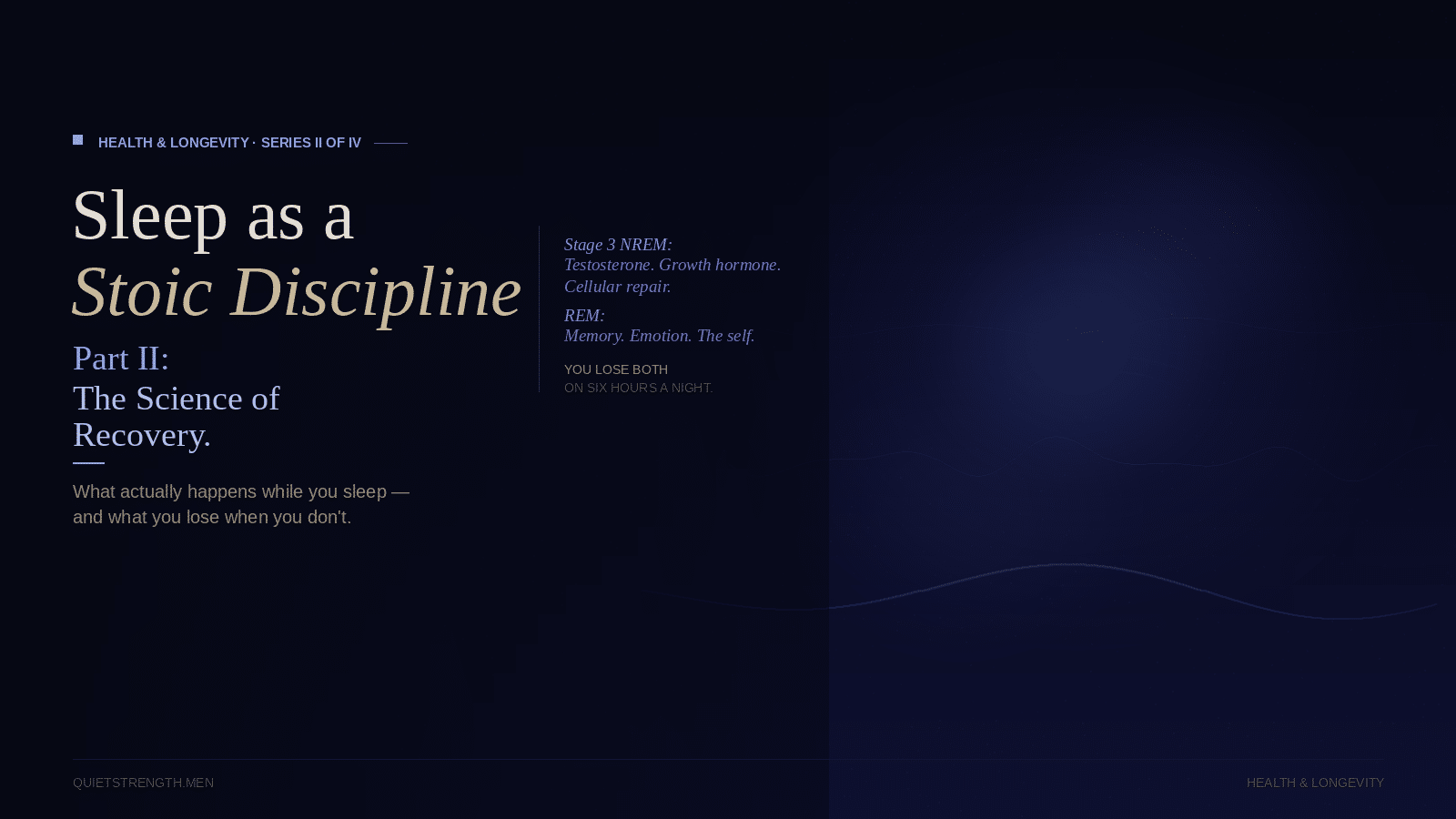
What actually happens while you sleep — and what you permanently lose when you don’t.
Sleep as a Stoic Discipline · Part II of IV
In Part I we made the philosophical argument: that sleep is not weakness, that the ancients understood its necessity, that the modern glorification of exhaustion is a form of self-destruction dressed as virtue.
Here we make the scientific one.
Because the philosophy alone is insufficient. Men who have been told their whole lives that sleep is for the weak do not change that belief because Seneca had opinions about rest. They change it when they understand, precisely, what is happening inside their body and brain during the hours they are unconscious — and what is being permanently destroyed when those hours are cut short.
What follows is not a list of sleep tips. It is an account of a biological system so complex and so consequential that neuroscientists spent most of the twentieth century assuming it was largely passive — the brain simply turning off, the body resting — before discovering, in the last thirty years, that almost exactly the opposite is true.
Sleep is not the absence of waking. It is a different kind of work. And it is work that cannot be done any other way.
The architecture of a night
Sleep is not a single state. It is a sequence of distinct stages, cycling approximately every ninety minutes throughout the night, each with specific biological functions that cannot be substituted or rescheduled.
The two primary stages are Non-REM (NREM) sleep and REM sleep. Within NREM there are three sub-stages, deepening progressively. The complete sequence — light NREM, deep NREM, REM — constitutes one sleep cycle. A full night contains four to six of these cycles, and this is critical: the composition of the cycles changes across the night.
The first half of the night is dominated by deep NREM sleep — the slow, powerful brainwave activity that accompanies physical restoration. The second half is dominated by REM sleep — the stage associated with dreaming, emotional processing, and cognitive integration.
This means that cutting sleep short by even ninety minutes — sleeping six hours instead of seven and a half — disproportionately eliminates REM sleep, because REM is concentrated in the second half of the night. You do not lose ninety minutes of evenly distributed sleep. You lose most of the night’s REM.
This is not a minor inconvenience. What REM sleep does is irreplaceable.
What NREM does
Deep NREM sleep — stage three, slow-wave sleep — is when the body does its most intensive physical repair.
Human growth hormone is secreted almost exclusively during this stage. Not the synthetic version sold in supplement stacks, not the hormone that bodybuilders pay for — the naturally produced version that drives tissue repair, muscle synthesis, immune function, and metabolic regulation. If you are training seriously and sleeping poorly, you are working against yourself in a way that no training volume can compensate for.
The glymphatic system — the brain’s waste clearance network, discovered by researchers at the University of Rochester in 2013 — operates primarily during deep NREM sleep. The glymphatic system uses cerebrospinal fluid to flush metabolic waste products from the brain, including amyloid beta and tau proteins, the accumulation of which is directly associated with Alzheimer’s disease and other neurodegenerative conditions.
This is not speculative. The research is consistent, replicated, and alarming: chronic sleep deprivation accelerates the accumulation of the precise proteins that destroy the brain over time. You are not just tired. You are doing structural damage.
Immune function consolidates during deep NREM. Natural killer cell activity — the immune system’s primary weapon against cancer cells and viral infection — drops by approximately 70% after one night of four to five hours of sleep. This single statistic is, when properly absorbed, more persuasive than almost any other argument for sleep.
What REM does
REM sleep is where the brain processes emotional experience, consolidates long-term memory, and integrates new information with existing knowledge.
During REM, the brain replays experiences from the day — not as passive playback but as active processing. The hippocampus, which holds short-term memories, transfers information to the neocortex for long-term storage. Skills practised during the day are encoded. Insights that require connecting disparate pieces of information — the kind of thinking that produces creative solutions and strategic clarity — emerge from this stage.
Thomas Edison famously napped with steel balls in his hands. When he drifted into sleep and the balls dropped, he would wake and immediately write down whatever he had been thinking. He was harvesting the hypnagogic state — the transition into REM — precisely because he knew that was where novel connections formed. He called it the genius gap. Neuroscience has since confirmed what he intuited.
Matthew Walker, whose research on sleep at UC Berkeley represents the most comprehensive contemporary scientific account of sleep function, describes REM sleep as providing “overnight therapy” — a process by which emotional memories are replayed in a neurochemical environment stripped of the stress hormones present during waking experience. The emotion of the memory is processed and filed; the physiological charge associated with it diminishes.
Men who sleep poorly do not just feel more irritable. They are carrying unprocessed emotional content from the previous days, weeks, months — the load accumulating because the nightly processing system is being chronically shortchanged.
The testosterone problem
This deserves its own section because it is the one that most directly contradicts the masculine mythology around sleep deprivation.
Testosterone is produced during sleep. Specifically, it peaks during the REM stages of the early morning hours — the sleep that is cut when you set an alarm earlier than your body would naturally wake.
A study published in the Journal of the American Medical Association found that healthy young men who slept five hours per night for one week showed testosterone levels equivalent to men ten years older. Not slightly reduced. Ten years of age-related testosterone decline, produced in one week.
The Stoics understood that the body was an instrument. Epictetus, writing from the position of a man who had every reason to neglect his body, still maintained that the instrument required maintenance. Not indulgence — maintenance. The distinction is everything.
Deliberately destroying your testosterone production through sleep restriction and then attempting to compensate with training, supplements, or force of will is not Stoic discipline. It is self-sabotage with philosophical branding.
The compounding debt problem
Here is what the research shows about the relationship between sleep deprivation and subjective experience of impairment, and it should unsettle anyone who believes they have adapted to short sleep.
When people are sleep-restricted to six hours per night for two weeks, their cognitive performance declines to the level of someone who has been awake for twenty-four hours straight. But their subjective sense of how impaired they feel levels off after a few days. They stop feeling tired. They report feeling fine.
They are not fine. The objective cognitive tests tell a different story. Reaction time, decision quality, working memory, impulse control — all significantly degraded. But the subjective experience of sleepiness adapts, while the actual impairment does not.
This is the danger. The man who sleeps six hours and feels fine has lost the ability to accurately assess how impaired he is. He is, in the Stoic sense, operating with a degraded hegemonikon — and crucially, the degraded hegemonikon cannot perceive its own degradation.
You cannot trust your own assessment of how tired you are. The instrument you would use to make that assessment is the instrument that’s broken.
Can you catch up?
The short answer, based on current research: partially, but not fully, and not on the timeline most men assume.
Weekend recovery sleep — the pattern of sleeping five or six hours on weekdays and then sleeping nine or ten hours on weekends — does not restore the cognitive and physiological deficits accumulated during the week. Reaction time returns to baseline relatively quickly. But the metabolic effects, the testosterone suppression, the immune degradation, the emotional processing deficit — these take considerably longer, and the research suggests that some cumulative damage from chronic restriction may not be fully reversible.
The Stoic concept of melete — the discipline of preparation, of maintaining the conditions for virtue rather than constantly recovering from their absence — applies here precisely. The man who protects his sleep does not need recovery weekends. He is not constantly digging out of a hole he keeps falling back into.
Prevention and maintenance, not remediation. This is the Stoic position on almost everything. Sleep is no exception.
What this means in practice
Not yet the protocol — that is Part III. But three things worth establishing now, based purely on what the science shows.
First: the target is seven to nine hours of uninterrupted sleep, positioned consistently — same bedtime, same wake time. Consistency of timing is almost as important as duration, because the circadian system that governs sleep architecture is a timing mechanism, and disruption of timing degrades sleep quality even when total hours are maintained.
Second: the hour before sleep matters more than most people believe. The brain does not switch off instantly. The transition from waking to sleep requires a specific neurological handover — melatonin rising, core body temperature falling, cortisol dropping — and anything that interferes with this transition (bright light, stimulants, emotional activation from news or confrontational content) delays the process and compresses the sleep architecture that follows.
Third: alcohol is not a sleep aid. It is a sedative that fragments sleep architecture, suppresses REM dramatically, and produces a withdrawal rebound in the second half of the night that results in lighter, more disrupted sleep overall. The man who drinks to fall asleep is not sleeping better. He is sedated earlier and sleeping worse throughout.
The Stoic frame, restated
The Stoics cared about sleep because they cared about the hegemonikon — the ruling faculty, the capacity for reason and judgement that they considered the seat of all virtue. Everything they recommended — diet, exercise, philosophy, the morning routine — was in service of maintaining and sharpening that capacity.
Sleep is not a competing priority. It is the foundational maintenance without which every other discipline degrades.
The man who trains but does not sleep is building on a collapsing foundation. The man who meditates but does not sleep is attempting philosophy with a broken instrument. The man who tries to be patient, clear-headed, and deliberate while chronically sleep-deprived is fighting his own biology and losing, and calling the struggle discipline.
It is not discipline. It is waste.
Sleep is the preparation. Everything else is what you do with it.
Sleep as a Stoic Discipline — Part II of IV. Part I: Why the Ancients Slept Better. Next — Part III: A 14-Day Protocol for rebuilding sleep quality from the ground up.