There is a version of this story you already know. The emperor, the philosopher, the stoic. The marble bust. The quotes on Instagram.
Forget all of that. This is the other version.
Somewhere around the year 170 AD, the most powerful man in the world sat down in his tent on the Danube frontier and wrote a reminder to himself.
Not to posterity. Not to his court. To himself, in the second person, the way you talk to a man who is slipping.
“Begin the morning by saying to thyself, I shall meet with the busy-body, the ungrateful, arrogant, deceitful, envious, unsocial.”
He was fifty years old. He had been emperor for nine years. He was far from Rome, fighting a war he hadn’t started and didn’t particularly want to win — he wanted it to end. His co-emperor and adoptive brother had just died, possibly poisoned, probably not by him but in a world where that needed to be said. His wife was with him on campaign. His children — of the fourteen he would have, most were already dead.
And every morning, he woke up and wrote himself a reminder of what kind of day was coming, so that it couldn’t surprise him.
This is not the Marcus Aurelius of the quotes. This is a man doing the actual work.
What the Meditations actually are
Most people encounter Marcus through excerpts. A line about obstacles. A line about the present moment. A line about anger. Each one distilled to something you could fit on a coffee mug, and each one, stripped of context, meaning something subtly different — and weaker — than what he intended.
The Meditations were not written to be read. They were written to be practiced. A private journal, never meant for publication, in which the emperor of Rome rehearsed his own philosophy the way an athlete rehearses a movement — not because he had mastered it, but because mastery requires constant repetition and he knew he hadn’t.
This is the detail that changes everything about how you read the book.
Marcus Aurelius was not a man who had figured it out. He was a man who had to keep refiguring it out, every morning, against the considerable force of his own bad instincts — impatience, vanity, the temptation to use power badly, the exhaustion that comes from governing an empire while trying to also be a decent human being.
He failed regularly. The Meditations are, in part, a record of those failures — not confessions, exactly, but the kind of notes a man leaves himself when he knows what he should be doing and cannot always manage it.
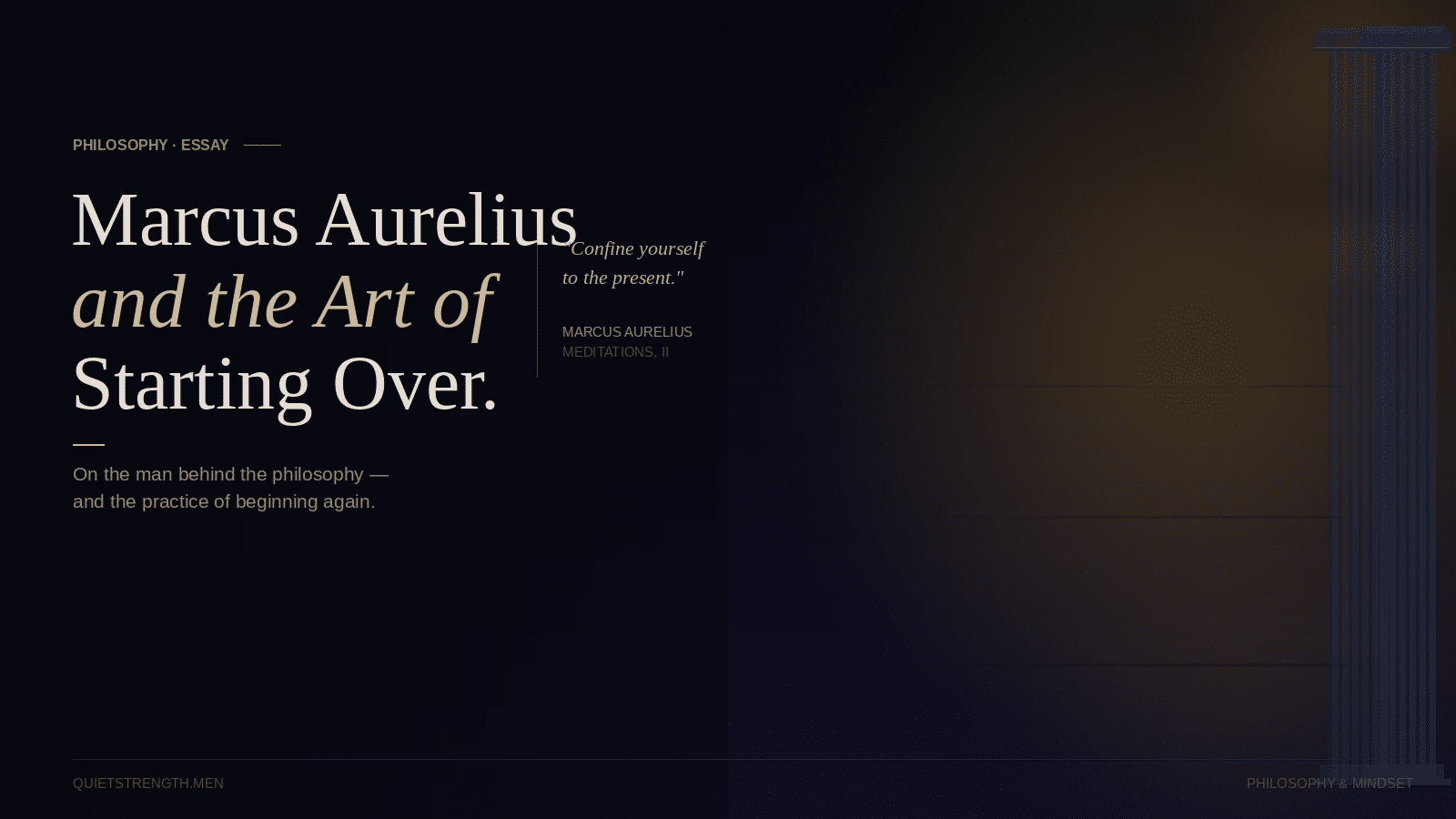
“Confine yourself to the present.” He wrote this more than once. You don’t write the same reminder to yourself twice if you’ve already learned it.
On starting over
There is a specific kind of man this journal is written for. He is not failing in any way that the world would recognise. He is doing the work. He is showing up. He is, by every external measure, a reasonable success.
And yet.
There is something — a quietness in him that has gone somewhere else, a sense that the version of himself he is currently running is not quite the version he intended. Not a crisis. Not a breakdown. Something more like drift. The slow, barely perceptible movement away from who you meant to be.
Marcus Aurelius knew this feeling. Intimately.
Book Two of the Meditations begins with a line that has struck me differently every time I’ve returned to it at different ages:
“Thou hast seen those things; look also at these. Do not disturb thyself by thinking of the whole of thy life. Let not thy thoughts at once embrace all the various troubles which thou mayest expect to befall thee. As occasion arises, so deal with them now, but ask thyself, ‘What is there in that that is intolerable and past bearing?'”
This is not a man who has transcended difficulty. This is a man talking himself off a ledge on a Tuesday morning, in a tent, in a foreign country, with a war outside and an empire to govern and a grief he is not allowed to show.
The thing he is describing — the practice of returning, again, to the present moment, again, after again losing it — is not a one-time event. It is a daily discipline. It is the art of starting over.
Not starting over in the dramatic sense. Not quitting your life and moving to Portugal. Starting over in the sense of: it is morning, I am not who I want to be yet, and today I will try again.
The emperor who kept forgetting
One of the more remarkable things about the Meditations, if you read them in full rather than in excerpt, is how repetitive they are. The same ideas recur, phrased slightly differently, across all twelve books.
Control what you can control. Book after book after book.
Treat people well even when they don’t deserve it. Again and again.
The present moment is all you have. Dozens of variations.
A lesser reader might think this is sloppiness — a disorganised mind returning to the same well. A more honest reader recognises it as something else: evidence that these ideas are genuinely difficult to hold onto.
You don’t write “control what you can control” forty times because you’ve mastered it. You write it because your mind keeps releasing it, keeps getting pulled back toward anxiety about things outside your influence, and you have to retrieve it again. Every time. With patience, not despair.
This is what the Stoics called askesis — practice, exercise, the deliberate repetition of mental habits until they become less effortful. It’s not meditation in the modern, app-assisted sense. It’s more like training. Repetition against resistance, in the knowledge that the resistance never fully disappears.
Marcus understood this at a level that most people who quote him don’t. The Meditations are not the output of a man who has achieved philosophical calm. They are the training log of a man who is still fighting for it.
What “starting over” actually looks like
Here is what I think Marcus was describing, without using these words:
Every day is a new attempt. Every morning is another chance to be more like the man you intend to be and less like the man your habits have made you. The distance between those two versions of yourself doesn’t close permanently. It closes temporarily, on good days, and opens again.
This is not a failure of character. This is the structure of the thing.
The mistake most men make — and I include myself in this, without reservation — is treating personal change as a destination. You read the book, you change the habit, you do the work, and eventually you arrive somewhere. The difficult version of yourself is left behind. The better version takes over.
This is not what happens. What happens is more like weather. Some days clear, some overcast, some genuinely dark. The question is not how to make all the days clear. The question is what you do on the overcast ones.
Marcus’s answer — and he wrote it down repeatedly, because he kept needing to — was this: you start again. Without drama. Without punishing yourself for having drifted. You note where you are, and you begin again from there.
“At dawn, when you have trouble getting out of bed, tell yourself: I have to go to work — as a human being.”
He wrote that to himself. The emperor. On a morning when getting up was hard.
The private man
I want to say something about the privacy of the Meditations, because it matters to what they are.
These were not written for an audience. Marcus had every resource in the Roman world available to create a monument to his philosophy — he could have commissioned a treatise, dictated his ideas to scholars, built a school in his name. He did none of this.
Instead he wrote, in a private journal in Greek (not Latin — the language of intimacy and philosophy, not of Roman administration), something he never intended anyone to read.
This changes the credibility of the text entirely. When a man writes for an audience, he performs. When he writes for himself, alone, in the tent at the end of the day, he tells the truth.
The truth Marcus told was that he was not naturally patient, not naturally calm, not naturally given to the equanimity the Stoics recommended. He had to work for it. Every day. Often he lost. Sometimes he won. He never stopped trying.
This, more than any single idea in the book, is what I find most useful about Marcus Aurelius.
Not the philosophy, though the philosophy is good.
The man.
The man who kept losing the thing he was trying to learn, and kept trying to learn it anyway, and wrote it down in the dark so he wouldn’t forget to try again in the morning.
The start of a beginning
There is a particular version of starting over that I think about often. It is not dramatic. It involves no external change. It happens between the moment you wake up and the moment you speak your first word of the day.
In that interval, you have a choice. You can carry yesterday forward — its failures, its accumulations, its version of who you are — or you can set it down. Not forget it. Not pretend it didn’t happen. Simply decide that today is, in whatever small way matters, a new beginning.
Marcus Aurelius did this every morning. An emperor, with the weight of a civilisation on him, chose every day to begin again.
He failed at it constantly. He succeeded at it constantly. Both things are true, and neither cancels the other out.
“You have power over your mind — not outside events. Realize this, and you will find strength.”
He knew this. He forgot it. He remembered it again.
That is the practice. That is all the practice is.
And it begins, as everything does, in the morning, when you decide to get up and try.
Philosophy — the first of five pillars. Next: what Seneca wrote to his friend about the one thing that actually shortens a life.