The Stoics kept a skull on the desk. Not as theatre. As a tool.
There is a Roman tradition that historians mention and most people skip over quickly.
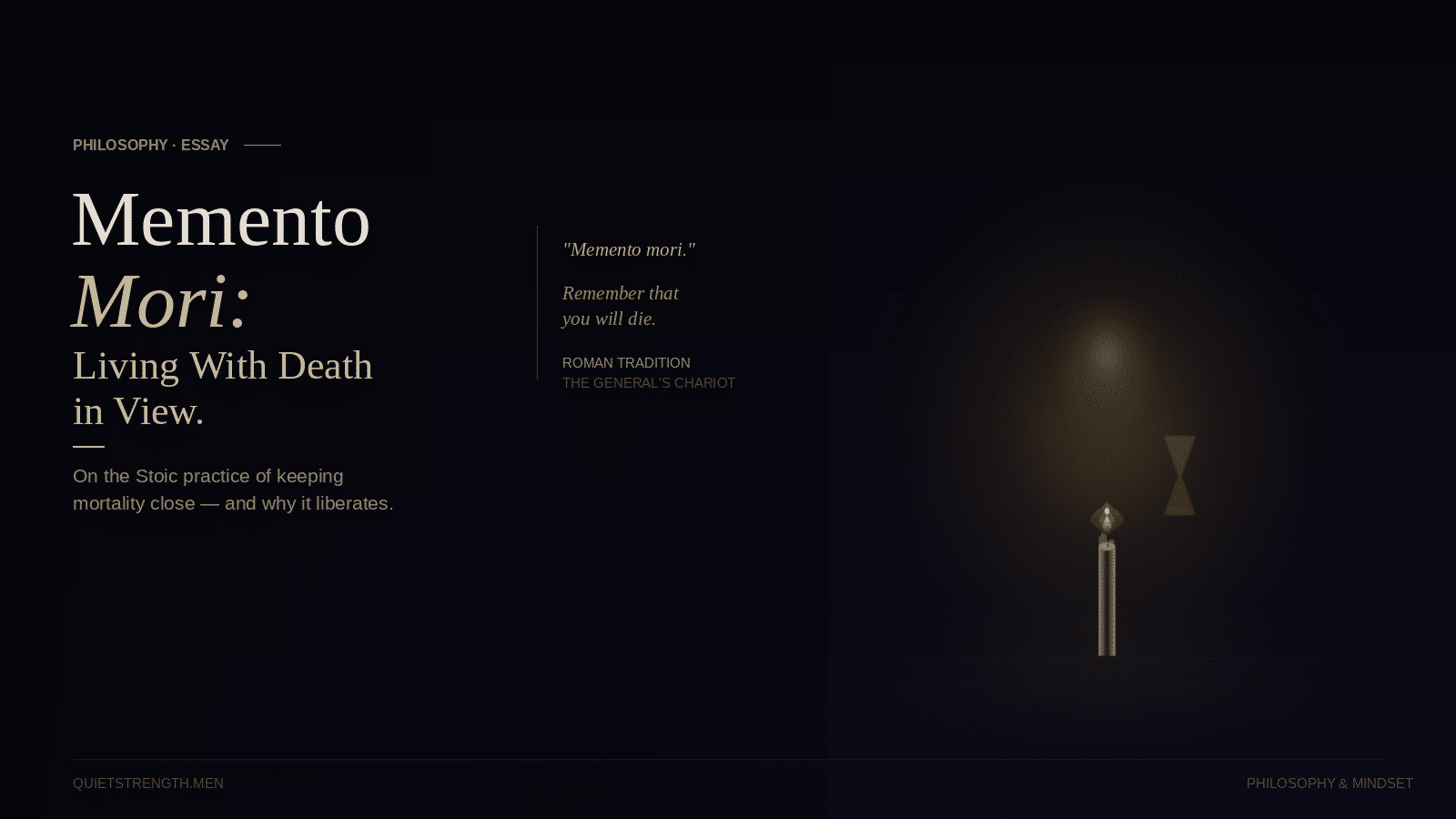
When a general returned from war — victorious, wreathed, riding through the streets of Rome to the sound of the crowd — a slave rode beside him in the chariot. The slave’s job was singular. Throughout the entire procession, as the crowd cheered and the city celebrated and the general sat at the highest point his life would likely reach, the slave leaned over and repeated the same words into his ear.
Memento mori.
Remember that you will die.
Not as a curse. Not as a threat. As a gift. As the one piece of information that, properly absorbed, changes everything about how you inhabit whatever time you have.
The Romans understood something that we have spent two thousand years trying to unlearn: that the awareness of death is not the enemy of life. It is the condition of it.
What we do instead
Modern life is organised, to a degree that would astonish a Roman, around the avoidance of this awareness.
We have euphemisms — passing, losing a battle, no longer with us — that soften the fact into something more manageable. We have institutions — hospitals, hospices, funeral homes — that remove death from the domestic space where it once occurred, and place it behind professional walls where specialists handle it so we don’t have to look. We have a culture of distraction so thoroughgoing and so efficient that most people can go weeks, months, years without sitting with the fact that this — all of it, every conversation and meal and morning and argument and moment of accidental beauty — will end.
And then something happens. A diagnosis. A phone call. A funeral for someone who was younger than you expected.
And the avoidance collapses. And you are left with a feeling that is not quite grief and not quite fear but something underneath both of them — the sudden, vertiginous awareness that you have been living as though you had unlimited time, and you don’t, and you knew this, and somehow knowing it never changed anything.
The Stoics would have said: yes. That is what happens when you forget. That is what the skull is for.
The Stoic practice
Marcus Aurelius returns to death in the Meditations more than to almost any other subject. Not obsessively — he was not a morbid man. But consistently, the way you return to a principle that keeps slipping.
“Think of yourself as dead. You have lived your life. Now take what’s left and live it properly.”
“Do not indulge in such thoughts as ‘What if I live only three days more, or three years?’ As if what remains is anything but a gift.”
“It is not death that a man should fear, but he should fear never beginning to live.”
These are not consolations. They are not the ancient equivalent of a motivational poster. They are working notes from a man who understood that the awareness of mortality, properly maintained, is the sharpest instrument available for cutting away everything that isn’t real.
What is real? The conversation you keep postponing. The work that actually matters, underneath the work that merely feels urgent. The relationship you’ve been managing at a distance because full presence is risky. The version of yourself that you’ve been deferring until conditions improve.
All of it comes into focus when you hold the fact of your death clearly enough to see by its light.
Seneca, who wrote about this with more urgency than almost any other Stoic, was brutal about the arithmetic:
“We suffer more in imagination than in reality” — but then, in the very next breath, the harder thing: “Omnia aliena sunt, tempus tantum nostrum.”
Everything is foreign to us. Time alone is ours.
Not money. Not reputation. Not the good opinion of people who will also die. Time. The only genuinely non-renewable resource, the only thing being spent whether you choose to spend it or not.
What it actually feels like
I want to be careful here, because this is where the philosophy most easily tips into performance.
There is a version of memento mori that is just aesthetics. The skull on the desk. The Latin tattoo. The Instagram caption about living with urgency. None of this is the thing. The thing is considerably less comfortable than the aesthetic.
The thing is sitting with your actual death — not death in general, not the philosophical concept, but yours specifically — and letting it be real for long enough that it changes something.
This is harder than it sounds, because the mind resists it. The same cognitive machinery that allows us to function without constant existential paralysis — the part that files death under important but not urgent and returns your attention to what’s in front of you — is the part you have to gently override.
The Stoic practice was specific. Not a general awareness that death exists, but a deliberate, brief, regular meditation on the fact of your own mortality. Marcus did it in the morning. Seneca structured entire essays around it. Epictetus built it into his teaching so thoroughly that his students could not leave a lecture without having been reminded that they were going to die.
The purpose was never to produce despair. The purpose was the opposite: to produce what the Stoics called amor fati — not the passive acceptance of fate, but something closer to its active embrace. The understanding that because this ends, it matters. That the limitation is what gives the thing its weight.
A conversation that could go on forever is not the same as a conversation you know will end. A life that extended indefinitely would not be a longer version of the life you have. It would be something else entirely — something without shape, without the urgency that shape produces.
Your life has a shape. You don’t know the dimensions yet. But you know it has them.
The view from the end
There is a thought experiment the Stoics used, which Seneca articulates most clearly: imagine yourself at the end. Not in the abstract — specifically. You are old, or ill, or simply at the last day. Looking back.
What do you see?
Not what you hoped for. Not what you planned. What actually happened, in the life you actually lived, with the choices you actually made.
The question the meditation asks is not did you succeed? It asks something more precise: did you live in a way you can look back on without flinching? Did you spend your time on things that were real to you, or on things that seemed important because other people seemed to think they were? Did you show up fully for the people who deserved your full presence, or did you offer them the distracted, managed, partial version of yourself that was easier and safer?
Did you do the work that mattered, or did you do the work that was nearby?
Most men, when they sit with this honestly, find that the answer is mixed. Not catastrophic — lives are rarely catastrophic in their entirety. But mixed. There are the years that went to things that turned out not to matter as much as they seemed. The relationships that got the budget surplus rather than the real allocation. The work that was important deferred in favour of the work that was urgent.
This is not cause for despair. It is cause for adjustment.
This is the whole point of the practice.
Why now
The most common response to memento mori, when people first encounter it seriously, is: I’ll think about this when I’m older.
Seneca anticipated this response in Letter I, written to Lucilius as the first thing — the very first thing — in a correspondence about how to live:
“Ita fac, mi Lucili: vindica te tibi.”
Do it, my Lucilius. Claim yourself for yourself.
Then, immediately: “Omnia, Lucili, aliena sunt, tempus tantum nostrum.”
He was not writing to an old man. He was writing to a man in his prime, at the height of his career, with every reason to believe he had time. He was insisting — not gently — that the practice begins now, not later. Because later is not a place you can count on reaching, and even if you do, the habit of deferral will have become so entrenched that arriving there will change nothing.
The skull on the desk was not there to make the Roman general miserable on his greatest day.
It was there so that his greatest day would be genuinely great — inhabited fully, appreciated precisely, not half-lived in the distracted, future-oriented way that most good things are half-lived by people who are busy planning for tomorrow.
Remember that you will die.
Not as a threat. As an invitation.
To be here. Now. Entirely. While there is still time to choose what that means.
Philosophy — the first of five pillars. Previously: Marcus Aurelius and the Art of Starting Over. Next: what Seneca wrote to Lucilius about the one thing that shortens every life.