The Stoics tracked themselves every single day of their lives, with no device, no app, and no score. What they measured is not what you think, and it is almost never what your wrist is currently measuring for you.
Seneca, most nights, waited until the lamp was out and his wife was asleep before he ran the account.
He describes the habit himself, in De Ira — not as a philosophical abstraction but as a literal nightly practice, learned from his teacher Sextius: when the light is put out and his wife has fallen silent, aware of his habit, he examines his entire day, going back over what he did and said. He hides nothing from himself, passes over nothing. What fault of mine have I remedied today? What vice have I resisted? In what respect am I better?
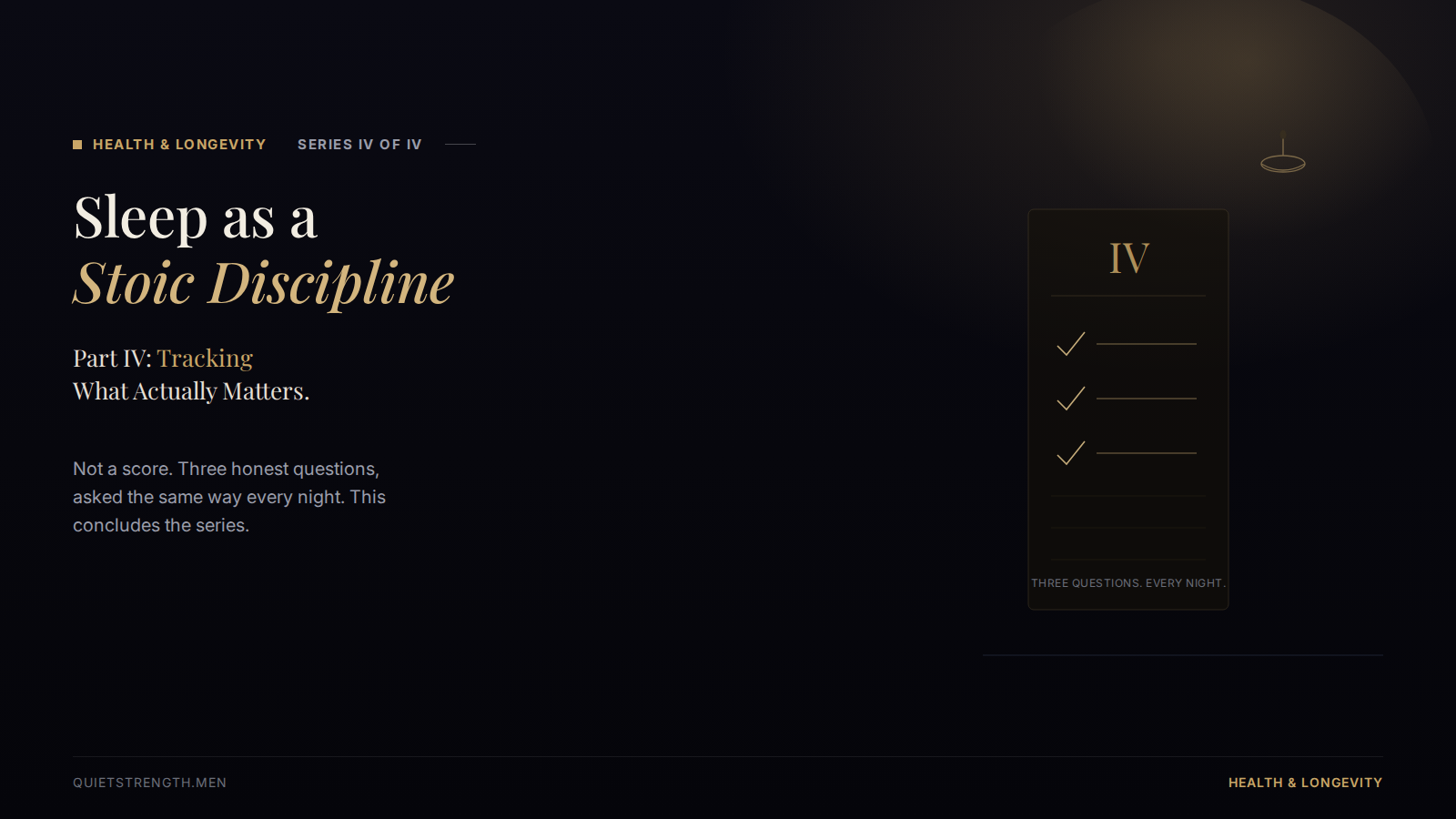
Three questions. No device. No score. No graph of the night before.
This is where Part IV of this series has to end up, because it is where the whole series has been heading since Part I: not toward more data, but toward the right three questions, asked with the same honesty Seneca brought to his own ledger every single night for the whole of his adult life.
The nightly account that wasn’t a ledger
What Seneca is describing is a specific kind of tracking — and it’s worth being precise about what made it work, because the mechanism is exactly what most modern sleep tracking gets backwards.
He wasn’t recording data points. He was asking three fixed questions, every night, about things entirely within his control: what he’d corrected, what he’d resisted, where he’d improved. The consistency was in the questions, not in the numbers. He wasn’t trying to hit a target score. He was maintaining a practice of honest attention to his own conduct, repeated often enough that avoiding the account each night would have been more uncomfortable than sitting with whatever it revealed.
This is not a coincidence of Stoic style. It’s the entire discipline in miniature. The Stoics had a name for the underlying practice: prosochē — attention, in the specific sense of continuous, vigilant self-monitoring. Pierre Hadot, the scholar who did more than anyone to recover what Stoic practice actually looked like day to day, called prosochē “the fundamental Stoic spiritual attitude” — not one exercise among many, but the precondition for every other one. Without it, nothing else in the system functions. Epictetus warned his students that relaxing this attention even briefly meant your affairs would be measurably worse the next day, precisely because the vigilance had lapsed.
But — and this is the detail every modern account of “Stoic tracking” tends to miss — prosochē was never meant to become anxious. The Stoics were explicit that the goal was steady awareness, not obsessive self-surveillance. Attention that curdles into anxiety has stopped being prosochē and become something closer to its opposite: a mind so busy monitoring itself that it can no longer act freely at all.
This is exactly the failure mode waiting inside a sleep tracker.
The condition that didn’t have a name until 2017
In 2017, a sleep researcher named Kelly Glazer Baron, working out of Rush University Medical Center, published a case series describing something her clinic kept encountering and had no term for: patients whose sleep had gotten worse specifically because of their relationship with their sleep tracker. She and her colleagues named it orthosomnia — from ortho, correct, and somnia, sleep, deliberately echoing orthorexia, the obsessive pursuit of “correct” eating that becomes its own disorder.
One of her patients, a man in his forties, had an average tracked sleep duration of seven hours and forty-five minutes — objectively fine, by any reasonable clinical standard — and still felt nightly pressure to hit eight hours on the display, attributing every bad afternoon to whatever number the app had shown him that morning. Another patient trusted her wrist-worn tracker over an actual clinical sleep study, because the tracker’s verdict felt more real to her than the diagnosis a specialist had just given her in person.
Neither of these people had a sleep problem, in the sense their bodies were failing to rest. They had a prosochē problem: attention pointed at the wrong object, applied with an intensity that had turned monitoring into the very thing preventing the rest it was meant to protect. Sleep researchers now widely agree that worrying about a bad number is one of the more reliable ways to manufacture a bad night — which means the tracker, used this way, doesn’t just fail to help. It actively produces the exact outcome it was bought to prevent.
Seneca’s three questions never did this to him, and the reason is structural, not a matter of ancient men simply having steadier nerves than modern ones. His questions pointed at conduct he had already carried out and could no longer change that day — a closed, calm, retrospective account. A sleep score, refreshed the instant you open your eyes, points at a number you’re now anxious to have been different, about a night that is also already finished and equally unchangeable. One produces a settled account. The other produces a live, renewable source of dread, every single morning, indefinitely.
What actually deserves tracking
None of this is an argument against measurement. Part III of this series was a fourteen-day structured protocol precisely because some things about sleep are genuinely worth deliberate, systematic attention. The distinction that matters is the one prosochē was always drawing: attention belongs on what is within your control, applied to inputs, not fixated on outputs you cannot directly command by wanting them harder.
The inputs are almost boringly simple, and they are also the entire list: a consistent time to lie down and a consistent time to rise, regardless of how the previous night went. A cutoff for caffeine early enough that it has actually cleared your system by the time you need it to. Light and screens tapering down rather than staying at full brightness until the moment you close your eyes. A room cool and dark enough that your body isn’t fighting its environment on top of everything else it’s managing. These are the only levers you actually hold. Everything downstream of them — how deep the sleep was, how many cycles you completed, what percentage was REM — is an output, and outputs respond to inputs handled consistently over weeks, not to being stared at anxiously every morning.
The honest subjective markers are worth far more than the granular ones. Did you wake without an alarm, close to when you meant to? Is there usable energy in the middle of the afternoon, or a wall you hit every day at the same hour? Is your temper a little shorter than it should be for no external reason? These are closer to Seneca’s three questions than anything on a sleep app’s summary screen — because they ask what actually changed in the conduct of your day, not what a sensor estimated about a biological process it is, at best, guessing at from your pulse.
The account you can actually keep
The version of this practice worth adopting is close to Seneca’s own, adapted forward with only the mildest translation. Not a nightly score. Three honest questions, asked consistently, about things you actually controlled: did you protect the wind-down, did you hold the schedule, did you notice — without panic — where you didn’t.
That’s the whole of it. It requires no subscription, no wearable, no dashboard. It requires exactly what it required in Seneca’s house two thousand years ago: the willingness to sit with the account after the lamp is out, and answer it honestly, whether or not you like what it says.
This closes the series where it needed to close — not with a device, but with a discipline old enough to have outlasted every device that has ever tried to replace it.
Health & Longevity — Sleep as a Stoic Discipline, a four-part series on rest as a practiced discipline rather than a passive default. This concludes the series.