Not acceptance. Not resignation. Something harder and more useful than either.
In the winter of 177 AD, Marcus Aurelius lost his son.
Hadrianus was not the first. Of the fourteen children Marcus would have in his lifetime, most died in childhood. He buried them with the regularity that the ancient world imposed on parents without sentiment — or rather, with the sentiment fully felt and fully absorbed, because what other choice was there.
He kept writing.
Not about grief, exactly. About what grief revealed. About the gap between what happens and what we make of what happens. About the extraordinary, ordinary, daily work of deciding that the thing you cannot change will not unmake you.
This is what the Stoics meant by amor fati.
Not the Instagram version — love your journey, embrace the process, everything happens for a reason. That is a soft thing wearing borrowed clothes. What the Stoics meant was harder, stranger, and considerably more useful.
What the phrase actually means
Amor fati is Latin. Love of fate. It does not appear in Marcus Aurelius, as many people assume — the phrase was actually coined by Nietzsche, who was reading the Stoics and trying to name something they had practiced without naming.
What Marcus did write, in Book IV:
“Amor fati: let that be your love henceforth.”
No — that is Nietzsche, from Ecce Homo, 1888. The confusion is common and instructive. What Marcus actually wrote is, if anything, stronger:
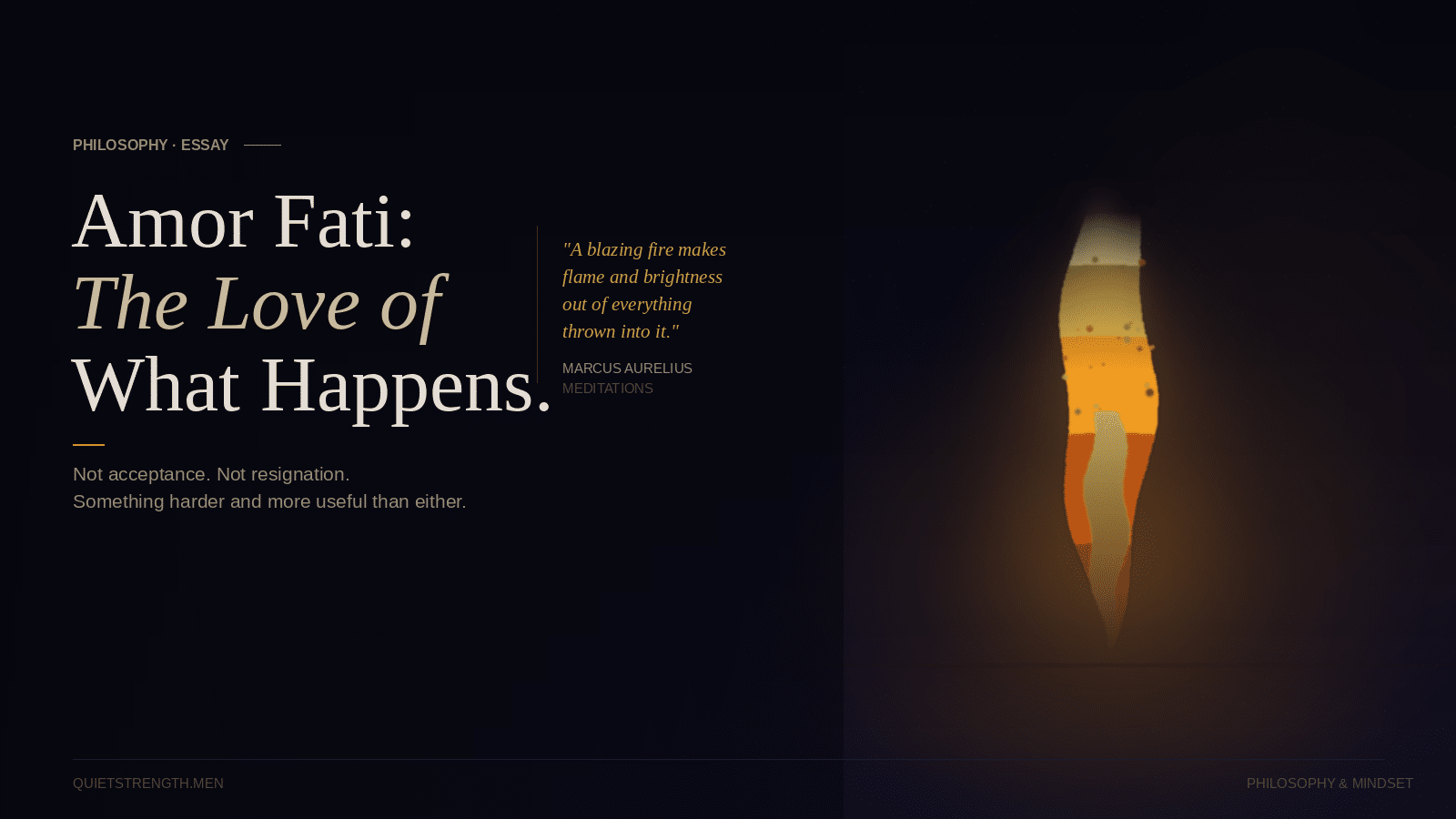
“A blazing fire makes flame and brightness out of everything that is thrown into it.”
That is the image. Not the fire that tolerates what is thrown into it. Not the fire that accepts. The fire that consumes, transforms, uses. The difficulty becomes fuel. The obstacle becomes material. The loss becomes — not nothing, not cancelled, not made not to have happened — but part of what you are made of.
This is not optimism. It is something more demanding than optimism.
The three wrong readings
Before the right one, the three most common mistakes.
Mistake one: amor fati means pretending things are fine.
It doesn’t. Marcus Aurelius was not a man who pretended things were fine. He wrote about exhaustion, about difficult people, about the weight of obligations he did not choose. He wrote about missing the philosophical life he had wanted and the military and administrative life he got instead. He was not performing contentment.
What he was doing was refusing to add a second layer of suffering — the suffering of resenting what had already happened — to the suffering that was simply present. This is hard and this should not be happening are different thoughts. The first is a fact. The second is an argument with reality, and reality never loses.
Mistake two: amor fati means passivity.
It doesn’t. The Stoics were not passive people. Cato walked into a war he knew he would lose rather than live under Caesar. Marcus spent most of his reign on military campaigns he found exhausting. Seneca wrote three million words while managing an empire’s finances and navigating the paranoia of Nero’s court.
Amor fati is not about what you do. It is about the relationship you have with what you cannot control. You act fully — on what is yours to act on. You hold the outcome loosely — because the outcome is not yours to determine. These are not the same thing, and confusing them is how people become either passive or anxious.
Mistake three: amor fati means everything happens for a reason.
It doesn’t. The Stoics were not teleologists in the cheap modern sense. They did not believe the universe was optimising for your personal development. Children died. Plagues came. Wars destroyed cities that deserved better. Marcus did not think his dead children died in order to teach him something. He thought they died because that is what happens in the world, and that the work was to remain a complete person nonetheless.
The difference is important. If everything happens for a reason, you are owed a reason. If you can love fate regardless of reasons, you are owed nothing and freed from nothing and still, somehow, intact.
What it actually is
Here is what I think amor fati actually points to, when you strip it of its misreadings.
It is the practice of meeting what arrives — not with enthusiasm you don’t feel, not with denial you can’t sustain, not with the performance of equanimity — but with the full recognition that this, whatever this is, is now part of your life. It is in you. It has already happened. The question is not whether you accept it. The question is what you make of it.
This requires something very specific. It requires the abandonment of what the Stoics called phantasia — the false impression — and in particular the false impression that your life should look different than it does. That the difficulty is an error. That the loss is a malfunction. That the version of events you had planned for was the correct one and this one is a deviation.
There is no correct version. There is only this one.
And the man who can look at this one — actually look, without flinching, without resentment, without the exhausting work of wishing it were otherwise — this man has access to something the man who is still arguing with reality does not.
He has his full attention available for what’s actually in front of him.
The practical reality
I want to say something about what this looks like in practice, because the philosophical statement is easy to misread as mystical, and it isn’t.
Amor fati in practice looks like this: your business fails, or your marriage ends, or you don’t get the thing you spent three years working toward, or something happens to your body that changes what’s possible.
The first response is emotional. Grief, anger, fear — these are not failures of philosophy. These are the appropriate responses of a nervous system to real loss. The Stoics never said not to feel these things. They said to feel them and not be unmade by them.
The practice begins not at the moment of impact but sometime after it, when the initial response has moved through and there is a question of what happens next. And the question, in the Stoic frame, is simply: what do I do with this?
Not: why did this happen.
Not: how do I make it not have happened.
Not: what does this mean about me or about the universe.
What do I do with this.
The fire doesn’t ask what was thrown into it. It burns.
Marcus, again
There is a passage in Book VI that I have returned to many times over many years at many different life stages, and it has meant something different each time:
“The cucumber that is ripe in spring desires nothing, hopes nothing, considers nothing. It is what it is, and it grows.”
That is not Marcus. That is me, paraphrasing badly. What Marcus actually wrote:
“Accept the things to which fate binds you, and love the people with whom fate brings you together, and do so with all your heart.”
He wrote this while managing an empire he didn’t ask for, fighting wars he didn’t start, buried children he had loved. He wrote it not as a man who had transcended difficulty but as a man who had decided, again and again and again, to love the life that had actually arrived rather than the life he had imagined.
This is the practice. Not once. Not when you feel like it. Again and again, against the grain of the part of you that is still convinced things should be different.
Until the fire doesn’t need to decide anymore. Until the love is not an act of will but a way of being.
That is what Marcus was pointing toward. That is what Nietzsche was trying to name.
That is what amor fati actually means.
One last thing
A man I respect told me once that the hardest thing about growing older is learning to love the specific life you have instead of the general life you imagined.
He didn’t know he was quoting two thousand years of Stoic philosophy. Nobody told him. He had simply arrived there — through enough time, enough loss, enough of the ordinary accumulation of things that didn’t go as planned — at the same conclusion the ancients reached by argument.
The life you imagined is not coming. It was never coming. It was never real.
This one is.
Love it.
Philosophy — the first of five pillars. Previously: Marcus Aurelius and the Art of Starting Over · Memento Mori · The Dichotomy of Control. Next: Premeditatio Malorum — on imagining the worst before it arrives.