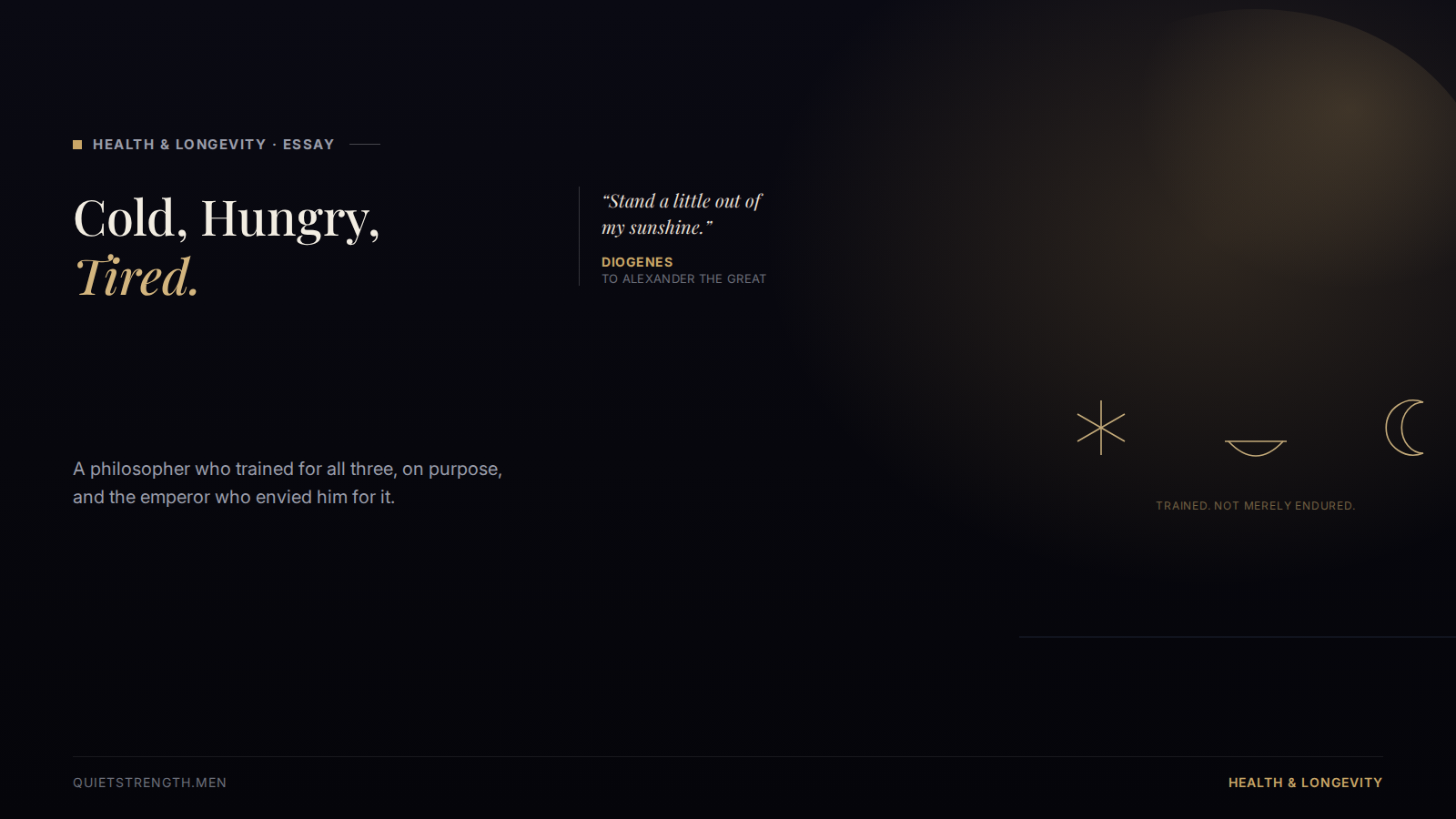
Most men spend their entire lives arranging things so they never have to feel any of the three. One Greek philosopher walked directly toward all three, on purpose, as a matter of daily practice — and somehow this made him, by Alexander the Great’s own admission, the freest man either of them had ever met.
In the middle of an Athenian winter, passersby in the agora would occasionally find Diogenes of Sinope standing with his arms wrapped around one of the marble statues in the square, snow settling on his shoulders, his bare skin pressed against stone cold enough to ache. He was not doing this to make a scene, although scenes tended to follow him regardless. He was training.
The Greek word for what he was doing was askesis — the same root that gives the modern word “ascetic,” but meaning something closer to athletic conditioning than religious self-denial. Diogenes trained his capacity to withstand discomfort the exact way a wrestler trains his grip: repeatedly, deliberately, and specifically so the body would still function when circumstance stopped asking politely.
The man in the tub
Diogenes owned almost nothing by design. Ancient sources place his actual residence, for a stretch of his life in Athens, inside a large ceramic storage jar — a pithos — kept near the Metroön. He wrapped a single cloak around himself doubled over, so the same piece of cloth served as both his clothing during the day and his only bedding at night. He carried his food, when he had any, in a beggar’s knapsack slung over one shoulder.
He had not always lived this way. Diogenes arrived in Athens as an exile, banished from his home city of Sinope after a currency-defacing scandal involving either himself or his father, depending on which ancient account is followed. He was, by some accounts, later captured by pirates and sold into slavery in Corinth — and even there, asked by the auctioneer what skills he possessed, is said to have replied that he was skilled “in ruling men,” and instructed the crowd to sell him to whichever buyer most needed a master. This was not a man born to poverty who made peace with it out of necessity. It was a man who had lost a city, his freedom, and his standing in fairly rapid succession, and who responded to that cascading loss not by scrambling to rebuild what he’d lost but by testing, methodically, how much of it he had actually needed in the first place.
None of this was presented as tragedy. Diogenes Laertius records his own summary of the philosophy underneath it: that he met fortune with courage, convention with nature, and passion with reason. The tub was not a symbol of what Diogenes had lost. It was closer to a laboratory — the minimum viable setup for finding out exactly how little a human body actually required once every comfort a wealthier man assumed was necessary had been stripped away and tested individually.
The mouse that taught him everything
The story behind the tub is worth knowing, because it explains the method rather than just the eccentricity. Diogenes, by his own account, arrived at his conclusions about shelter and comfort partly by watching a mouse — an animal that ran about with no need for a bed to sleep in, no fear of the dark, no craving for the dainties other creatures thought essential to a decent life. If a mouse could get by adapting to whatever circumstance it found itself in, Diogenes reasoned, so could he.
This is the detail that separates his askesis from simple stubbornness. He was not gritting his teeth through poverty because virtue was supposed to hurt. He was running an actual experiment on himself, informed by observation, testing the hypothesis that comfort and necessity had been quietly confused with each other by everyone around him, and that a great deal of what passed for a basic human need was, on inspection, negotiable.
The cup he didn’t need
Diogenes carried out this experiment continuously, refining his own list even after he thought he’d already gotten it down to nothing. Diogenes Laertius records the moment he finally discarded his one remaining drinking cup: watching a child at a fountain, cupping water in his bare hands to drink because he had no vessel and hadn’t thought to need one. Diogenes’s own verdict on himself, recorded afterward, was blunt — a child has outdone me in frugality — and he threw the cup away rather than continue carrying something a child had just demonstrated he didn’t require.
This is worth sitting with because it shows the practice had no natural stopping point that Diogenes was willing to accept in advance. He did not decide, once, what the minimum equipment for a good life was and then hold that line. He kept testing the line itself, willing to discover, at any point, that something he still considered essential was actually one more comfort he’d simply never gotten around to questioning.
Snow in summer, sand in winter
The physical training extended in both directions, not merely toward cold. Ancient sources describe Diogenes rolling in scorching summer sand with the same deliberateness he brought to embracing frozen statues in winter — heat and cold both treated as equally worth habituating himself to, rather than cold alone being the mark of toughness and heat simply avoided. The point was never to prefer suffering. It was to remove the body’s dependence on a narrow comfortable range, so that whichever extreme circumstance actually delivered — a cold winter with no shelter, a summer with no shade — found a body already familiar with it rather than a body encountering real hardship for the first time exactly when it could least afford to.
Diogenes had a specific complaint about people who trained physically without applying the same discipline anywhere else. He admired what athletes and flute players achieved through repetition, Diogenes Laertius records, but added a pointed correction: if these men had turned that same capacity for training toward their minds, their effort would not have gone to waste. A body conditioned to hardship, attached to a mind never subjected to the same discipline, struck him as a wasted opportunity — strength built in exactly one place while everything that actually determined how a man met his life went untrained entirely.
What Alexander saw in him
The most famous encounter of Diogenes’s life makes the point better than any amount of description could. Alexander the Great, having conquered most of the known world, sought Diogenes out and offered him whatever he wanted. Diogenes, lying in a patch of sunlight at the time, asked only that Alexander stop blocking his light.
What makes the exchange worth remembering is not the wit, though the wit is real. It’s the asymmetry it reveals. Alexander had every material thing a man could plausibly want, and had come looking for something Diogenes appeared to possess despite having nothing at all. Diogenes’s own reported verdict on himself — that he had countered fortune with courage rather than with wealth — was the entire answer sitting in plain view. Alexander is said to have remarked afterward that if he had not been Alexander, he would have wished to be Diogenes. The most powerful man alive had looked at the man with nothing and recognised, correctly, that something real was missing from his own side of the exchange.
The two men were, in a sense, running opposite experiments on the exact same question. Alexander was testing how much of the world a man could acquire before he ran out of ambition. Diogenes was testing how little a man could require before he ran out of things fortune could threaten to take from him. Only one of these experiments could actually be completed within a single lifetime, and only one of them left its subject lying untroubled in the sun while the most powerful man alive stood over him, blocking the light, waiting to be told what he could offer.
What this asks of you
Nobody reading this needs to live in a jar or hug a frozen statue to take the actual lesson. The point was never the specific hardship. It was the willingness to find out, deliberately, on your own schedule, which of the comforts you currently treat as necessary are actually just familiar — untested, unexamined, assumed rather than confirmed. Cold exposure, a missed meal, a genuinely hard physical effort, a night with too little sleep handled without complaint: these are not virtues in themselves, any more than Diogenes’s tub was a virtue in itself. They are the modern, considerably gentler version of his actual method — small, chosen encounters with cold, hunger, and fatigue, entered into on purpose, so that the real versions, whenever they eventually arrive uninvited, find a body and a mind that have already been there before.
The distinction worth holding onto is the one Diogenes drew himself, watching athletes train their bodies while leaving everything else about themselves untouched. The modern equivalent is easy enough to spot: a man who has built real physical resilience — who can genuinely handle cold, hunger, a hard training session — but has never once turned that same capacity toward the parts of his life that have nothing to do with his body at all. The discomfort tolerated in a gym or a cold shower is only worth anything if it is actually training something, rather than becoming its own kind of performance, one more comfortable identity to retreat into. Diogenes never trained hardship for its own sake. He trained it because a man who has already met cold, hunger, and exhaustion on his own terms has considerably less left to fear from the day any of the three arrive without an invitation.
Diogenes never claimed the discomfort itself was the goal. The goal was what Alexander noticed from the outside without being able to name it directly: a man who had tested his own requirements down to the studs, and discovered that almost none of what he’d been told was necessary actually was.
Health & Longevity — on the body treated with the same seriousness as the mind.