This site has already told you about Cato the man who wouldn’t trade — the senator who chose exile and a sword over accommodation with Caesar. This is a different Cato, from earlier in the same life: the one who marched a legion across a desert on foot, and who sailed across a sea to recruit a philosopher.
In the winter of 47 BC, ten thousand men under Cato’s command set out to cross roughly a hundred miles of Libyan desert on foot, from Cyrene toward Utica, with the news of Pompey’s murder in Egypt still fresh and Caesar’s forces somewhere behind them.
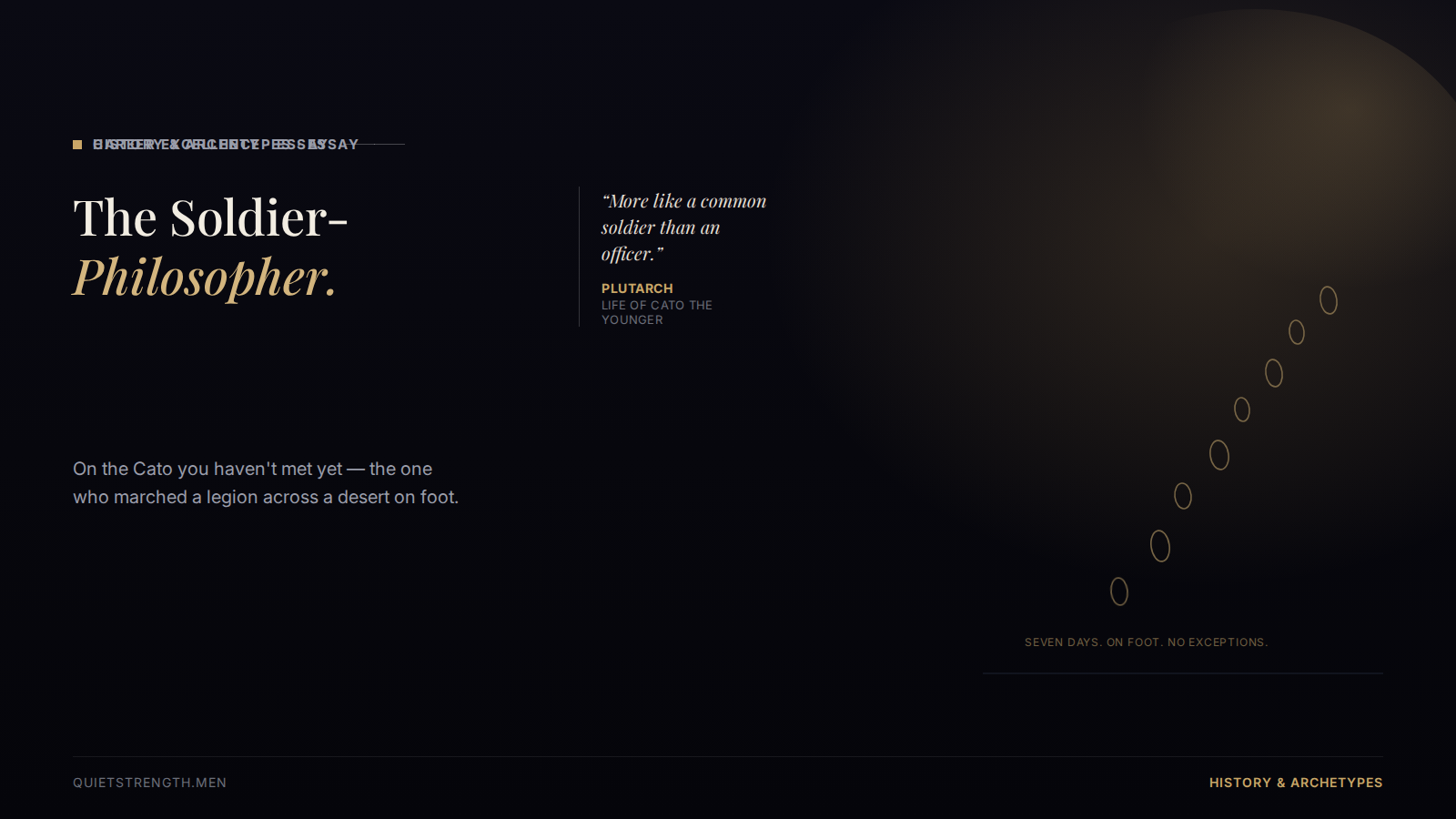
Cato had asses in the baggage train to carry water. He had horses and carriages available for anyone who needed them. He used none of it. For the full seven days of the march, by every surviving account, he walked at the front of the column, in the same winter conditions his soldiers were enduring, and made a point of it being visible that the man in command had not exempted himself from a single mile his men were being asked to cover.
This was not the only occasion, in that final campaign, when Cato’s personal courage was tested against an accusation rather than a desert. Once safely behind the walls of Utica, he continued advising the overall commander, Metellus Scipio, against risking open battle with Caesar — counsel Scipio rejected, at one point writing to Cato to accuse him of cowardice for being content to sit inside fortified walls while other men took the field. Cato’s reply is preserved: he offered to take the very legionaries and cavalry he had personally marched across Libya, cross the sea back to Italy with them, and draw Caesar’s attention away from Scipio and onto himself directly — an offer to personally invite the war’s most dangerous general to come looking for him instead, made by a man Scipio had just called afraid. Scipio did not take him up on it. He went on to face Caesar at Thapsus without Cato, and lost.
This is where this essay actually begins — not with Cato’s famous last stand at Utica, which this site has already told, but with the years before it, when the same man who would later choose a sword over Caesar’s mercy was first learning what it meant to lead men who could see, every single day, whether he was asking anything of them he wasn’t willing to do himself.
The tribune who ate what his men ate
Cato’s first serious military posting came years earlier, as a volunteer in the war against Spartacus, before he ever held formal command of his own. Even there, before any rank gave him reason to, he distinguished himself enough in the fighting that the praetor in charge wanted to award him a decoration. Cato refused it, on the grounds, he said, that he had done nothing beyond what any soldier ought to do. It is a small detail, easy to skip past, but it establishes the pattern the rest of his military life would simply repeat at larger scale: doing the job to the full standard, and declining the specific reward for having merely met it.
His first real command came somewhat later, as a military tribune assigned to a legion in Macedonia. He arrived, by his own evident design, indistinguishable from the men he was about to lead: “in his apparel, his diet, and mode of travelling, he was more like a common soldier than an officer.” Given command of the legion, Cato did not rely on the formal authority of his rank to produce discipline. He set out, in Plutarch’s account, to make his soldiers as much like himself as he could — not by relaxing the actual requirements of the office, but by “associating reason with his authority”: explaining himself, rewarding and punishing according to what was actually deserved, and consistently doing himself whatever he ordered done.
The results, according to the same account, were soldiers who were difficult to categorize by the usual military measures: “it was hard to say whether they were more peaceable or more warlike, more valiant or more just; they were alike formidable to their enemies and courteous to their allies.” And when his term of service ended, the soldiers gave him a send-off Plutarch says few Roman commanders of any rank ever received: they spread their own cloaks on the ground for him to walk over, and kissed his hand as he passed.
This detail is worth sitting with because it did not come from higher command, from a triumph, or from any of the usual instruments of Roman military prestige. It came from several thousand ordinary soldiers who had spent a year watching a nobleman with every excuse to ride choose to walk beside them instead, and who had drawn their own conclusions about what that meant.
The philosopher he crossed a sea for
Between his Macedonian command and his later, more famous political career, Cato did something that reveals how seriously he took the other half of the title this essay is built on. Hearing that a Stoic philosopher of considerable reputation, Athenodorus Cordylio, was living in Pergamum and had a firm policy of refusing the friendship of princes and powerful men, Cato did not send a letter or dispatch an intermediary. He used the two months of leave Roman law allowed him and travelled there himself, in person, specifically to change the old philosopher’s mind.
He succeeded. Athenodorus returned to Rome with him and remained his close companion for years afterward, a permanent fixture in Cato’s household rather than an occasional dinner guest brought in to lend the evening some intellectual polish. The detail matters because it shows a man who did not treat philosophy as a decoration to be picked up secondhand through fashionable quotation — the very failure mode this site has already diagnosed in lesser men. Cato crossed a sea, spent political capital he didn’t have to spare, and personally overturned an old man’s settled resolve, because he wanted the actual philosopher in his own household, available for the kind of sustained argument that changes how a man actually thinks rather than merely how he talks at dinner.
The soldier who governed from a tent
A different emperor, more than two centuries later, would take this same fusion of soldiering and philosophy to a scale Cato never held the office to attempt. Marcus Aurelius spent the greater part of his reign on the Danube frontier, fighting the Marcomannic Wars from military camps rather than the Roman Senate, and it was in exactly those conditions — cold, exhausted, governing an empire from a tent between engagements he had not chosen — that he wrote the private notebook this site has spent six installments decoding.
The two men never met; Cato had been dead more than two centuries by the time Marcus took the purple. But the shape of the discipline is recognisably the same one, arrived at independently by a Republican senator commanding a single legion and an imperial emperor commanding the armies of the known world: that the philosophy is only actually worth anything if it can survive being tested in the specific conditions soldiering creates — genuine discomfort, real danger, and subordinates who are watching closely enough to notice the difference between a man who merely talks about virtue and one who is currently practising it under exactly the pressure that makes it difficult.
What the soldier-philosophers actually shared
Neither Cato’s legion nor Marcus’s army needed their commander to be the most naturally gifted soldier present. Rome had no shortage of technically superior tacticians in both centuries. What both men supplied instead, and what neither could have supplied from a comfortable distance, was visible proof that the standard being demanded of the men under them was a standard the men in command were also, personally, currently paying the price for.
This is the specific thing “soldier-philosopher” actually names, once the phrase is unpacked past its surface appeal. Not a man who happened to hold both a sword and a book. A man for whom the philosophy had nowhere left to hide — no comfortable study, no polite dinner-table audience willing to accept the argument instead of the practice — because the desert, or the frontier, or the winter march, was going to test the actual content of his character within days, in front of several thousand witnesses who had every reason to notice if the man giving orders was exempting himself from any part of what those orders cost.
Cato walked because riding would have meant asking his men to endure a hardship he had personally declined. Marcus wrote his most demanding private arguments with himself in the one setting that gave him no excuse to soften them. Both men understood, from direct experience rather than theory, that a philosophy which only functions in comfortable conditions was never actually tested in the first place — and both chose, repeatedly, to test theirs in conditions that left nowhere left to fake it.
There is a final piece of symmetry worth naming, because it separates this tradition from mere toughness for its own sake. Neither man treated the hardship as the point. Cato’s insistence on walking bought him nothing tactically — the legion would have moved at the same pace regardless of what its commander rode. Marcus’s insistence on writing out his own arguments, at length, after exhausting days of actual governance, added nothing to the campaigns themselves. In both cases the discipline was aimed entirely inward, at the only part of the arrangement either man could actually be certain of controlling: not the war, not the empire, not the loyalty of ten thousand tired soldiers, but the character of the one man among them who had chosen, without being required to, not to exempt himself from anything he was asking of everyone else.
That is what the phrase “soldier-philosopher” is actually pointing at, once the romance is stripped away from it. Not a man who could quote philosophy while also carrying a sword. A man for whom the sword and the desert and the frontier had become the only classroom rigorous enough to prove whether the philosophy was real.
History & Archetypes — on the men worth studying and what their lives reveal about ours.