Part III of this series left the gap open — two men who want the same thing, unable to close the distance through wanting alone. The Romans never left it to wanting. They built a structure that closed the gap whether the men inside it felt like it that week or not.
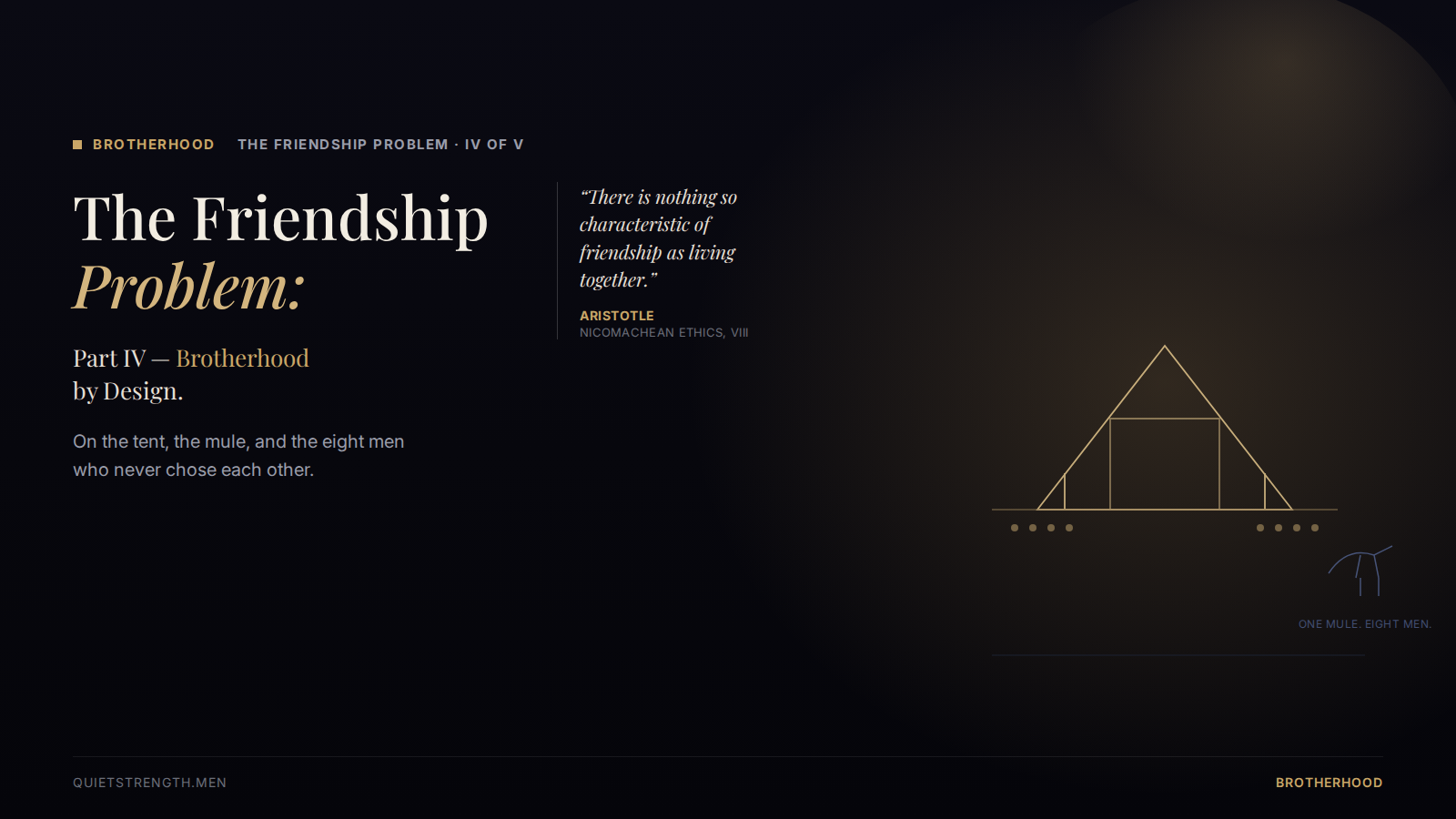
Eight men shared a tent.
Not loosely, not by preference, not because they’d found each other likeable across a crowded legion of five thousand strangers. The Roman army assigned it: eight legionaries to a contubernium, one leather tent between them, one mule to carry it, one set of cooking gear, one rotation of duties that had to get done regardless of who felt like doing them that day. If the mule went missing, or the hand-mill for grinding grain was lost on the march, all eight men answered for it together. If discipline broke down badly enough for the army to make an example of a unit, the punishment — decimation, in its most extreme form — fell on the group, not the individual.
The contubernium had, by most modern reconstructions, no tactical function whatsoever. It didn’t fight as a unit. It didn’t manoeuvre as a unit. Its entire purpose, as far as historians can tell, was to keep eight men in close, unavoidable, structurally enforced contact with each other, day after day, for years, until whatever bond eight strangers were going to form had time to actually form.
This is Part IV’s whole argument in miniature: the Romans did not leave brotherhood to chance, or to the individual initiative of eight tired men who might or might not feel like bonding after a twenty-mile march. They built a structure that manufactured it, whether anyone felt like it that week or not.
The unit with no tactical purpose
Ten contubernia made up a century; the century was the meaningful fighting formation, the one that manoeuvred and held the line. The contubernium sat one level below that, in a strange administrative position — real enough to have its own equipment allotment, its own junior leader (the decanus, usually the longest-serving man in the tent), its own shared responsibility for lost gear, but militarily invisible the moment battle actually started.
If the contubernium had no combat function, its survival as an institution across centuries of Roman military reform has to be explained some other way. Modern military historians, reconstructing its purpose from what evidence survives, describe it plainly: it “was likely used to maintain morale and group solidarity by keeping soldiers in close contact with each other.” Not a side effect the army tolerated. A mechanism it built on purpose.
This is worth sitting with, because it inverts the assumption most modern men carry into adult friendship without ever examining it: that bonds like this emerge from compatibility, from two people happening to like each other enough. Aristotle, discussed at length in Part II of this series, had already identified the actual ingredient centuries before any Roman legion existed: “there is nothing so characteristic of friendship as living together.” Not liking each other. Not wanting the same things, which Part III of this series already showed isn’t sufficient on its own. Simply the shared, repeated, physical fact of days spent in the same place. The contubernium didn’t discover a new theory of friendship. It built the one Aristotle had already named, and made it mandatory for men who would never have chosen it voluntarily.
The mule and the shared account
The mechanism is worth being specific about, because “forced proximity” alone doesn’t fully explain it. Soldiers in the same legion were also in forced proximity with thousands of other men they never bonded with in the same way. What the contubernium added on top of proximity was shared stakes — a single mule that belonged to all eight men and to none of them individually, a single set of equipment that could be lost only collectively, a single rotation of unglamorous chores that had to be covered by whoever’s turn it was, and consequences, in the worst cases, that landed on the whole tent regardless of which individual had actually failed.
This is closer to what sociologists studying adult friendship formation have identified as the real structural conditions for a bond to form: not simply spending time near someone, but spending it under conditions of repeated, unplanned interaction combined with shared vulnerability — situations where something is actually at stake for both people, not merely scheduled goodwill. Proximity alone gets you acquaintances. Proximity plus shared consequence gets you the contubernium.
The mule mattered. Not because eight legionaries were sentimental about a pack animal, but because the mule was a single point of shared failure that none of them could opt out of individually. You couldn’t quietly let your three tentmates handle the mule while you focused on your own gear. Its condition was everyone’s problem, permanently, which meant every man in that tent had a standing, unavoidable reason to know how the other seven were actually doing.
Why adulthood stopped providing this for free
Most men who eventually notice how much thinner their friendships have gotten since their twenties are not imagining it, and the reason is structural rather than personal. School assigned you a contubernium whether you wanted one or not — the same twenty-five kids in the same room, every day, for a full year, with enough shared stakes (group projects, shared teachers, shared reputations) to force bonds that pure preference never would have produced on its own. Team sports did the same thing through shared physical stakes. Military service, for the men who went through it, did it more literally than anything else on this list.
Adult professional life does none of this. A modern office puts colleagues in proximity, but rarely in the specific combination of repeated unplanned contact plus shared, personal vulnerability that actually produces a bond — most workplace relationships stay firmly in the register of pleasant, low-stakes cooperation, precisely because almost nothing about a modern job requires two colleagues to actually need each other the way eight men sharing one mule needed each other. The structures that used to manufacture brotherhood as a side effect of ordinary life have mostly stopped existing for adult men, and nothing has automatically replaced them. This is not a failure of character in the men who notice the gap. It’s the absence of an institution that used to do the work for free.
What building one looks like now
The uncomfortable implication of the contubernium is that waiting to feel closer to the men already in your life is exactly the wrong lever to pull, for the same reason it would have been the wrong lever for eight tired legionaries who didn’t yet like each other in month one of a campaign. The lever that actually worked was structural: shared stakes, imposed regularly, that didn’t depend on anyone’s mood that week.
The nearest modern equivalent is not a group chat or an occasional dinner, both of which stay in the low-stakes register that produces acquaintances rather than contubernales. It is something closer to a standing obligation with actual consequences attached — a recurring commitment where something is genuinely lost if a man doesn’t show up, not merely a missed social nicety. A training group with a shared goal that fails without full participation. A financial or logistical stake shared among a small, fixed number of men, rather than a large, diffuse one. The specific size matters too — the Romans didn’t try to build cohesion across an entire legion of five thousand. They built it in units of eight, small enough that every man’s absence was immediately, personally felt by the other seven.
This is Part IV’s answer to the gap Part III left open. The gap between two men who want the same closeness does not close through better intentions applied to the same loose, low-stakes contact they already have. It closes through redesigning the contact itself — smaller, more binding, with something real enough at stake that showing up stops being optional.
Brotherhood — The Friendship Problem, a five-part series on why men lose each other after thirty and what actually closes the distance. Next: Part V — The Long Game, the concluding part of this series.